
Marine cargo insurance protects goods against loss or damage while they are in transit by sea, air, rail or road. Most guides stop at explaining what the cover is. This one goes a step further and answers the question importers and exporters actually get stuck on: exactly which documents you need, which Institute Cargo Clause to select, and what drives the premium you are quoted. If you are new to the subject, start with our overview of marine insurance types and coverage and come back here when you are ready to get quoted.
Key Takeaways
- Marine cargo insurance is issued under Institute Cargo Clauses A, B or C. Clause A is the widest all-risks form, Clause C the most limited, and the choice materially changes both cover and price.
- A single shipment and an open marine cover need different document sets. Shipment documents describe one consignment, open cover documents describe a year of trading.
- Premium is driven by the nature and value of the goods, packing quality, mode of transport, route, destination, clause selected and claims history.
What Marine Cargo Insurance Protects
Marine insurance protects goods, ships, containers, and related interests against loss or damage during transport. Despite the name, it is not limited to the sea. Cover commonly extends to air, rail and road movements, and to multimodal transportation where a single consignment changes mode along the way, depending on the specific policy terms.
It provides financial protection against accidents, theft, fire, sinking, collision, natural disasters and other unforeseen events that occur during transit. The national insurance regulator oversees the UAE insurance sector. For a UAE trading business, particularly one already carrying a business insurance policy, this matters because the exposure sits in a window where the goods are neither in your warehouse nor in your customer's, and neither party's property policy is designed to respond.
The Six Types of Marine Insurance
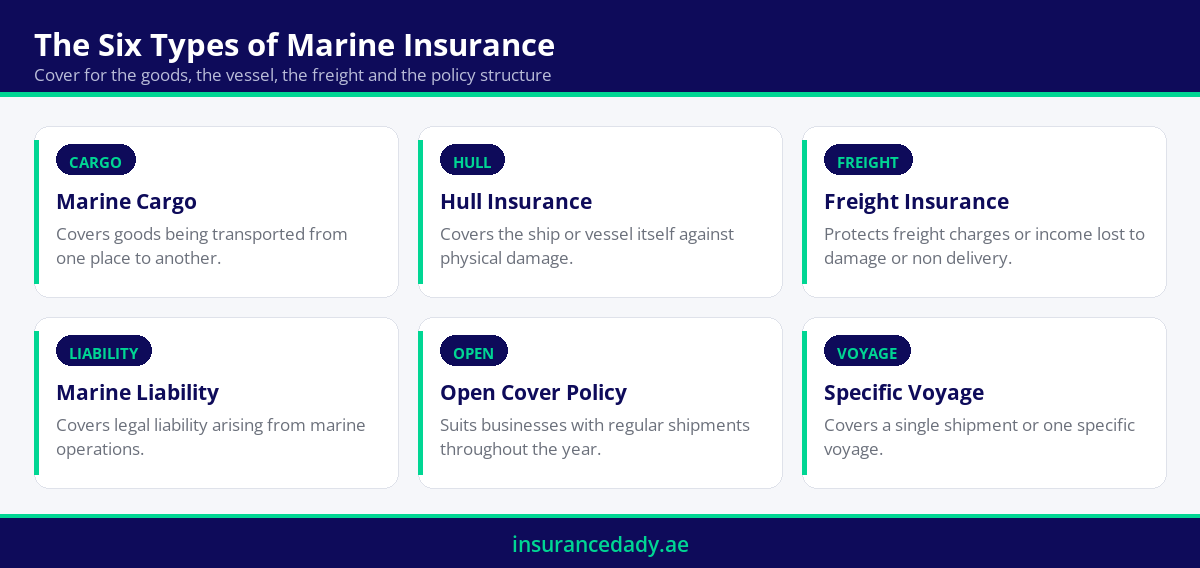
Marine insurance is a family of products, not a single policy. Which one you need depends on whether you own the goods, the vessel, the freight income or the operational liability, and on how often you ship.
Cover for the Goods and the Vessel
Marine cargo insurance covers goods being transported from one place to another, and it is the policy most UAE trading businesses actually need. Hull insurance covers the ship or vessel itself against physical damage, and is a shipowner's cover rather than a cargo owner's. Freight insurance protects freight charges or income that may be lost due to damage or non-delivery, making it relevant to carriers and forwarders.
Liability and Policy Structure
Marine liability insurance covers legal liability arising from marine operations. Separately from what is covered, two structures determine how a policy is issued. An open cover policy suits businesses with regular shipments throughout the year, declaring consignments as they move. A specific voyage policy covers a single shipment or one specific voyage, and suits occasional shippers.
Single Voyage or Open Cover: Choosing the Structure
Before the clause and before the extensions, you must make a structural decision. It shapes the paperwork, pricing, and the amount of administration your team handles throughout the year.
When a Specific Voyage Policy Fits
A specific voyage policy covers a single shipment or one defined journey. It suits businesses that ship occasionally, that are moving an unusual consignment outside their normal pattern, or that are testing a new route or supplier. Each shipment is underwritten on its own facts, which gives precision at the cost of repeating the exercise every time.
When Open Cover Fits
An open cover policy suits businesses with regular shipments throughout the year. Rather than arranging a new policy per consignment, shipments are declared as they move under one standing arrangement. The gains are administrative and commercial at once: less paperwork per shipment, and a spread of business that is generally easier for an insurer to price than a series of isolated voyages.
The practical trigger for moving to open cover is usually frequency rather than value. A business arranging cover more than a handful of times a year is likely spending more time on the process than the premium difference justifies.
What Marine Cargo Insurance Covers
The perils below are the ones a marine cargo policy commonly responds to. As always, the exact position depends on the wording issued and the clause selected.
- Fire and explosion
- Vessel collision
- Ship sinking or capsizing
- Theft and pilferage
- General Average contribution
- Loading and unloading risks
- Heavy weather and storms
- Earthquake, cyclone and flood, subject to policy terms
- Accidental damage during transit
- Non-delivery due to insured perils
- Jettison of cargo
- Water damage, where covered
General Average Is the One Most Shippers Miss
General Average is a centuries-old principle of maritime law. If a vessel is in peril and cargo or expense is deliberately sacrificed to save the voyage, every cargo owner on board contributes proportionally to that loss, whether or not their own goods were touched. That means an uninsured shipper can face a bill for a casualty that did no damage at all to their consignment. It is one of the strongest practical arguments for insuring cargo even on routes you consider low risk.
Common Exclusions
Marine cargo exclusions cluster around three themes: things that were always going to happen, things the shipper controlled, and things that are not physical loss at all.
- Ordinary leakage or evaporation
- Normal wear and tear
- Improper packing
- Delay in transit
- Loss due to poor quality of goods
- Intentional acts by the insured
- War and terrorism, unless specifically covered
- Nuclear risks
- Customs confiscation
- Financial loss due to market fluctuations
Improper packing is the exclusion that generates the most avoidable declined claims, because it is entirely within the shipper's control and it is assessed after the damage rather than before. Packing appropriate to the mode of transport, the route and the handling the consignment will receive is the single cheapest risk improvement a trader can make. Delay is the second: a marine policy responds to physical loss or damage, not to the commercial consequences of a late arrival.
Institute Cargo Clauses A, B and C
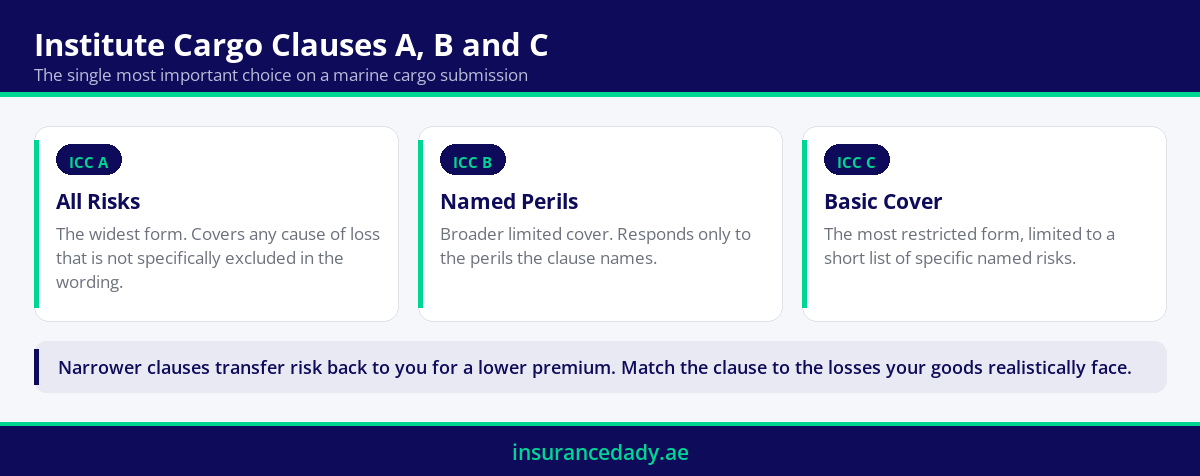
Marine cargo policies in the UAE are commonly issued under one of the Institute Cargo Clauses, the standard forms maintained by the Lloyd's Market Association. This is the single most important choice on the submission, because it sets the breadth of cover before any extension is considered.
Choosing Between Them
Clause A is the widest form, working on an all-risks basis so any cause of loss not excluded is covered. Clause B is a named-perils form offering broader, limited cover. Clause C is basic cover, limited to specific named risks.
The practical rule is that the narrower clauses transfer risk back to you in exchange for a lower premium. That trade can make sense for robust, low-value, well-packed bulk goods on a short route. It makes considerably less sense for high-value, fragile or theft-attractive cargo, where the perils Clause C leaves out are precisely the ones most likely to occur. Compare the clause against the loss scenarios your goods realistically face, not the premium alone.
Who Needs Marine Cargo Insurance
Anyone with an insurable interest in goods while they are moving carries the exposure, which is why marine sits alongside the rest of our general insurance coverage. In the UAE that covers a broad slice of the trading economy.
- Importers
- Exporters
- Freight forwarders
- Trading companies
- Manufacturers
- Logistics companies
- Shipping companies
- E-commerce businesses
- Project cargo contractors
The trade term agreed in the contract of sale sets which party carries the risk at any point in the journey. The Incoterms rules published by the International Chamber of Commerce define where risk passes from seller to buyer, and reading your contract against them is the fastest way to establish whether you need cover for a given shipment or whether your counterparty does.
Reading Your Trade Terms Before You Buy Cover
The single most common source of confusion in marine cargo insurance is not the policy at all. It is uncertainty about who was carrying the risk at the moment the loss occurred.
The trade term in the contract of sale answers that question, not the insurance policy. Under some terms the seller carries risk until the goods reach a named place. Under others, risk passes to the buyer much earlier, sometimes before the goods have physically moved. The Incoterms rules set out where that transfer happens for each term.
Two failure modes follow from getting this wrong. The first is insuring a leg of the journey where you carried no risk, which is wasted premium. The second, and more serious, is assuming your counterparty had it covered and discovering after a loss that they did not. Reading the trade term alongside the transport document is a five-minute exercise that prevents both.
Extensions are where a marine cargo policy stops being generic and starts fitting the trade you actually do. The useful exercise is to walk the journey your goods take and ask what the base clause leaves open at each stage.
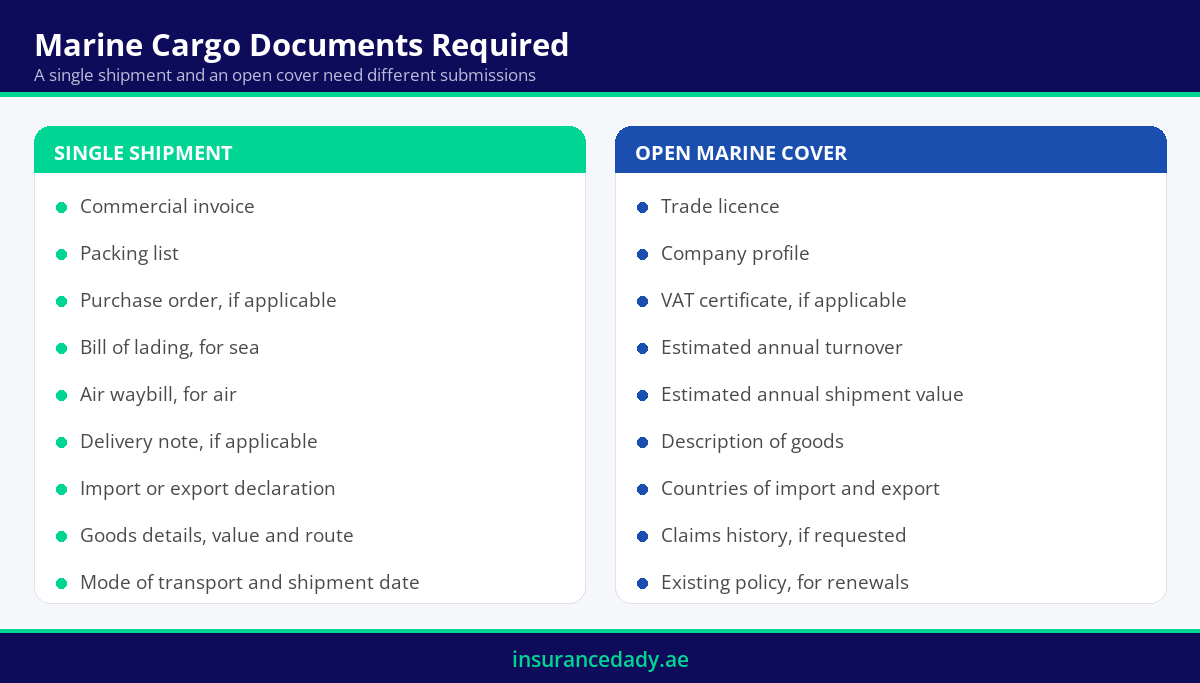
Documents Required for a Single Shipment
A specific voyage submission describes one consignment, so the paperwork is the shipment's own paper trail.
- Commercial invoice
- Packing list
- Purchase order, if applicable
- Bill of lading, for a sea shipment
- Air waybill, for an air shipment
- Delivery note, if applicable
- Import or export declaration, where required
Alongside those documents, the insurer needs the shipment facts: details of the goods, the shipment value, the origin and destination, the mode of transport by sea, air or road, and the expected date of shipment.
Documents Required for Open Marine Cover
An open cover submission describes a business rather than a box, much as an SME insurance submission does. The insurer is underwriting a year of trading, so the documents shift from shipment paperwork to company and volume evidence.
- Trade licence
- Company profile
- VAT certificate, if applicable
- Estimated annual turnover
- Estimated annual shipment value
- Description of goods
- Countries of import and export
- Claims history, if requested
- Existing policy, for renewals
Estimated annual shipment value is the figure that most affects the arrangement, and it is worth estimating carefully rather than conservatively. Open cover is designed to flex with your trading, but a materially understated estimate can create difficulties at adjustment.
Information Required for a Quotation
Beyond documents, an underwriter needs a compact description of the risk itself. Supplying it all at once avoids the round trips that slow a submission down.
- Name of the insured
- Nature of goods
- Packing details
- Shipment value and currency
- Origin and destination
- Mode of transport
- Voyage details
- Required coverage under ICC A, B or C
- Any additional extensions required
What Drives the Premium
Marine cargo pricing is a function of what is moving, how it is protected, and where it is going. The factors below are the ones insurers weigh.
- Nature of goods
- Cargo value
- Packing quality
- Mode of transport
- Shipping route
- Country of destination
- Type of coverage under ICC A, B or C
- Claims history
- Annual shipment volume
You control two of these on every shipment. Packing quality directly reduces the likelihood of the most common damage claims and is visible to an underwriter. Annual shipment volume works in your favour under an open cover, because a consistent book of business is easier to price than a series of one-off consignments.
Getting the Insured Value Right
The shipment value on the submission is doing important work, and it is worth being deliberate about what goes into it. A figure taken straight from the commercial invoice describes what you paid for the goods. It does not necessarily describe what you would be out of pocket if the consignment never arrived.
Consider what else is committed to the shipment by the time it is in transit. Freight charges are typically already incurred. Duties and clearance costs may be. If the goods are sold on arrival, they also have a commercial position behind them. The exact treatment of these elements depends on the policy and the agreed terms, so it is a question to raise at the quotation stage rather than assume.
The currency matters too, which is why the submission asks for shipment value and currency together. Where the goods are invoiced in one currency and the policy is issued in another, movement between the two is a variable worth understanding before it becomes relevant.
Common Extensions Available
Extensions attach cover that the base clause leaves out. Which ones you need depends on the route, the goods and the terms of sale.
- War Risk
- Strike, Riot and Civil Commotion, known as SRCC
- Theft, Pilferage and Non-Delivery, known as TPND
- Warehouse to Warehouse Cover
- Temperature Controlled Cargo Cover
- Loading and Unloading Extension
Warehouse to Warehouse Is the Extension to Ask About First
A transit policy that begins at the port and ends at the port leaves two uninsured gaps: the inland leg from your supplier's warehouse to the loading port, and the leg from the discharge port to your own door. Warehouse to warehouse cover closes both. For UAE importers moving goods on from Jebel Ali or Khalifa Port to an inland facility, that final leg is real exposure, not a technicality.
Route and Political Exposure
War risk and strike, riot and civil commotion cover known as SRCC respond to exposures that vary sharply by route and destination country. Both appear on the standard exclusions list, which means neither is covered unless added. Traders moving goods through regions where these exposures are live should treat the extensions as part of the core arrangement, not an optional extra.
Handling and Theft Exposure
Theft, pilferage and non-delivery cover, usually shortened to TPND, addresses losses that concentrate around handling points rather than during the voyage itself. Compact, valuable, easily resold cargo has a different profile from bulk goods, and the loading and unloading extension covers the moments when goods are most physically vulnerable.
Cargo Specific Requirements
Temperature-controlled cargo cover exists because refrigerated and sensitive consignments can be ruined without any visible physical damage occurring at all. For food, pharmaceutical and chemical traders, this is frequently the extension that matters most. Warehouse-to-warehouse cover, meanwhile, closes the inland legs at both ends of the journey and is relevant to almost every UAE importer moving goods from a port to their own facility.
Building a Submission That Prices Well
Marine underwriters are assessing a shipment they will never see, using only what you tell them. A specific submission, rather than an approximate one, tends to be priced against the actual risk instead of a cautious assumption.
- Describe the goods precisely, including whether they are new, used, fragile or hazardous, rather than using a broad commodity heading.
- Set out the packing in real terms, since packing quality is both a rating factor and an exclusion.
- Give the full route including any transhipment points, because a single leg described as origin to destination hides where the handling actually happens.
- State the clause you want rather than leaving it open, so the quotation you receive is comparable with others.
- Provide claims history where you have it, since a clean record on a regular trade lane is worth showing.
For businesses moving to open cover, estimated annual turnover and estimated annual shipment value carry the same weight as individual shipment details on a single voyage. Both are estimates, and both should be realistic rather than conservative, because the arrangement is built around them.
What to Do If a Cargo Loss Occurs
The quality of a cargo claim is largely determined in the first forty-eight hours, because evidence about the condition of goods degrades quickly once a consignment has been broken down and distributed.
The general principles are consistent across insurers. Record the condition of the goods and the packaging at the point damage is discovered, before anything is moved or repacked. Keep the packaging itself rather than disposing of it, since packing quality is both a rating factor and an exclusion. Note any damage or shortage on the delivery documentation at the time, not afterwards. And notify your broker or insurer promptly, because policies commonly set time limits for notification and for any claim against the carrier.
Keeping the shipment documents together is what makes the rest straightforward. The commercial invoice, packing list, transport document and delivery note that supported the quotation are the same documents that support the claim.
Marine Cargo Insurance Quotation Checklist
To pull the submission together, these are the items generally required to obtain a marine cargo quotation in the UAE. Companies need a current trade licence issued under UAE business licensing rules.
- Trade licence, for businesses
- Commercial invoice
- Packing list
- Bill of lading or air waybill
- Description of goods
- Shipment value
- Origin and destination
- Mode of transport
- Shipment date
- Required coverage under ICC A, B or C
These documents and details let insurers assess the shipment risk and prepare an appropriate quotation. Whether you are shipping a single consignment or need year-round open cover, having them ready shortens the process considerably. InsuranceDady can help you assemble the submission and compare marine options across insurers, subject to insurer terms, conditions and exclusions. See the general insurance range or start a policy enquiry.
Conclusion
Getting marine cargo insurance right comes down to three decisions: whether you need a single voyage policy or open cover, which Institute Cargo Clause matches the loss scenarios your goods actually face, and which extensions close the gaps the base clause leaves open. Assemble the invoice, packing list, transport document and shipment details before you approach the market, and be accurate on packing and value. Not sure which policy fits your situation? The InsuranceDady team can walk you through your options and help you request a quotation that matches your needs, subject to insurer terms, conditions and underwriting.
Frequently Asked Questions
What documents are required for marine cargo insurance in the UAE?
For a single shipment: commercial invoice, packing list, purchase order, bill of lading or air waybill, delivery note and the import or export declaration, plus goods details, value, route, mode and shipment date.
What is the difference between ICC A, B and C?
Clause A is the widest all-risks form, covering any cause not excluded. Clause B is a named-perils form with broader, limited cover. Clause C is basic cover restricted to specific named risks.
Which Institute Cargo Clause should I choose?
Match the clause to the loss scenarios your goods realistically face. Narrow clauses suit robust, low-value, well-packed bulk cargo. High-value, fragile, or theft-attractive goods usually warrant the wider form.
What is open marine cover?
An open cover policy suits businesses that ship regularly throughout the year. Consignments are declared as they move under one arrangement, rather than arranging a separate policy for each voyage.
Does marine cargo insurance cover delay?
No. Delay in transit is a standard exclusion. Marine cargo insurance responds to physical loss or damage to the goods, not to the commercial consequences of a late arrival.
What is General Average?
A maritime principle where all cargo owners contribute proportionally when cargo or expense is deliberately sacrificed to save a vessel in peril, even if their own goods were undamaged. Marine policies commonly cover this contribution.
Why are claims declined for improper packing?
Improper packing is a standard exclusion because it is within the shipper's control. Packing must suit the mode of transport, the route and the handling expected, and it is assessed after the damage occurs.
What is warehouse to warehouse cover?
An extension covering the inland legs at both ends of a journey, from the supplier's warehouse to the loading port and from the discharge port to your own facility, rather than port to port only.
What affects the marine cargo premium?
The nature and value of the goods, packing quality, mode of transport, shipping route, destination country, the ICC clause selected, claims history, and annual shipment volume under an open cover.
Who needs marine cargo insurance in the UAE?
Importers, exporters, freight forwarders, trading companies, manufacturers, logistics and shipping companies, e-commerce businesses, and project cargo contractors. See our services overview to discuss your route.