
Car insurance uae rules are simple at the surface and complicated underneath. Every vehicle on the road must be insured, but the minimum required cover protects other people rather than you, and most drivers never learn the difference until they have an accident. This guide explains the two cover types, what genuinely drives your premium, how registration and renewal work in Abu Dhabi and the Northern Emirates, which add ons earn their cost, and how claims and no claims discounts actually operate. It is written for drivers who want to buy well rather than buy quickly.
Key Takeaways
- Third party cover is the legal minimum and pays nothing towards your own vehicle.
- Premiums are driven by vehicle value, driver history and claims record far more than by insurer branding.
- Registration and renewal are handled by separate authorities in each emirate, with different inspection rules.
- A no claims discount is usually worth more than the small claim that would destroy it.
What the law requires and what it leaves to you
Motor cover is compulsory for every registered vehicle, and proof of insurance is a condition of registration and renewal. That much is consistent across all seven emirates. What varies is everything else, including how registration is processed and which authority handles it.
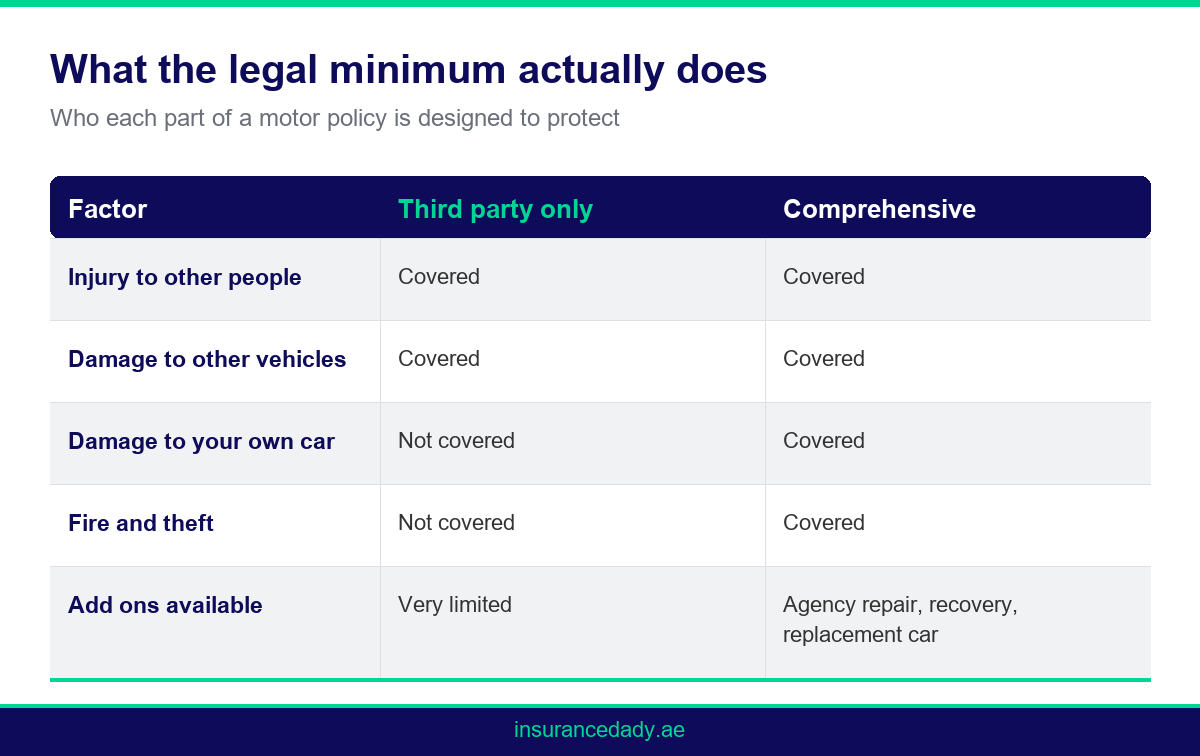
The compulsory element is third party liability. It exists to protect other road users, not the policyholder. If you cause an accident, it pays for the injury and property damage you inflict on others. Your own vehicle, your own injuries and your own losses sit entirely outside it unless you have bought more. Traffic law and licensing across the country are coordinated through the Ministry of Interior, while registration itself is handled at emirate level.
That distinction catches out a surprising number of drivers. A policy can be entirely valid, fully compliant and completely useless to you personally after a single vehicle accident. Deciding how much cover to buy above the legal floor is the real decision, and it is one most people make on price alone.
There is also a practical reason to carry more than the minimum. Liability limits under compulsory cover are finite, and a serious injury claim can exceed them. Where that happens the balance falls to the person responsible, personally. Comprehensive policies generally carry higher liability limits alongside their own damage benefits, so the upgrade buys protection in two directions rather than one.
Third party against comprehensive
These are the two products on the market. Everything else is a variation, an add on or a marketing name layered on top of one of them.
When third party cover is the right answer
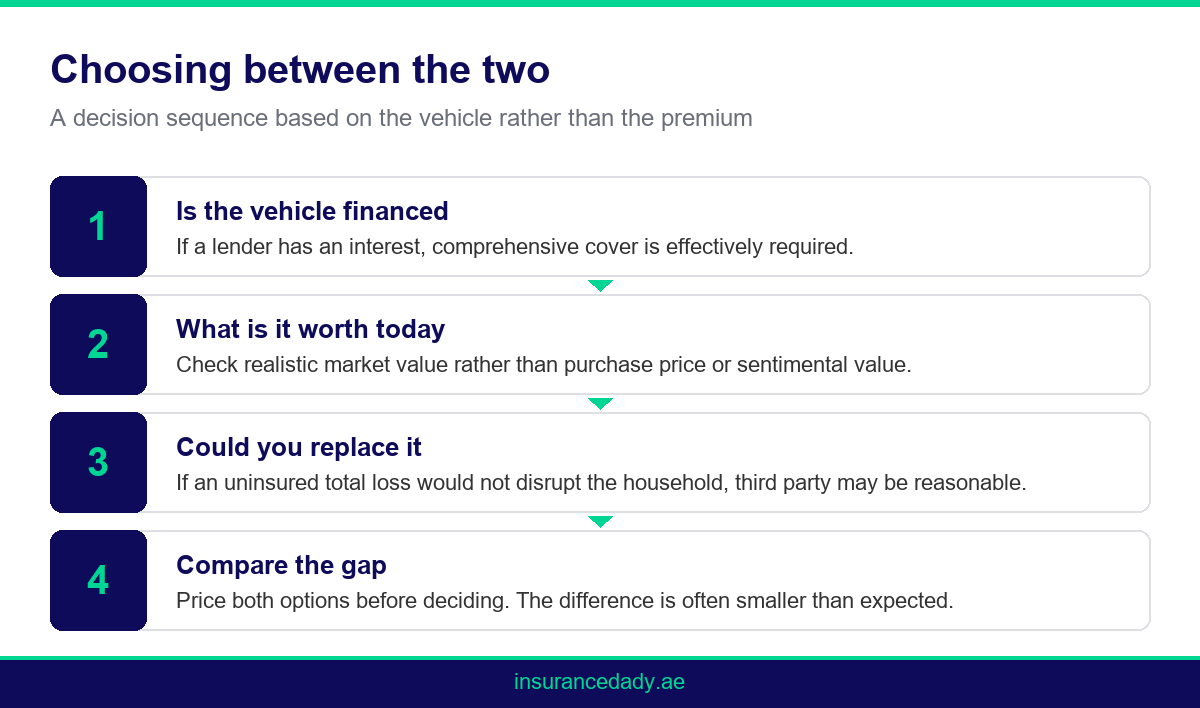
Third party is appropriate for older vehicles where the cost of comprehensive cover approaches a meaningful share of what the car is worth. If a vehicle would be written off after a modest impact and its market value is low, paying to insure that value rarely makes sense.
It is also a reasonable choice for a second vehicle used infrequently, or for a car that would simply be replaced rather than repaired. The decision should follow the value of the vehicle, not the age of the driver or the size of the premium in isolation.
When comprehensive is worth the difference
Comprehensive adds cover for your own vehicle against collision, fire, theft and often natural events. For any financed vehicle it is effectively mandatory, because the lender requires its interest to be protected. For a newer car it is straightforward arithmetic, since the potential loss is large and the premium difference is not.
Comprehensive policies also carry the benefits that matter in daily use: agency repair options in the early years, roadside assistance, replacement vehicle provision and windscreen cover. A side by side breakdown sits in the two cover types compared, and the general structure of both is covered in our full vehicle cover guide.
What actually drives your premium
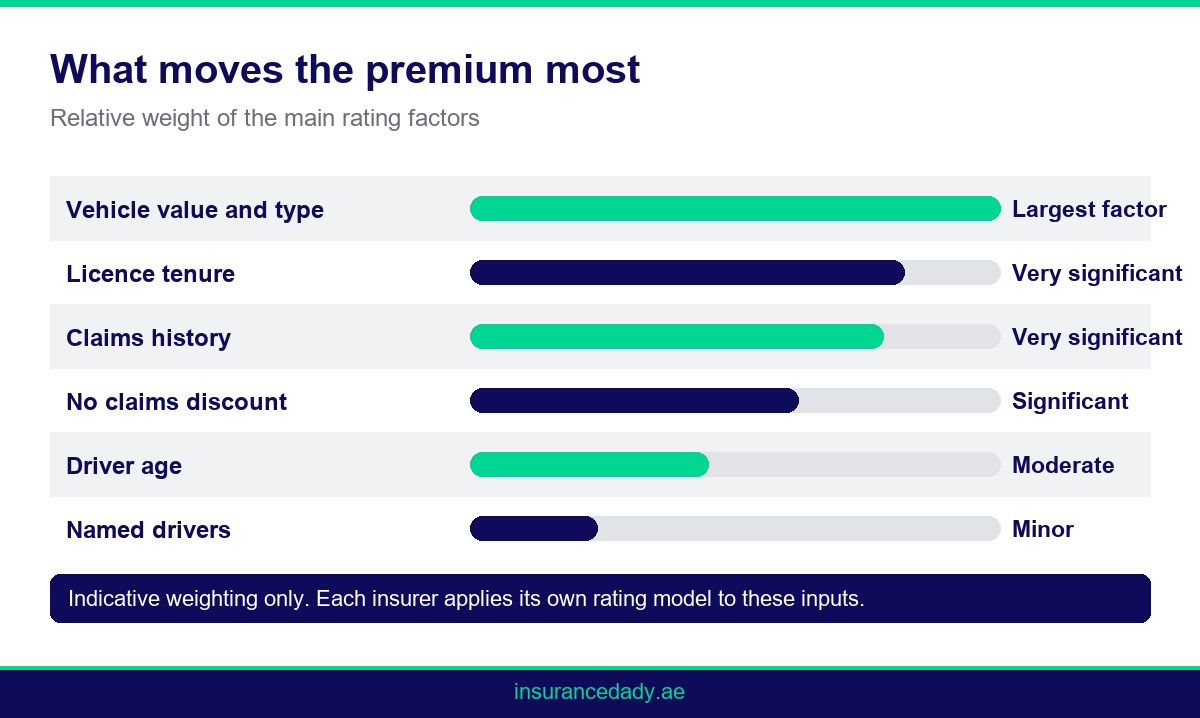
Motor pricing is more transparent than most insurance because the inputs are objective. Understanding which ones you can influence is the difference between accepting a renewal and negotiating one.
Vehicle factors
Market value is the foundation of a comprehensive premium, because it sets the maximum the insurer might pay. Declaring a value above the realistic market figure costs more without increasing what you would receive, since settlements are based on market value at the time of loss rather than on the sum you insured.
Vehicle type matters next. Performance models, large engines and cars with expensive parts attract higher rates because repairs cost more. Age cuts both ways. An older vehicle is cheaper to insure comprehensively but may be excluded from agency repair, which changes where and how it will be fixed.
Driver factors
Licence tenure is the single largest driver variable. Insurers price experience in years held, and a licence obtained locally is treated differently from one converted from overseas, so carry evidence of your original licence date when shopping for quotes.
Age, claims history and the no claims discount follow. A clean record over several consecutive years produces a substantial reduction, and it is portable between insurers provided you obtain the certificate before cancelling. Where you park the vehicle overnight and how many named drivers are on the policy also move the figure, usually modestly.
Registration and renewal across the emirates
Insurance and registration are linked. You cannot renew registration without valid cover, and the renewal window is shorter than most drivers assume.
Abu Dhabi
Vehicle registration and renewal in the capital are administered through Abu Dhabi Mobility, which publishes the inspection requirements and the documents needed at each stage. Insurance must be active before the registration transaction can complete, and the policy period usually needs to extend beyond the new registration expiry.
Fines and outstanding violations are typically settled as part of the process, and traffic matters in the emirate are handled through Abu Dhabi Police. Leaving renewal to the final week is the most common reason drivers end up paying more, because there is no time left to compare quotes.
Dubai and the Northern Emirates
In Dubai the process runs through the Roads and Transport Authority. Sharjah, Ajman, Ras Al Khaimah, Fujairah and Umm Al Quwain each operate their own registration arrangements, and inspection standards and fee structures differ between them.
Drivers who live in one emirate and work in another should keep two points in mind. First, the policy must cover use across the whole country rather than one emirate, which standard policies normally do but commercial ones sometimes do not. Second, a vehicle registered in a Northern Emirate and driven daily into Dubai is assessed on its actual usage pattern, so describe that pattern honestly at quotation rather than giving only the registration address.
Timing differs between emirates as well. Grace periods after expiry, inspection validity and the documents accepted at renewal are not identical, and a driver who has renewed in Dubai for years will find the Sharjah or Ras Al Khaimah process unfamiliar. Check the current requirement with the relevant authority rather than assuming last year's process still applies, since these procedures are digitised and updated regularly.
Add ons that earn their cost
Optional extensions are where motor policies differ most, and where a cheap policy is often revealed as an expensive one.
Agency repair keeps the vehicle within the manufacturer's network, which matters for newer cars, warranty conditions and resale value. It typically remains available for the first few years and then ceases, so check whether your renewal quietly moved you to a garage network.
Roadside assistance and off road recovery are genuinely useful given long intercity drives and summer temperatures. Replacement vehicle cover matters for anybody who cannot simply stop driving during a repair. Personal accident cover for driver and passengers is inexpensive and addresses a risk the liability section does not touch at all.
Windscreen cover is worth checking separately. Glass damage is common on long intercity routes where loose chippings are thrown up at speed, and many policies repair or replace a windscreen without affecting the no claims discount. Where that benefit exists it is one of the few genuinely free wins in a motor policy, and drivers who do not know they have it tend to pay for repairs themselves.
Cover for natural events deserves attention after recent flooding. Water damage is usually covered under comprehensive policies but sometimes sits behind a specific extension, and the wording differs between insurers. If your vehicle is parked in an area that has flooded before, confirm the position in writing before renewal.
Claims, excesses and the no claims discount
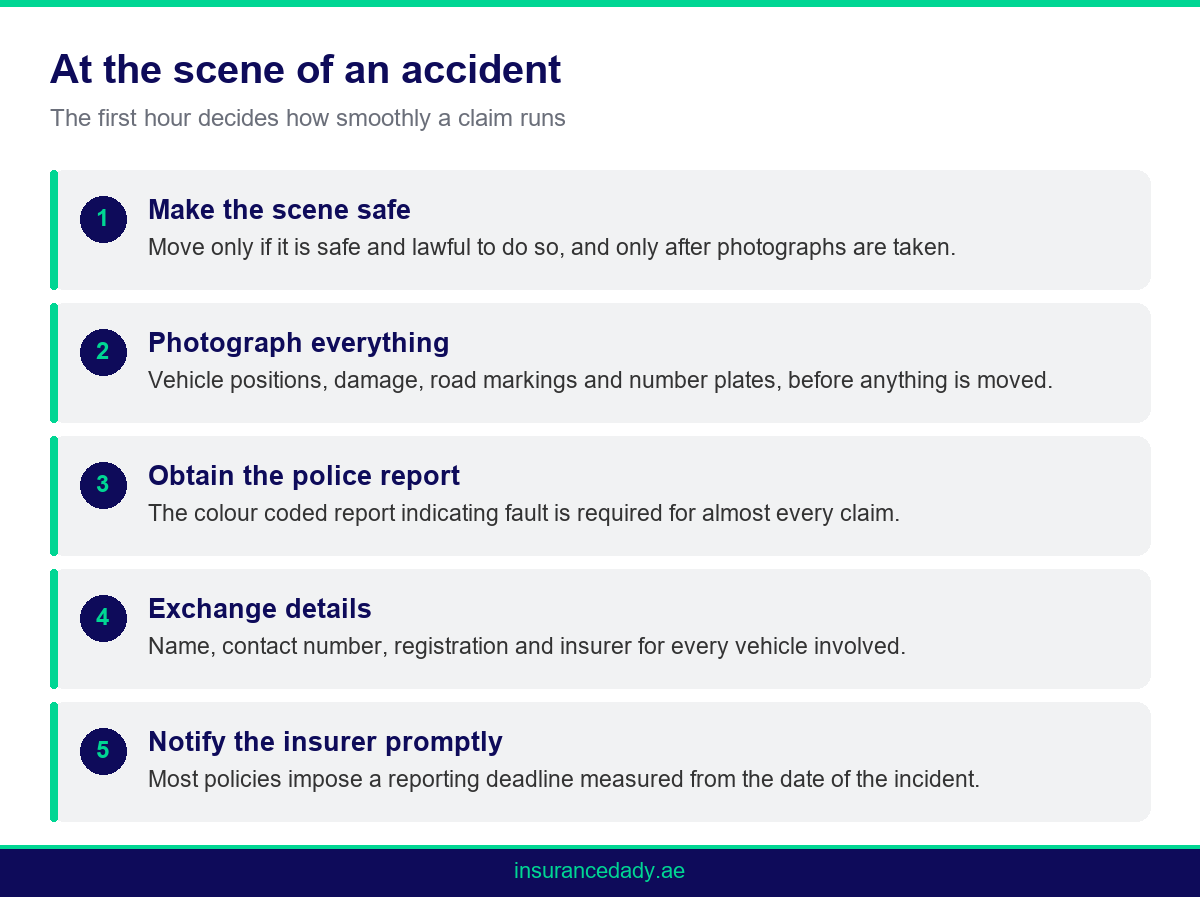
How a claim is handled is decided mostly in the first hour, by whether the paperwork is done correctly.
A police report is required for almost every motor claim, and the colour coded report indicating fault determines how the claim proceeds. Obtain it at the scene rather than afterwards. Photograph the vehicles, the position on the road and any visible damage before anything is moved, provided it is safe to do so.
Every comprehensive policy carries an excess, the first portion of any own damage claim that you pay. A low premium frequently conceals a high excess, which makes small claims pointless. Work out the excess before assuming a policy is cheap, because that figure is where the saving usually went.
The no claims discount is the asset most drivers undervalue. Several consecutive claim free years produce a meaningful reduction, and making one small claim can cost more over the following three renewals than the repair itself. Where damage is minor and clearly below or near the excess, paying for it directly is often the better commercial decision.
Notification is separate from claiming, and the distinction is worth knowing. Most policies require you to report an incident within a set period even if you do not intend to claim, because the other party may later claim against you. Reporting an incident for record purposes does not automatically cost you the discount, whereas failing to report one can prejudice the insurer's position and give it grounds to decline. When in doubt, notify and state clearly that you are not making a claim.
Commercial vehicles, fleets and two wheelers
Anything used for business is rated differently from a private car, and using a private policy for commercial activity invalidates it.
Commercial cover reflects higher annual mileage, multiple drivers and goods carrying use. Businesses running several vehicles should compare per vehicle pricing against a single fleet policy, since fleet arrangements are usually cheaper to administer and avoid gaps when drivers change vehicles. The structures are set out in single and fleet policies for businesses and compared directly in how individual and fleet cover differ.
Heavy vehicles carry their own rating basis, driver licensing requirements and liability exposure, covered in heavy vehicle and truck cover. Two wheelers are rated separately again, and riders working in delivery need commercial permitted use rather than a private certificate. The general position for riders is explained in cover for riders on two wheels.
Repairs, total losses and how settlements are decided
Once liability is agreed, the argument moves to money, and most disagreements at that stage come from a misunderstanding of how settlements are calculated.
Repair basis
Comprehensive policies repair through either the manufacturer's agency network or an approved garage network. Agency repair uses original parts and manufacturer trained workshops, which protects warranty and resale value. Garage repair is cheaper for the insurer and typically uses approved rather than original parts.
Most policies provide agency repair for the first few years of a vehicle's life and then move to garage repair automatically. That change often happens silently at renewal. If agency repair matters to you, check the schedule every year and ask for it to be reinstated where it is still available, since it can usually be bought back for a modest additional premium.
When a vehicle is written off
A total loss is declared when repair cost approaches or exceeds a defined proportion of the vehicle's market value, commonly around half to two thirds. The insurer then pays market value at the date of loss, less the excess, and takes the salvage. Market value is assessed from comparable local sales rather than from what you paid or what you owe.
That last point causes real hardship for financed vehicles. A car bought recently can be worth less than the outstanding finance, leaving the owner with a shortfall after the insurer has paid in full. Some insurers offer a shortfall or replacement value extension that closes this gap, and for a new financed vehicle it is usually worth the cost. Ask about it at inception rather than after a loss, since it cannot be added retrospectively.
Insuring a vehicle you have just acquired
The days around a purchase or transfer are when drivers are most likely to be uninsured without realising it, because cover does not follow a vehicle automatically when it changes hands.
Buying new or used
A policy belongs to the policyholder, not to the car. When you buy a used vehicle the seller's cover ends at transfer, and yours must be active before the registration transaction completes. Dealers frequently arrange a policy on the spot, which is convenient and almost never the best price available.
Arrange quotes before the purchase rather than at the counter. You need the chassis number, the registration details and the declared value, all of which the seller can provide in advance. Buying ahead also gives you the chance to set the excess and repair basis deliberately rather than accepting whatever the dealer's preferred insurer offers by default.
Transfers, imports and modified vehicles
Vehicles imported from another country need inspection and registration before they can be insured normally, and some insurers restrict cover on models never sold locally because parts availability affects repair cost. Declare the origin of the vehicle at quotation, since discovering it after a claim is a reliable way to have that claim questioned.
Modifications matter more than owners expect. Suspension changes, engine tuning, non standard wheels and body kits all alter the risk, and an undeclared modification can void the own damage section entirely. Declaring them usually costs a modest loading. Not declaring them can cost the whole vehicle.
What a motor policy will not pay for
Exclusions on motor cover are narrower than on most products, but the few that exist are applied firmly and account for most disputes.
Driving without a valid licence for the vehicle class voids cover, as does driving under the influence. Both apply even where the other party was clearly at fault, which surprises drivers who assume fault is the only question that matters.
Use outside the permitted description is the next largest category. A private policy used for delivery, ride hailing or driving instruction will not respond, because the certificate describes a different activity from the one being performed. Racing, track use and off road driving in unsuitable terrain are excluded on most standard policies too.
Wear and tear, mechanical breakdown and gradual deterioration are never covered. Insurance responds to sudden and accidental events, not to a gearbox reaching the end of its life. Nor does it usually cover personal belongings left in the vehicle, which fall to a household or travel policy instead. Reading the exclusions once a year takes minutes and prevents nearly all of these arguments.
Buying and comparing properly
Motor insurance is the most shopped and least compared product on the market. Most drivers compare premiums and nothing else.
Start roughly four weeks before expiry. That leaves time to obtain a no claims certificate, gather quotes and negotiate, rather than accepting whatever appears in the renewal notice. Insurers price renewals on the assumption that most customers will not move.
Gather three things before you start. The current policy schedule, the registration card and a no claims certificate from the existing insurer. With those in hand a broker can produce genuinely comparable terms in a single pass, rather than a series of indicative figures that shift once the real details arrive.
Compare on identical assumptions. The same declared value, the same excess, the same repair basis and the same named drivers. A quote that looks cheaper because it assumes a garage repair and a higher excess is not cheaper, it is a different product. Then read the exclusions, particularly around off road use, water damage and drivers not named on the policy.
If you would rather not do this every year, we compare across our partner insurers on a like for like basis. You can review the motor products we arrange, read about cover for a privately owned vehicle, or simply get a comparison with your current schedule as the starting point.
Conclusion
Buying motor cover well takes about an hour a year and saves more than any other insurance decision most households make. Decide the cover type from the value of the vehicle rather than the size of the premium, insure at a realistic market value, check the excess and the repair basis before congratulating yourself on a low price, and protect the no claims discount you have already earned. Drivers in Abu Dhabi, Sharjah, Ajman and Ras Al Khaimah should also confirm their policy follows the way they actually drive across emirate borders. Contact Insurance Dady and we will compare like for like across our partner insurers before your next renewal falls due.
Frequently Asked Questions
Q1: Is third party cover enough?
It satisfies the law but pays nothing towards your own vehicle. For newer or financed cars it leaves you exposed to the full cost of your own repairs.
Q2: Should I insure my car for more than it is worth?
No. Settlements follow market value at the time of loss, so over declaring raises the premium without increasing the payout you would actually receive.
Q3: What is an excess and why does it matter?
It is the first portion of any own damage claim you pay yourself. A low premium often hides a high excess, which makes smaller repairs uneconomic to claim.
Q4: How long does a no claims discount take to build?
Usually several consecutive claim free years, with the discount growing each year. It transfers between insurers if you obtain the certificate before cancelling the old policy.
Q5: Does my policy cover me in every emirate?
Standard private policies normally do, but commercial ones sometimes restrict territory. Check the geographical limits if you drive across emirate borders regularly.
Q6: Is flood or water damage covered?
Usually under comprehensive cover, though some insurers place it behind a specific extension. Confirm the wording in writing if you park in an area that has flooded.
Q7: What is agency repair and when does it end?
It keeps repairs within the manufacturer network, typically for the first few years. Renewals often move you to a garage network quietly, so check each year.
Q8: Can I use a private policy for delivery work?
No. Carrying goods for payment triggers a hire and reward exclusion. Commercial permitted use must be stated on the certificate before the vehicle is used that way.
Q9: What do I need at the scene of an accident?
A police report indicating fault, photographs of the scene before vehicles move, and the other party's details. Claims stall most often on a missing report. See our services.
Q10: When should I start shopping for renewal?
About four weeks before expiry. That allows time to obtain a no claims certificate and compare properly rather than accepting the renewal notice.