
This is one of the most expensive misunderstandings in UAE trade. An importer assumes their freight forwarder's insurance protects their goods. It does not. The two coverages look similar on the surface but answer completely different questions. Marine cargo insurance protects the goods. Freight forwarding insurance protects the forwarder. This guide explains the difference in plain language, so you know which one you need and what you are actually buying.
Key Takeaways
- Marine cargo insurance protects the cargo owner. Freight forwarding insurance protects the freight forwarder.
- Cargo insurance covers physical loss or damage to the goods. Forwarder cover responds to the forwarder's legal liability.
- A forwarder's liability is usually limited by contract and by international convention, so a payout can be far less than what the goods are worth.
- If you own the goods, insure the goods. Do not rely on someone else's liability policy to make you whole.
The Short Answer
The person who owns the goods buys marine cargo insurance, and it pays for the goods. The company moving the goods buys forwarder liability cover, and it pays when that company is found legally responsible for something going wrong.
Different buyer, different subject, different trigger. Once you see it that way, the rest of the comparison follows naturally.
The confusion is understandable. Both policies sit around the same shipment, both are arranged by people in the same industry, and both are loosely described as cargo cover in conversation. But one is a property-style cover on goods, and the other is a liability cover on a business, and those two things behave completely differently when a claim is made.
What Marine Cargo Insurance Does
Marine cargo insurance sits with the cargo owner. It covers physical loss of or damage to goods while in transit, whether by sea, air, road, or rail.
- It protects the cargo owner.
- It covers physical loss or damage to cargo.
- It is purchased by importers and exporters.
- It covers the value of the cargo.
That last point is the important one. Cargo cover is written against the value of the shipment, so a valid claim is measured against what the goods are worth rather than against anyone's fault. Our guide to what a marine insurance policy covers sets out the perils and exclusions in more detail. All cover remains subject to the policy terms and conditions.
What Freight Forwarding Insurance Does
This second cover sits with the logistics company. It is a liability cover, which means it responds when the forwarder is held legally responsible for a loss, not simply because a loss happened.
- It protects the freight forwarder.
- It covers the freight forwarder's legal liability.
- It is purchased by freight forwarders and logistics companies.
- It covers legal claims, defence costs and liabilities.
So the trigger is fault, or at least an allegation of it. If cargo is damaged in a storm and nobody was negligent, a forwarder's liability policy has nothing to respond to. The cargo owner's own policy covers that loss. This same structural difference separates property cover from professional liability cover in any other industry.
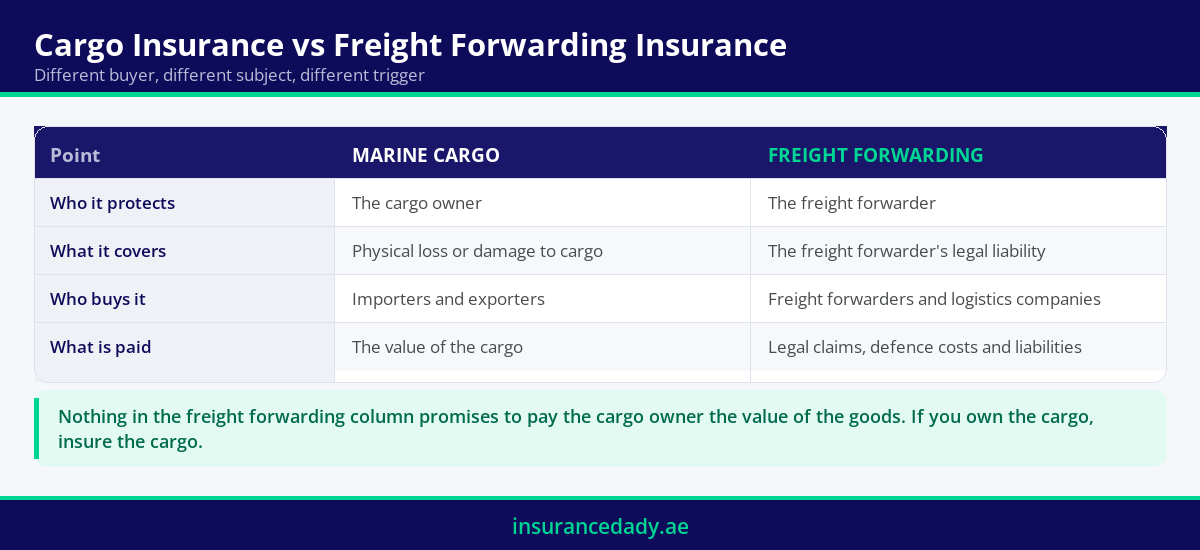
The Two Covers Side by Side
Read the table row by row and one thing becomes obvious. Nothing in the right-hand column promises to pay the cargo owner the value of the goods. That is not what a liability policy is for.
- Who it protects. Marine cargo insurance: the cargo owner. Freight forwarding insurance: the freight forwarder.
- What it covers. Marine cargo insurance: physical loss or damage to cargo. Freight forwarding insurance: the freight forwarder's legal liability.
- Who buys it. Marine cargo insurance: importers and exporters. Freight forwarding insurance: freight forwarders and logistics companies.
- What is paid. Marine cargo insurance: the value of the cargo. Freight forwarding insurance: legal claims, defence costs and liabilities.
Why a Forwarder's Cover Will Not Make You Whole
There are three reasons an importer relying on a forwarder's policy usually ends up disappointed.
- Fault has to be proved. If nobody was negligent, the liability policy has nothing to answer.
- Liability is limited. Forwarder liability is normally capped by the trading conditions in the contract and by international convention, often by weight rather than by value.
- The claim is against the forwarder, not for you. Even a successful claim is a dispute you have to run, and it takes time you may not have.
The weight-based cap surprises people most. A light, high-value consignment can be worth a great deal and weigh very little, so a liability settlement calculated on weight can fall a long way short of the invoice. The standard trading conditions that shape a forwarder's liability come through FIATA internationally, and the UAE sector is represented by the National Association of Freight and Logistics.
It is worth saying plainly that none of this is a criticism of freight forwarders. A liability policy is exactly the right cover for a business that handles other people's goods, and a good forwarder will tell you to insure your own cargo. The problem arises when a cargo owner assumes protection that was never on offer.
A Simple Illustration
The following example is illustrative only, and the figures are made up to show the mechanism rather than to describe any real case.
Imagine a consignment of electronics worth AED 400,000, weighing 500 kilograms, damaged by water during a sea leg. Nobody was negligent. The container was properly stowed and the weather was bad.
- Under the cargo owner's own marine policy, the claim is assessed against the value of the goods, subject to the sum insured, the clause set and the policy terms.
- Under the forwarder's liability policy, there is nothing to respond to, because the forwarder did nothing wrong.
Now change one fact. The damage happened because the forwarder stowed the container badly. The liability policy may now respond, but the amount is normally capped by the trading conditions and by convention, often calculated on weight. On a light, high-value consignment, that calculation can settle at a fraction of the invoice, and the cargo owner absorbs the difference.
That is the whole argument in one example. Even when the forwarder is at fault, their cover is not designed to make the cargo owner whole. It is designed to cover their own legal liability, within limits agreed long before the shipment moved.
Which One Do You Need?
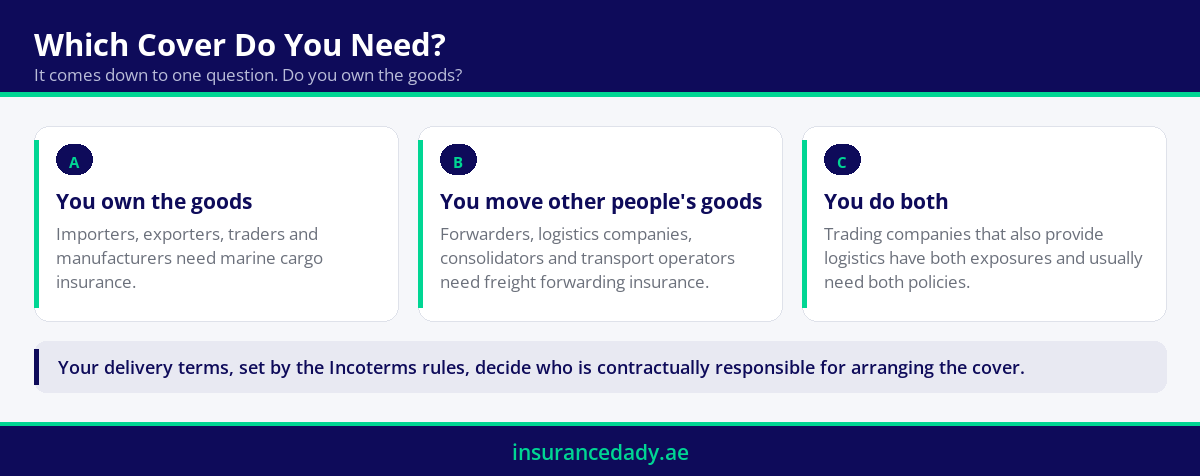
It comes down to a single question. Do you own the goods?
- If you are an importer, exporter, trader or manufacturer and the goods are yours, you need marine cargo insurance.
- If you are a freight forwarder, logistics company, consolidator or transport operator handling other people's goods, you need forwarder liability cover.
- If you are both, which some trading companies are, you need both, because they answer different exposures.
One more thing is worth checking. Your delivery terms decide who is contractually responsible for insuring the shipment. Those terms come from the Incoterms rules, and a quick look at which one is on your invoice will usually answer the question before you even get to insurance.
What Each Policy Needs at Quotation Stage
The two submissions look nothing alike, which is another clue that they are different products. Requirements vary by insurer, so treat these as starting points.
For marine cargo insurance:
- Nature and value of the goods
- Packing details
- Origin, destination and mode of transport
- Level of cover required
- Trade licence and annual shipment value, for an open cover
For freight forwarding insurance:
- Trade licence and company profile
- The services you provide, such as forwarding, warehousing or customs clearance
- Annual turnover
- The trading conditions you contract on
- Claims history
Notice that the cargo submission is about a shipment and the forwarder submission is about a business. Once you see that, the difference between the two covers stops being confusing.
There is one more practical difference. A cargo submission is usually turned around in hours, because the insurer is pricing a single, well-defined journey. A forwarder submission takes longer, because the insurer is assessing an entire operation, including how the business contracts with its customers.
Getting a Quotation
Whether you own the cargo, move it, or do both, it is worth being clear about which policy is protecting you. InsuranceDady can arrange both and explain where one stops and the other starts. Browse the general insurance range or start a policy enquiry.
Conclusion
Marine cargo insurance and freight forwarding insurance are not alternatives. They protect different parties against different things. Cargo cover pays the owner for the value of the goods. Forwarder cover answers the forwarder's legal liability, within limits that are often set by weight rather than value. If you own the goods, insure the goods, and check your delivery terms to confirm whose job that is. All cover remains subject to the policy terms, conditions and exclusions. The InsuranceDady team can help you work out which policy, or which pair of policies, your business needs.
Frequently Asked Questions
What is the difference between cargo insurance and freight forwarding insurance?
Cargo insurance protects the cargo owner and covers physical loss or damage to the goods. Freight forwarding insurance protects the forwarder and covers their legal liability, defence costs and claims against them.
Does my freight forwarder's insurance cover my goods?
Not in the way most people assume. It responds to the forwarder's legal liability, not to the value of your cargo, and it only answers where the forwarder is found responsible.
Who buys marine cargo insurance?
Importers and exporters, along with traders and manufacturers who own goods in transit. The party that bears the financial loss if the shipment is damaged or does not arrive buys it.
Who buys freight forwarding insurance?
Freight forwarders and logistics companies. It is a business liability cover for firms that handle, move, consolidate or store goods belonging to other people.
Why is a forwarder's liability limited?
Liability is normally capped by the trading conditions in the contract and by international convention, often calculated by weight rather than by the consignment's value.
Can one company need both covers?
Yes. A trading company that also provides logistics services owns goods and handles other people's goods, so it has both exposures and usually needs both policies.
Do Incoterms decide who insures a shipment?
They decide who is contractually responsible for arranging cover and where risk passes between buyer and seller. Checking the Incoterm on your invoice usually answers the question.
What does cargo insurance pay out?
It is written against the value of the shipment, so a valid claim is measured against what the goods are worth, subject to the sum insured and the policy terms, conditions and exclusions.
Is cargo insurance mandatory in the UAE?
It is usually a commercial requirement rather than a legal one, though banks, buyers and letters of credit often insist on it. Check your contract and your delivery terms.
Where do I start if I ship regularly?
An annual open cover usually suits regular shippers better than insuring each consignment. Our general insurance guide explains how these programmes are arranged.