
Health cover in Dubai is arranged in tiers. The entry-level plan gives lower-salary employees access to essential care at a price a small employer can afford. Dubai basic medical insurance is the plan most companies buy for their junior staff, drivers, helpers and site workers. This guide explains in plain language who the plan is aimed at, the two salary bands employers are asked to plan around, and what to check before you buy. For the wider picture, our Dubai medical insurance guide covers the full range of plans.
Key Takeaways
- Dubai basic medical insurance is the entry-level tier of cover, aimed at employees on lower salaries rather than at senior staff.
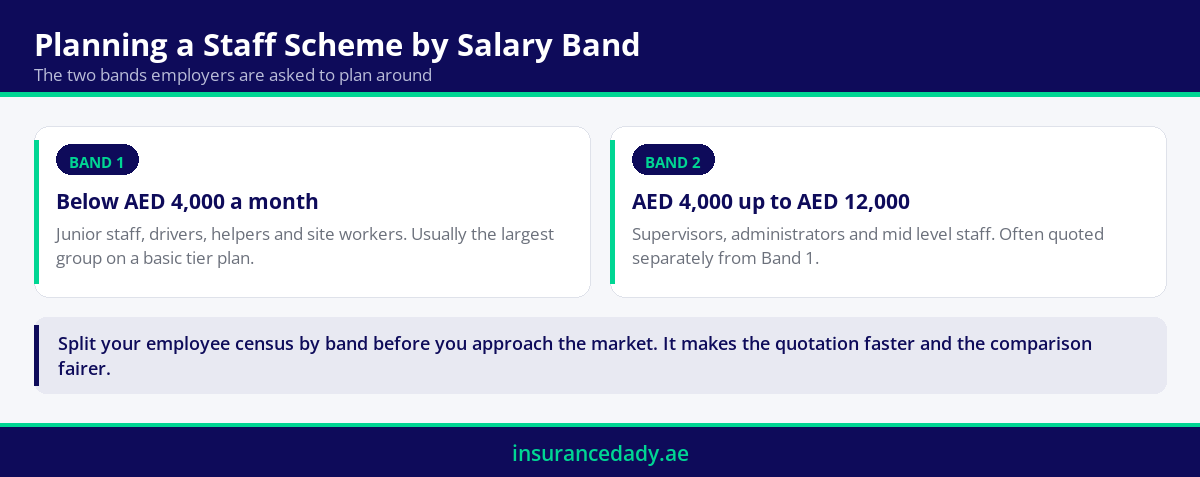
- Two salary bands matter when you plan a staff scheme: employees earning less than AED 4,000, and employees earning above AED 4,000 and up to AED 12,000.
- Benefits, limits and network access vary by insurer and plan, so compare the plan documents rather than the headline price.
- Confirm the current rules with the Dubai Health Authority or your broker before you commit, because health insurance requirements are reviewed from time to time.
What Basic Means in Dubai Medical Insurance
Basic does not mean poor quality. It means the plan covers essential medical needs at the lowest sustainable price. Coverage, limits and hospital networks are narrower than on a mid-tier or premium plan, and the premium reflects that.
The trade-off is simple. A basic plan gives an employee access to care they would otherwise pay for out of pocket. It is not designed to match the coverage a senior executive would expect. Dubai's health insurance system is administered by the Dubai Health Authority, and plans sold in the emirate are registered through its health insurance portal. Always confirm the current position with the authority or with your broker, because the rules are reviewed from time to time.
It helps to picture health cover in the emirate as a ladder. At the bottom sits the basic tier, built for essential care at the lowest sustainable price. Above it sit mid-tier plans with wider networks and higher limits, and above those sit premium plans aimed at senior staff and their families. Most companies use more than one rung, matching the plan to the salary band rather than buying one plan for everybody.
The Two Salary Bands Employers Plan Around
When a broker prices a staff scheme in Dubai, salary is one of the first questions asked. Two bands come up again and again:
- Employees earning less than AED 4,000 a month.
- Employees earning above AED 4,000 and up to AED 12,000 a month.
These bands matter because a workforce is rarely uniform. A company with fifteen site workers, four supervisors and two managers will usually be quoted differently for each group. Splitting your census by salary band before you approach the market makes quoting faster and comparison fairer.
If your workforce sits mostly above these bands, a basic plan is probably not the right starting point. Look instead at a mid-tier group medical scheme, which is priced and structured for a different profile.
Salary is used as a proxy for two things. First, it reflects what the employer can realistically afford per head across the workforce. Second, it reflects the kind of care the plan is expected to deliver. Neither is a judgement about the employee. It is simply how the market segments its products.
Who Arranges the Cover
In most cases, the employer arranges and pays for employee health cover in Dubai. That is the normal commercial arrangement, and it is why basic plans exist at the price point they do.
Where an individual is not covered through an employer, they may need to arrange their own plan. Self-employed people, investors, dependents and people between jobs all fall into that group. Our guide to individual medical insurance explains how a personal plan differs from a staff scheme. The UAE publishes employment-related obligations through the official government portal.
What to Check Before You Buy a Basic Plan
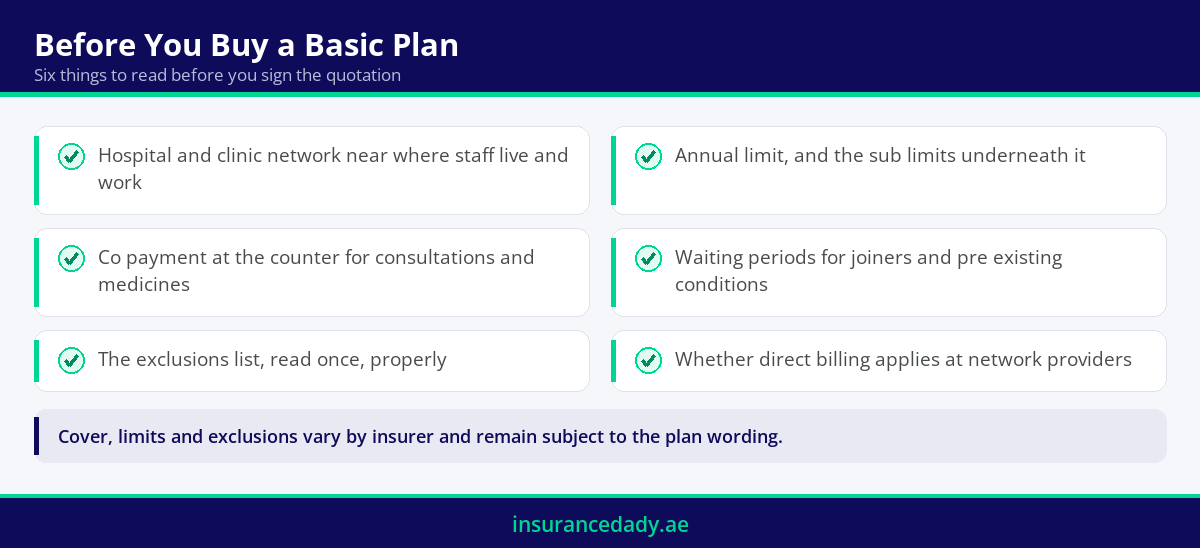
Two basic plans at the same premium can behave very differently when someone actually needs treatment. These are the things worth reading before you sign.
- The hospital and clinic network. Check that there is a clinic near where your staff live and work, not just somewhere in the emirate.
- The annual limit and any sub-limits. A headline annual figure can still be broken down into smaller caps per benefit.
- Co-payment. Find out what the employee pays at the counter for consultations, medicines, and tests.
- Waiting periods. New joiners and pre-existing conditions often have a waiting period before cover starts.
- Exclusions. Read them once properly. It is faster than discovering them during a claim.
- How claims are handled. Direct billing at network providers is much easier for a junior employee than paying and claiming back.
Co-payment and network access are the two that decide whether staff actually use the plan. A cheap plan that nobody can reach and nobody can afford to use is not a saving. All of this remains subject to the terms, conditions and exclusions of the plan you choose.
What Insurers Usually Ask For
A quotation for a staff scheme normally starts with a short set of details. Requirements vary by insurer, so treat this as a starting point, not a fixed list.
- Trade licence
- Employee census, showing name, date of birth, gender, nationality and salary band
- Number of employees in each salary band
- Any dependants to be included
- The emirate or emirates where staff are based
- Existing policy schedule, if this is a renewal
- Claims history, if requested
The census does the most work. A clean, accurate census usually produces a faster, more competitive quotation than a rough headcount, because the insurer isn't pricing in uncertainty.
Common Mistakes Employers Make
The same handful of mistakes come up every renewal season. None of them is expensive to avoid.
- Buying on premium alone. The cheapest quotation often has the narrowest network and the highest copayment.
- Sending a rough headcount instead of a proper census. It slows the quotation down and usually prices in a margin for uncertainty.
- Forgetting the owner. Business owners are regularly left off the scheme they arranged for everyone else.
- Leaving renewal to the last week, which removes any chance of testing the market properly.
- Not telling staff what the plan actually covers. A benefit nobody knows about is a benefit nobody uses.
The last one is the cheapest to fix and the most often skipped. A one-page summary in plain language, handed out when the cards are issued, saves the HR team a great deal of time and helps staff use the cover they already have.
It is also worth reviewing the scheme against the rest of your business cover once a year. Employers carrying staff liabilities should check how the medical scheme sits alongside their workers' compensation and general business cover, so the same event doesn't fall between two policies.
Getting a Quotation
If you are setting up cover for the first time, start early. Gathering a census and comparing plan documents takes longer than most employers expect. InsuranceDady can compare basic plans across insurers and explain the differences in plain terms. Browse the health insurance range or start a policy enquiry.
Conclusion
Dubai basic medical insurance exists so lower-salary employees can access essential care at a price an employer can sustain. Plan your scheme around the two salary bands, split the census before you approach the market, and compare network, co-payment, and waiting periods rather than the headline premium. Cover, limits and exclusions vary by insurer and remain subject to the plan wording, so confirm the detail before you commit. If you would like help comparing plans for your team, the InsuranceDady team can walk you through the options.
Frequently Asked Questions
What is Dubai basic medical insurance?
It is the entry-level tier of health cover in Dubai, built to give lower-salary employees access to essential medical care at the lowest sustainable premium. Cover and limits are narrower than on mid tier or premium plans.
Which salary bands matter when planning a staff scheme?
Two come up repeatedly: employees earning less than AED 4,000 a month, and employees earning above AED 4,000 and up to AED 12,000 a month. Splitting your census by band makes quotations faster and fairer.
Who pays for employee health insurance in Dubai?
In most cases the employer arranges and pays for it. If someone isn't covered through an employer, such as a self-employed person or a dependant, they may need to arrange their own individual plan.
What does a basic plan usually not include?
Cover, limits, sub-limits, and exclusions differ by insurer and plan. Read the plan document rather than assuming. If a benefit matters to your team, confirm in writing that it is included before you buy.
What is a co-payment?
It is the share the employee pays at the counter, for example, for a consultation, a medicine or a test. A low premium with a high co-payment can end up costing your staff more than a slightly dearer plan.
What is a network in health insurance?
The network is the list of hospitals and clinics where the plan can be used with direct billing. Check that the network reaches the areas where your staff actually live and work.
Can dependants be added to a basic plan?
That depends on the insurer and the plan. Ask before you buy, because adding dependants later can be more expensive than including them from the start.
How long does it take to set up cover?
Once the trade licence and a clean employee census are ready, quotations usually come back quickly. Most delays in practice come from assembling the census, so start there.
Is a basic plan enough for senior staff?
Usually not. Basic plans are priced for a lower salary profile. Companies with a mixed workforce often place junior staff on a basic tier and senior staff on a wider plan.
Where can I check the official position?
Confirm current health insurance requirements with the Dubai Health Authority or your broker. Wider UAE health information sits on the government portal.