
Two quotations arrive. One is cheaper. Choosing the cheaper one without reading the table of benefits is how employers end up with a scheme their staff cannot use. The table of benefits tells you what a group medical insurance plan will actually pay for, and it is where the real differences live. This guide explains how to read one in plain language, and how to put two plans side by side without being misled by the headline premium. For the basics of how these schemes work, start with our group medical insurance guide for employers.
Key Takeaways
- The table of benefits, not the premium, is what tells you how good a group medical insurance plan really is.
- An annual limit means little on its own. Sublimits sitting underneath it decide what a benefit is actually worth.
- Network tier is the single change that moves price the most, because it decides which hospitals your staff can walk into.
- Staff join and leave during the year, so check how mid-term additions and deletions are handled before you sign.
What a Table of Benefits Is
A table of benefits is a one-page or two-page summary that lists every benefit in the plan and what the insurer will pay for each one. Insurers usually call it the TOB. It sits with the quotation, and it is the document you should be comparing, not the covering email.
- Annual limit. What to look for: The per-person-per-year ceiling. Why it matters: Sets the outer boundary of the whole plan.
- Outpatient. What to look for: Whether it is fully covered and the co-payment. Why it matters: This is the benefit staff use most.
- Sub limits. What to look for: Caps on maternity, dental, physiotherapy and diagnostics. Why it matters: A large annual limit can still hide small caps.
- Network tier. What to look for: Which hospitals and clinics are actually included. Why it matters: Decides whether staff can reach care easily.
- Waiting periods. What to look for: For new joiners, maternity and pre-existing conditions. Why it matters: Decides when cover really starts.
- Territorial scope. What to look for: UAE only, GCC, or worldwide. Why it matters: Matters for staff who travel or take home leave.
Read it as a list of promises with numbers attached. Each row names a benefit. Next to it sits either a monetary limit, a percentage, a waiting period, or the word covered or excluded. Everything on that page is subject to the full policy wording, so treat the table as the summary rather than the contract.
The Dubai Health Authority administers health insurance sold in Dubai and registers it through its health insurance portal. Employers in Abu Dhabi deal with the Department of Health instead, and the two emirates do not run identical systems, so check which one applies to each part of your workforce.
One habit makes the whole exercise easier. Ask every insurer for the table in the same format and read them side by side rather than one after the other. Differences that are invisible when you read a document on its own become obvious the moment two are next to each other.
The Rows That Matter Most
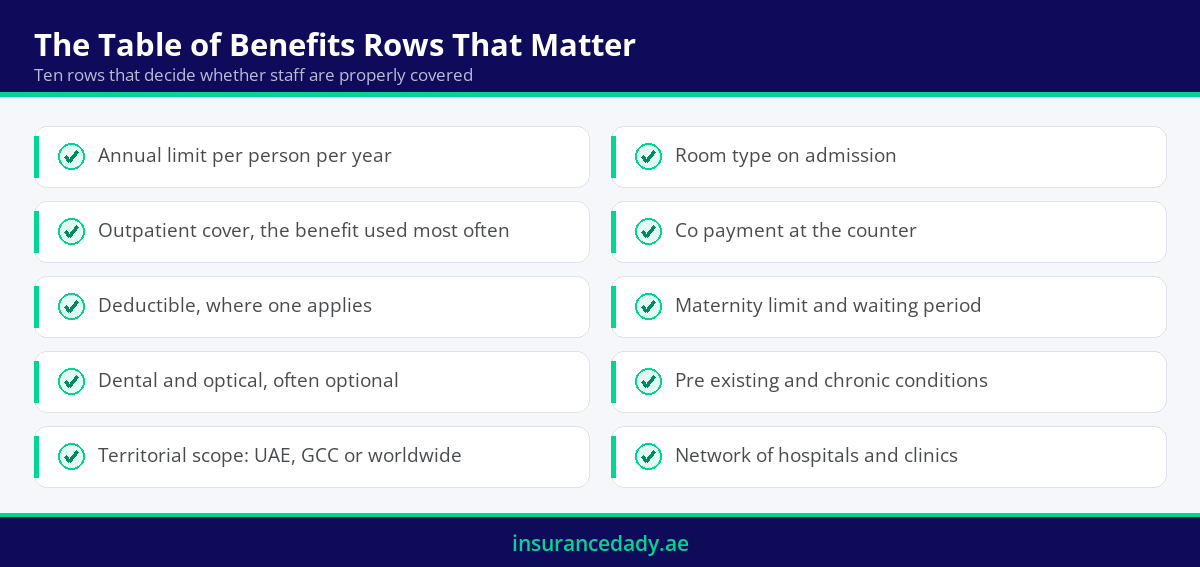
A full table can run to forty rows. These are the ones that decide whether staff are properly covered.
- Annual limit. The total the insurer will pay per person per year.
- Room type. Whether an admitted employee gets a shared room, a semi-private room or a private room.
- Outpatient cover. Consultations, medicines and tests without admission. This is what most people use most often.
- Co-payment. The share the employee pays at the counter, often shown as a percentage with a cap.
- Deductible. A fixed amount the employee pays before the plan responds, where applicable.
- Maternity. Usually shown as a separate limit with its own waiting period.
- Dental and optical. Often excluded on entry-level plans and added as an option.
- Pre-existing and chronic conditions. Check both the limit and the waiting period.
- Territorial scope. Whether cover works only in the UAE, across the GCC, or worldwide.
- Network. The list of hospitals and clinics where the card works.
Outpatient cover and co-payment are the two rows employees notice first. Inpatient claims are rare. A clinic visit is. If the co payment on a consultation is high, staff will delay going, which usually costs the scheme more later.
Sub Limits: Where the Headline Number Stops Being True
This is the most common misunderstanding in the whole document. An annual limit is the yearly ceiling. A sub limit is a smaller ceiling that applies to a single benefit within it.
So a plan can show a large annual limit and still cap physiotherapy at a handful of sessions, cap maternity at a separate figure, and cap dental at a small annual amount. None of that is hidden. It is written in the table, in the row under the benefit. It is simply easy to skip.
When you compare two quotations, compare the sub limits on the benefits your workforce actually uses. A young team uses outpatient and maternity. An older team uses chronic condition cover and diagnostics. The right group medical insurance plan for you is the one whose sublimits match the people on your census.
A useful test is to pick the three benefits your team used most last year and look only at those rows. If you do not have claims data, ask your broker for a summary. Most insurers will provide one at renewal, and it turns the comparison from guesswork into arithmetic.
Network Tiers Explained
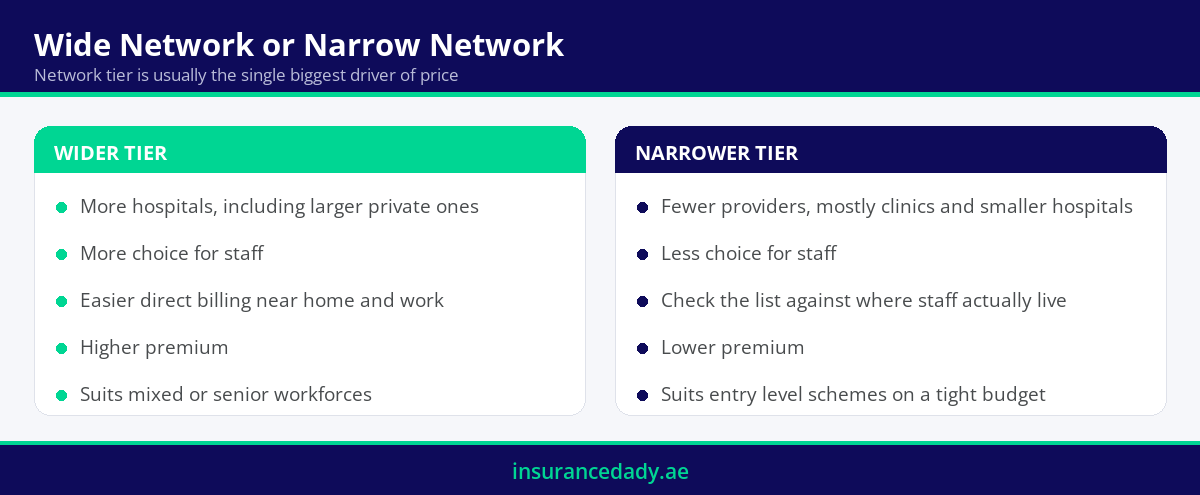
The network is the list of hospitals and clinics where the card works with direct billing. Insurers group these into tiers, and the tier is usually the single biggest driver of price.
- A wider tier includes more hospitals, including some of the larger private ones, and costs more.
- A narrower tier includes fewer providers, usually clinics and smaller hospitals, and costs less.
- Outside the network, the employee normally pays first and claims the money back afterwards, subject to the plan.
Before you accept a narrow tier to save money, check the network list against where your staff live. A tier that looks fine on paper is useless if the nearest clinic on it is an hour away. This is exactly the kind of trade-off covered in our SME and corporate medical insurance guide.
Putting Two Plans Side by Side
Compare like with like. Build a short table of your own with only the rows that matter to your team, then fill it in from each quotation.
Adding and Removing Staff During the Year
No workforce stays still for twelve months. People join, people leave, and dependants get added. Changes made to a policy after it starts are called endorsements.
Three things are worth settling in writing. How quickly can a new joiner be added and get a card? Is the premium charged pro rata for the part year? And what happens to an employee's cover on their last working day? The answers vary by insurer, and they matter more to day-to-day administration than almost anything else on the quotation.
What Happens at Renewal
A group medical insurance plan is repriced each year. The insurer looks at how much was claimed versus how much premium was paid, along with the team's age profile and any headcount changes.
Start the renewal conversation early, not in the final fortnight. It gives you time to gather an updated census, review the table of benefits again, and test the market properly. Cover, limits and pricing all remain subject to the insurer's terms and underwriting.
Employment-related obligations and general health information for the UAE are published on the UAE health information portal, which is worth checking once a year in case anything has moved.
Two practical points help. Keep your census current through the year rather than rebuilding it in the last fortnight, and keep a note of any large claim and what caused it. Being able to explain a one-off event to an underwriter is often the difference between a repriced renewal and a heavily loaded one.
Getting a Quotation
If you are comparing quotations and the tables don't line up, InsuranceDady.ae can put them side by side and explain what each row means in practice. Browse the health insurance range or start a policy enquiry.
Conclusion
The table of benefits is the honest version of a quotation. Read the annual limit, then read the sub limits underneath it, then check the network against where your staff actually live. Ask how joiners and leavers are handled before you sign, and start the renewal early enough to test the market. Everything in the table remains subject to the full policy wording, conditions and exclusions. If you would like a second pair of eyes on two quotations, the InsuranceDady team can walk you through them row by row.
Frequently Asked Questions
What is a table of benefits?
It is the summary page attached to a health insurance quotation that lists every benefit and what the insurer will pay for each one. Insurers usually shorten it to TOB. It is the document you should compare.
What is the difference between an annual limit and a sub limit?
The annual limit is the total the insurer pays per person per year. A sub-limit is a smaller cap on one benefit inside that total, such as maternity, dental or physiotherapy.
What is a co-payment?
It is the share the employee pays at the point of treatment, usually a percentage of the bill and often capped. A low premium with a high co-payment can cost your staff more overall.
What is a network tier?
A network tier is the list of hospitals and clinics where the insurance card works with direct billing. Wider tiers include more providers and cost more. Narrow tiers cost less but limit choice.
Can employees be added after the policy starts?
Usually yes, through an endorsement. Ask how quickly a new joiner gets a card and whether the premium is charged pro rata for the remaining part of the year.
What happens to cover when an employee resigns?
Cover normally ends in line with the policy terms once the employee leaves. Confirm the exact position with the insurer, because the timing differs between plans.
Why did our renewal premium go up?
Insurers look at claims against premium, the team's age profile, and any change in headcount. A year with heavy claims normally leads to a higher renewal, subject to the insurer's underwriting.
Do all plans cover maternity and dental?
No. Both are commonly shown with their own sub-limits and waiting periods, and entry-level plans often exclude dental altogether. Check the row rather than assuming.
What is a waiting period?
It is the time that has to pass before a benefit becomes available. Waiting periods commonly apply to new joiners, maternity and pre-existing conditions, and they differ between insurers.
Should small companies bother comparing benefit tables?
Yes. Small group medical insurance plans feel the difference most, because one heavy claim can affect the whole renewal. Our SME insurance guide explains what else to watch.