
Most people in the UAE get health cover through an employer. Not everyone does. Individual medical insurance is the plan you buy for yourself, in your own name, when there is no company scheme behind you. It matters more than people expect, because a single hospital admission can cost more than a year of premiums. This guide explains who usually needs a personal plan, how it differs from a staff scheme, and what to compare before you buy. If you are looking at cover for a whole household instead, start with our family health insurance guide.
Key Takeaways
- Individual medical insurance is cover you buy in your own name, rather than cover provided through an employer.
- Self employed people, business owners, freelancers, dependants and anyone between jobs are the groups that most often need it.
- A personal plan is priced on you, so age and medical history matter more than they do on a company scheme.
- Compare the network, the annual limit, the sub limits, the waiting periods and the exclusions, not just the premium.
What Individual Medical Insurance Is
An individual medical insurance plan is a health policy in one person's name. You choose it, you own it, and it stays with you if your job changes. That last point is the one people notice most. An employer scheme ends when the employment ends. A personal plan does not.
The cover itself works the same way as any health plan. You get access to a network of hospitals and clinics, an annual limit, and a set of benefits and exclusions written into the policy. What changes is who is being priced. On a personal plan the insurer is looking at you, not at a workforce.
There is a second difference that only shows up later. On a company scheme, the employer negotiates and renews on your behalf, and you inherit whatever they agree. On a personal plan you make those choices yourself. That is more work, but it also means the plan can be built around how you actually use healthcare rather than around an average across a workforce.
Who Usually Needs a Personal Plan
If nobody else is arranging cover for you, you are the one who has to. These are the situations that come up most often in the UAE.
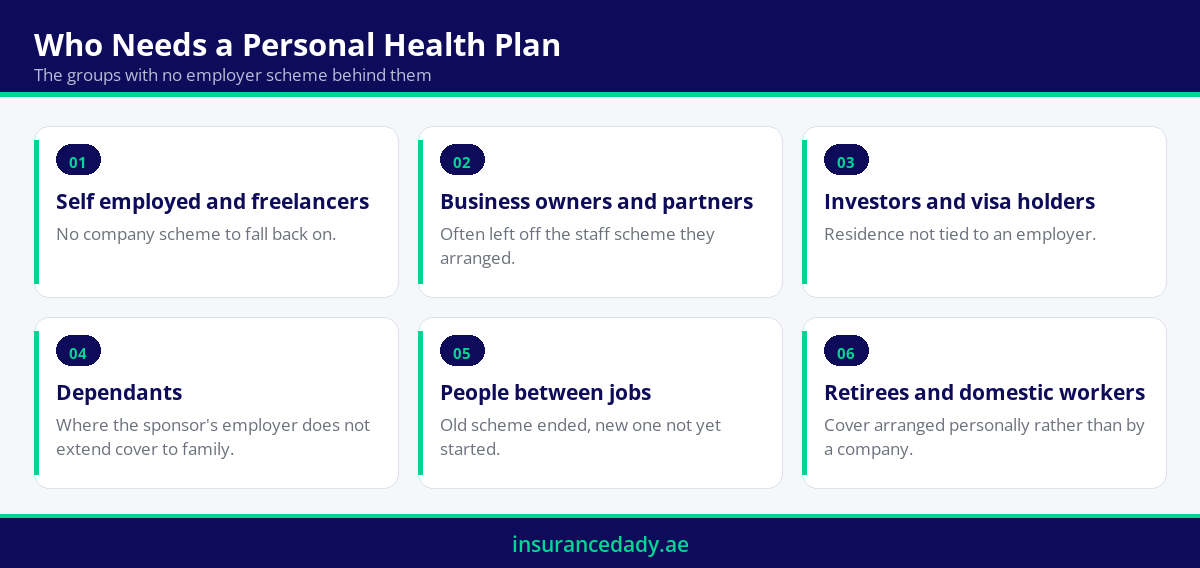
- Self employed people and freelancers, who have no employer scheme to fall back on.
- Business owners and partners, who are often left off the staff scheme they arranged for everyone else.
- Investors and people on a residence visa that is not tied to a job.
- Dependants such as a spouse, children or parents, where the sponsor's employer does not extend cover to family.
- People between jobs, where the previous scheme has ended and the new one has not started.
- Retirees and long term residents who no longer work.
- Domestic workers, where the sponsor arranges the cover personally.
Business owners are the group most often caught out. It is common to arrange a group medical scheme for the team and then discover the owner was never enrolled on it. If that describes you, a personal plan closes the gap.
Timing catches a lot of people out too. Cover on a company scheme typically ends with the employment, and a new employer's scheme may not start on day one. That gap can run for weeks. A short personal plan is the usual way to bridge it.
Individual Cover and Employer Cover Are Not the Same
People often assume a personal plan is simply a smaller version of a company scheme. The differences are worth knowing before you compare quotations.
- Who owns it. Individual plan: you do, it stays with you when your job changes. Employer scheme: the company does, it ends when the employment ends.
- How it is priced. Individual plan: on you, so age and medical history matter more. Employer scheme: on the group as a whole, which spreads the risk.
- Who chooses the benefits. Individual plan: you do, within what the insurer offers. Employer scheme: the employer does, usually by staff category.
- Medical declarations. Individual plan: you will normally be asked about your health history. Employer scheme: often lighter on a larger group, depending on the insurer.
- Renewal. Individual plan: you renew it yourself each year. Employer scheme: the employer renews it, usually on one common date.
None of this makes one better than the other. They simply answer different situations. What matters is that you are covered by one of them rather than neither.
What to Compare Before You Buy
Premium is the easiest thing to compare and the least useful on its own. These are the points that decide what the plan is actually worth to you.
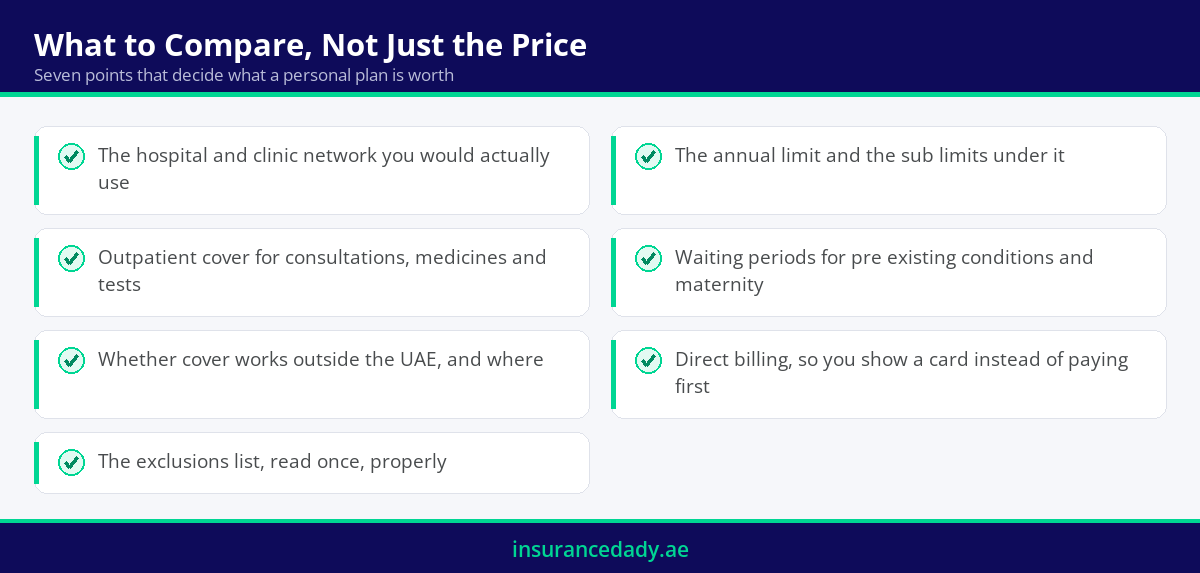
- The hospital and clinic network, and whether the ones you would actually use are on it.
- The annual limit, and any sub limits that sit underneath it for specific benefits.
- Outpatient cover, meaning consultations, medicines and tests, which is what most people use most often.
- Waiting periods, especially for pre existing conditions and maternity.
- Whether cover works outside the UAE, and in which countries.
- Direct billing, so you show a card rather than paying and claiming back.
- The exclusions list, read once, properly, before you sign.
Outpatient cover is the one to look at hardest. Inpatient claims are rare and dramatic. Outpatient claims are small and constant, and they are where a thin plan quietly costs you money every month. Our comparison of individual insurance plans covers how to weigh these against each other.
What Affects the Premium
Insurers price a personal plan on the individual. These are the factors that move the number.
- Your age.
- Your medical history and any declared conditions.
- The level of cover and the annual limit you choose.
- The network tier, since a wider hospital list costs more.
- Whether the plan covers you outside the UAE.
- Any add ons such as maternity, dental or optical, where available.
- The emirate you are resident in.
Age and medical history do most of the work here, and both are covered in more detail further down. Rules and requirements differ between the emirates too, which is why Abu Dhabi medical insurance is worth reading separately if you live there. Wider UAE health information is published on the government portal.
Documents Usually Asked For
A personal medical plan needs less paperwork than most people expect. Requirements vary by insurer, so treat this as a starting point rather than a fixed list.
- Passport copy
- Emirates ID copy
- UAE residence visa copy
- A completed application form
- A short medical declaration, where the insurer asks for one
- Existing policy copy, if you are switching or renewing
Answer the medical declaration honestly and in full. An undisclosed condition is the most common reason a claim runs into trouble later, and it is entirely avoidable. Health insurance sold in Dubai is administered through the Dubai Health Authority, and its requirements are worth confirming for your own emirate.
Why Buying Early Costs Less
Health cover is one of the few products where waiting makes the product worse as well as dearer. Two things change while you wait.
- Age. Premiums generally rise with age, and the increase is built into how the plan is priced rather than being a penalty.
- Medical history. A condition diagnosed before you apply is treated as pre existing, which usually means a waiting period, a sub limit, an exclusion or a loading.
Neither of these can be reversed later. Cover taken out while you are healthy is usually cheaper, quicker to place and broader than the same cover bought after a diagnosis. That is the practical argument for arranging a plan before you think you need one.
The same logic applies to renewals. Letting a plan lapse and restarting it later can mean waiting periods begin again, so continuous cover is generally worth more than a small saving on a single year's premium. Confirm the position with the insurer, because the treatment of continuity differs between plans.
Getting a Quotation
If you are self employed, between jobs, or arranging cover for a family member, it is worth comparing more than one plan before you commit. InsuranceDady can put the options side by side and explain the differences without the jargon. Browse the health insurance range or start a policy enquiry.
Conclusion
Individual medical insurance answers a simple question: if nobody else is arranging your cover, who is? Self employed people, business owners, dependants and anyone between jobs all sit in that gap. A personal plan is priced on you, so it rewards buying early and declaring honestly. Compare the network, the annual limit, the outpatient cover and the waiting periods before you compare the premium, and remember that all cover remains subject to the plan terms, conditions and exclusions. The InsuranceDady team can help you find a plan that matches your situation.
Frequently Asked Questions
What is individual medical insurance?
It is a health insurance plan bought in one person's own name, rather than provided through an employer. You choose the plan, you own it, and it stays with you when your job changes.
Who needs an individual plan in the UAE?
Self employed people, freelancers, business owners left off their own staff scheme, investors, dependants whose sponsor's employer does not cover family, people between jobs, retirees and domestic workers.
Is individual medical insurance more expensive than group cover?
Often, yes. A group scheme spreads risk across a workforce, while a personal plan is priced on you alone. Age and medical history therefore carry more weight on an individual policy.
Can I keep my plan if I change jobs?
An individual plan is in your name, so it is not affected by a change of employer. An employer scheme normally ends with the employment, which is the gap a personal plan is designed to close.
Does an individual plan cover pre existing conditions?
That depends on the insurer, the plan and what you declare. Waiting periods often apply. Declare your history in full, because an undisclosed condition is the most common reason a claim runs into trouble.
What is the difference between inpatient and outpatient cover?
Inpatient cover applies when you are admitted to hospital. Outpatient cover applies to consultations, medicines and tests without admission. Outpatient is what most people use most often.
What documents do I need to buy a personal plan?
Usually a passport copy, Emirates ID, residence visa copy, an application form and a short medical declaration. Insurers differ, so confirm the list before you apply.
Can I add my spouse and children to my plan?
Many insurers allow dependants to be added, sometimes on the same policy and sometimes on separate ones. Ask before you buy, since adding people later can cost more.
Does an individual plan work outside the UAE?
Some plans include cover abroad and some do not. Where it is included, the countries and the limits vary. Check the geographic scope in the plan document if you travel often.
What if I only need short term cover?
Short term and flexible options exist in the market. Our guide to flexi health insurance explains how those plans work and who they suit.