
Buying motor cover in the UAE is not complicated, but it is easy to get wrong in ways you only notice after an accident. Most guides stop at explaining the two cover levels. This one goes further and walks through the practical side: the documents you need, how renewal actually works, whether to choose agency or garage repair, how a no claims discount moves with you, and what happens when you sell the car. If you only want the cover comparison, our complete vehicle insurance guide covers that ground.
Key Takeaways
- Third Party Liability is the mandatory minimum level of motor vehicle insurance in the UAE. Comprehensive cover sits above it and adds protection for your own vehicle.
- Keep the Mulkiya, your driving licence and your Emirates ID together. Almost every motor transaction asks for the same three.
- Agency repair uses the manufacturer's workshop and costs more. Garage repair uses an approved workshop and costs less.
- A no claims discount is earned by not claiming and can usually be carried to a new insurer with proof, subject to their rules.
The Two Levels of Motor Vehicle Insurance
Every motor vehicle insurance policy in the UAE sits at one of two levels. Getting this choice right is the single biggest decision you make, because everything else, including price, follows from it.
- Third Party Liability, usually shortened to TPL. This is the mandatory minimum level of coverage in the UAE.
- Comprehensive cover. This includes third party protection and adds cover for damage to your own vehicle.
The rest of this guide applies to both. Where the two behave differently, it is called out. For a full comparison of the two levels, our post on the benefits of third party liability insurance goes into the detail.
Third Party Liability Cover in Detail
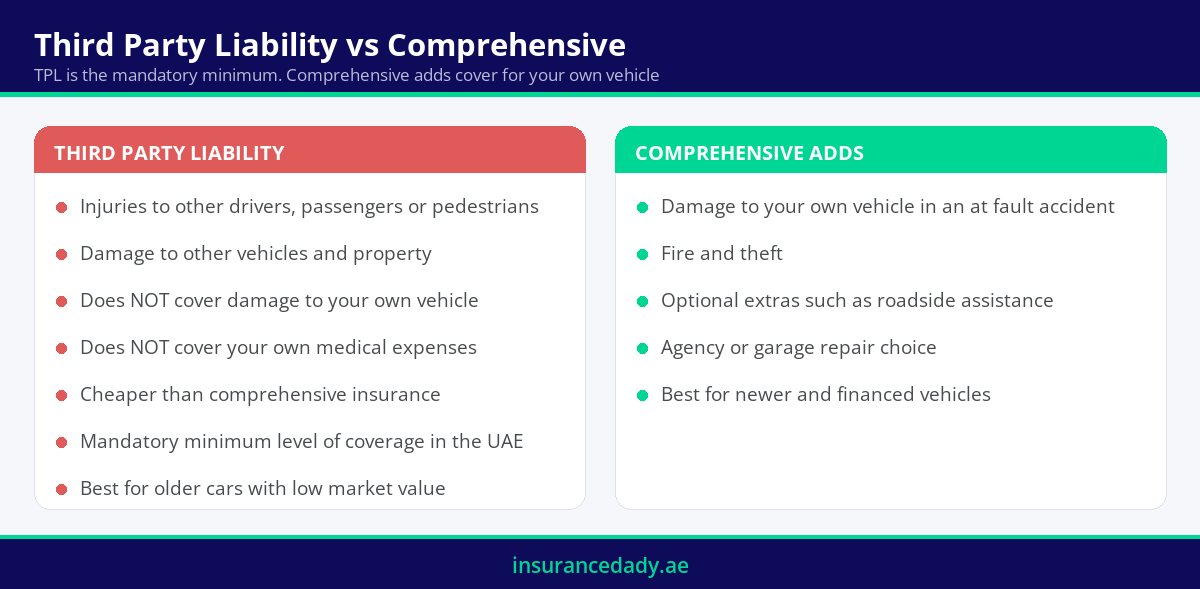
Third Party Liability covers damage and injuries caused to other people, other vehicles or other property in an accident where you are at fault. It does not cover damage to your own car or your own injuries.
What it covers:
- Injuries to other drivers, passengers or pedestrians
- Damage to other vehicles and property
What it does not cover:
- Damage to your own vehicle
- Your own personal medical expenses
TPL is cheaper than comprehensive insurance, and it is the mandatory minimum level of coverage in the UAE. It suits older cars with a low market value, and owners who want to meet the minimum legal requirement without paying for more.
Comprehensive Cover and What It Adds
Comprehensive cover includes everything third party liability does, then adds protection for your own vehicle. In general market practice that means damage to your car in an at fault accident, fire, theft and, depending on the policy, extras such as roadside assistance, a replacement vehicle and personal accident cover.
What is actually included differs between insurers and between policies, and everything remains subject to the policy terms, conditions and exclusions. Comprehensive generally suits newer vehicles, financed vehicles and any car whose replacement cost you could not comfortably absorb yourself.
A simple way to make the choice is to ask what you would do if the car were written off tomorrow and nobody paid you anything. If the honest answer is that you would replace it without much difficulty, third party liability may be enough. If the answer is that it would be a serious problem, comprehensive cover is doing real work for you.
Finance is the other deciding factor. Where a vehicle is on a bank loan or lease, the lender normally requires comprehensive cover for the life of the agreement, so the decision may already be made for you.
Documents You Need to Buy or Renew
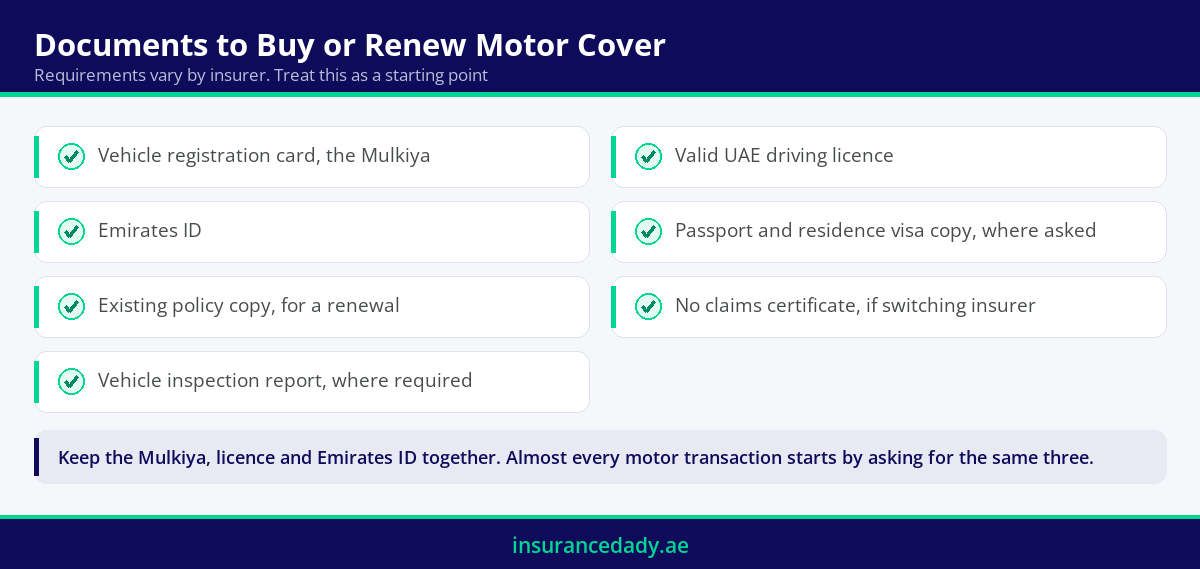
Motor vehicle insurance needs less paperwork than most insurance lines. Requirements vary by insurer, so treat the list below as a starting point rather than a fixed rule.
- Vehicle registration card, known as the Mulkiya
- Valid UAE driving licence
- Emirates ID
- Passport and residence visa copy, where the insurer asks for them
- Existing policy copy, if this is a renewal
- No claims certificate from your previous insurer, if you are switching
- Vehicle inspection report, where one is required
Keep the first three together, either as photos on your phone or as a folder in the glovebox. Almost every motor transaction in the UAE, from renewal to a claim, starts by asking for the same three. Vehicle registration and road rules are administered locally, for example by the Roads and Transport Authority in Dubai.
How Renewal Works and When to Start
A motor vehicle insurance policy runs for thirteen months in the UAE market, which gives a one month grace period on top of the twelve months of cover. That extra month exists to help with registration timing, not as spare driving time on an expired policy.
Start looking two to three weeks before expiry. That is enough time to gather a no claims certificate, get an inspection done if one is needed, and compare more than one quotation without rushing. Leaving it to the last day usually means renewing with the same insurer at whatever price is offered.
If your vehicle is used for business rather than personal travel, check that you are being renewed on the right basis. A private policy on a company vehicle can cause problems at claim stage, which is covered in our guide to commercial vehicle insurance.
What Affects Your Motor Premium
Two drivers with identical cars can be quoted very differently. These are the factors insurers weigh in the UAE market.
- The vehicle. Make, model, age and market value.
- Cover level. Third party liability against comprehensive.
- Repair basis. Agency repair costs more than garage repair.
- Driver age and how long you have held a licence.
- Claims history, and whether you hold a no claims discount.
- How the vehicle is used, whether personal or commercial.
- The emirate you are registered in.
- Any add ons, such as roadside assistance, off road cover or a replacement vehicle.
Two of these are worth pausing on. Declared use is the one that causes disputes, because a vehicle insured for personal use and then used commercially can run into difficulty at claim stage. Add ons are the one that quietly inflates a quotation, so check whether you are paying for cover you would never use.
Agency Repair or Garage Repair
On a comprehensive policy you will be asked to choose between agency repair and garage repair. The difference is simple and it changes your premium.
- Where the car is fixed. Agency repair: The manufacturer's authorised workshop. Garage repair: A workshop from the insurer's approved list.
- Parts used. Agency repair: Manufacturer supplied parts. Garage repair: Approved parts, which may not be manufacturer supplied.
- Cost. Agency repair: Higher premium. Garage repair: Lower premium.
- Usually chosen for. Agency repair: New cars, and cars still under manufacturer warranty. Garage repair: Older cars where the repair standard matters less than the price.
The usual rule of thumb is that a car under warranty should stay on agency repair, because using a non approved workshop can affect the warranty. After the warranty ends, garage repair is often the better value. Availability of either option depends on the insurer and the age of the vehicle.
No Claims Discount and How to Keep It
A no claims discount, often shortened to NCD, is a reduction in premium earned by going a full policy year without making a claim. It builds up over consecutive claim free years, subject to each insurer's own scale.
- It is earned by not claiming, not by driving carefully in the abstract. One claim usually resets or reduces it.
- It can normally be carried to a new insurer, but you have to prove it with a no claims certificate from the previous one.
- Ask for that certificate before you cancel or let a policy lapse, because it is harder to obtain afterwards.
For a very small repair, it is worth asking what the claim would cost you in lost discount over the next few years before you file it. Sometimes paying for a minor scratch yourself works out cheaper.
One more detail. A no claims discount usually belongs to the driver rather than to the car, so it normally survives changing vehicles. It does not usually survive a long gap in cover, which is another reason to renew before a policy lapses rather than afterwards. Each insurer applies its own rules, so confirm the position before you rely on it.
Selling or Transferring the Vehicle
When you sell a car, the policy does not simply move to the buyer. You normally have two options, and both depend on the insurer's own rules.
- Cancel the policy and ask for a refund of the unused premium, where the insurer allows it.
- Transfer the cover to your replacement vehicle, which is often simpler if you are buying another car straight away.
Tell the insurer before the sale rather than after. Cover that stays in your name on a car you no longer own is a problem waiting to happen.
Timing is the part people get wrong. Ownership transfer and insurance cancellation are separate steps, and they do not happen automatically because a sale went through. Until the insurer is told, the policy is still yours, and so is anything that happens under it.
If you are buying rather than selling, do not assume the seller's cover comes with the car. It does not. Arrange your own policy before you drive it away, because the moment the registration changes hands you are the one who needs to be insured. Vehicle registration and ownership transfer procedures are published through the official UAE government platform.
Driving Outside the UAE
A UAE motor policy does not automatically cover you in neighbouring countries. If you plan to drive into Oman or elsewhere in the GCC, ask your insurer about a cross border extension before you travel. Where available, it is added as an endorsement and usually carries an extra premium. Regional travel information is published on the UAE government portal.
Add Ons Worth Understanding
Comprehensive quotations usually come with a list of optional extras. Some are genuinely useful and some are quietly padding the price. These are the ones asked about most often. Availability and wording differ by insurer.
- Roadside assistance. Recovery, jump starts and flat tyre help. Cheap, and used more often than most drivers expect.
- Replacement vehicle. A car while yours is being repaired. Worth it if you have no second vehicle.
- Off road cover. Desert driving is normally excluded on a standard policy, so this matters if you actually go.
- Personal accident cover. Benefits for the driver or passengers after an accident, subject to the policy.
- Windscreen cover. Often available without affecting your no claims discount, which is the point of it.
- Cross border extension. Cover when driving into Oman or the wider GCC, where the insurer offers it.
Look at this list against how you actually drive. Off road cover on a car that never leaves the city is money spent for nothing, and windscreen cover on a car doing long highway runs usually pays for itself. All of these remain subject to the policy terms, conditions and exclusions.
What to Do After an Accident
Motor vehicle insurance claims are usually straightforward if the first hour is handled properly.
- Make sure nobody is injured and move to safety where it is possible to do so.
- Report the accident to the police and obtain the report, because insurers normally require it.
- Photograph the damage, the position of the vehicles and the other vehicle's plate.
- Exchange details with the other driver, including their insurance details.
- Notify your insurer as soon as you can, and within any time limit set out in your policy.
- Take the vehicle to the workshop your insurer directs you to, rather than one of your own choosing.
The police report is the document everything else hangs on. Without it, a claim becomes much harder to settle, no matter how clear the fault was.
One last point on timing. Policies set a period within which a claim has to be notified, and it is usually short. Even if you have not decided whether to claim, telling your insurer that an incident happened protects your position. It costs nothing and it keeps the option open.
Getting a Quotation
Whether you are insuring a first car, renewing an existing policy or moving a vehicle onto a business policy, it is worth comparing before you commit. InsuranceDady can put motor quotations side by side and explain what each one actually includes. Browse the motor insurance range or start a policy enquiry.
Conclusion
Motor vehicle insurance in the UAE comes down to a handful of decisions. Pick the cover level that matches what you could afford to lose. Keep the Mulkiya, licence and Emirates ID together. Start your renewal a few weeks early. Choose agency or garage repair based on the age of the car rather than habit, and protect your no claims discount by thinking twice before filing a very small claim. All cover remains subject to the policy terms, conditions and exclusions that apply. If you would like help comparing options, the InsuranceDady team is ready to walk you through them.
Frequently Asked Questions
What is the minimum motor vehicle insurance in the UAE?
Third Party Liability is the mandatory minimum level of coverage. It covers damage and injuries you cause to other people, vehicles and property, but not damage to your own car or your own injuries.
What documents do I need to insure a car in the UAE?
Usually the Mulkiya, a valid UAE driving licence and your Emirates ID, plus a passport and visa copy where asked, an existing policy for renewals and a no claims certificate if you are switching insurer.
What is a Mulkiya?
It is the vehicle registration card issued for a car in the UAE. It shows the vehicle details and the registered owner, and it is required for almost every motor insurance transaction.
What is the difference between agency and garage repair?
Agency repair uses the manufacturer's authorised workshop and manufacturer parts, and costs more. Garage repair uses a workshop from the insurer's approved list and costs less.
When should I renew my motor policy?
Two to three weeks before expiry. That leaves time to obtain a no claims certificate, arrange an inspection if one is needed, and compare more than one quotation without rushing the decision.
Can I transfer my no claims discount to a new insurer?
Usually yes, with a no claims certificate from your previous insurer as proof. Request it before you cancel or let the old policy lapse, because it is harder to obtain afterwards.
Does my UAE policy cover me in Oman or the rest of the GCC?
Not automatically. Ask your insurer about a cross border extension before you travel. Where it is available it is added as an endorsement and normally carries an extra premium.
What happens to my policy when I sell my car?
You can normally either cancel and request a refund of the unused premium, or transfer the cover to your replacement vehicle. Tell the insurer before the sale, not after.
Do I need a police report to make a claim?
In almost all cases yes. Insurers normally require the police report, and a claim becomes much harder to settle without it, regardless of how clear the fault was.
Is a private policy enough for a company vehicle?
Usually not. A vehicle used for business should be insured on the right basis. Our truck insurance guide explains how commercial cover differs.