
Most complaints about travel cover are really complaints about travel insurance exclusions that nobody read before departure. The policy did what it promised. The traveller simply expected it to do something else. For residents of Abu Dhabi, Sharjah, Ajman and Ras Al Khaimah who travel several times a year, understanding these gaps is worth more than shaving a small amount off the premium. This guide walks through the exclusions that generate the most refused claims and explains what to do about each one.
Key Takeaways
- Pre existing medical conditions are excluded by default on almost every policy sold.
- Cash, documents and high value items carry separate limits that are far lower than the headline baggage figure.
- Cancellation cover only responds to listed reasons, and changing your mind is never one of them.
- Most exclusions can be removed by declaring the risk and paying a modest additional premium.
Why exclusions exist at all
An exclusion is not a trick. It is the mechanism that keeps a travel policy affordable enough to be worth buying in the first place.
Travel insurance is priced on the assumption that most trips pass without incident and that the insurer is covering sudden, unexpected events. Anything predictable, anything already happening and anything within the traveller's control gets carved out, because covering it would mean charging every traveller for a certainty rather than a risk. Once you read the policy through that lens, most exclusions stop looking arbitrary.
The important consequence is that nearly every exclusion has a price. Insurers will cover declared medical conditions, named valuables and listed activities if you tell them in advance and pay for it. The gap almost always exists because nobody asked, not because the cover was unavailable. Our complete guide for travellers explains what the core benefits include before these carve outs apply.
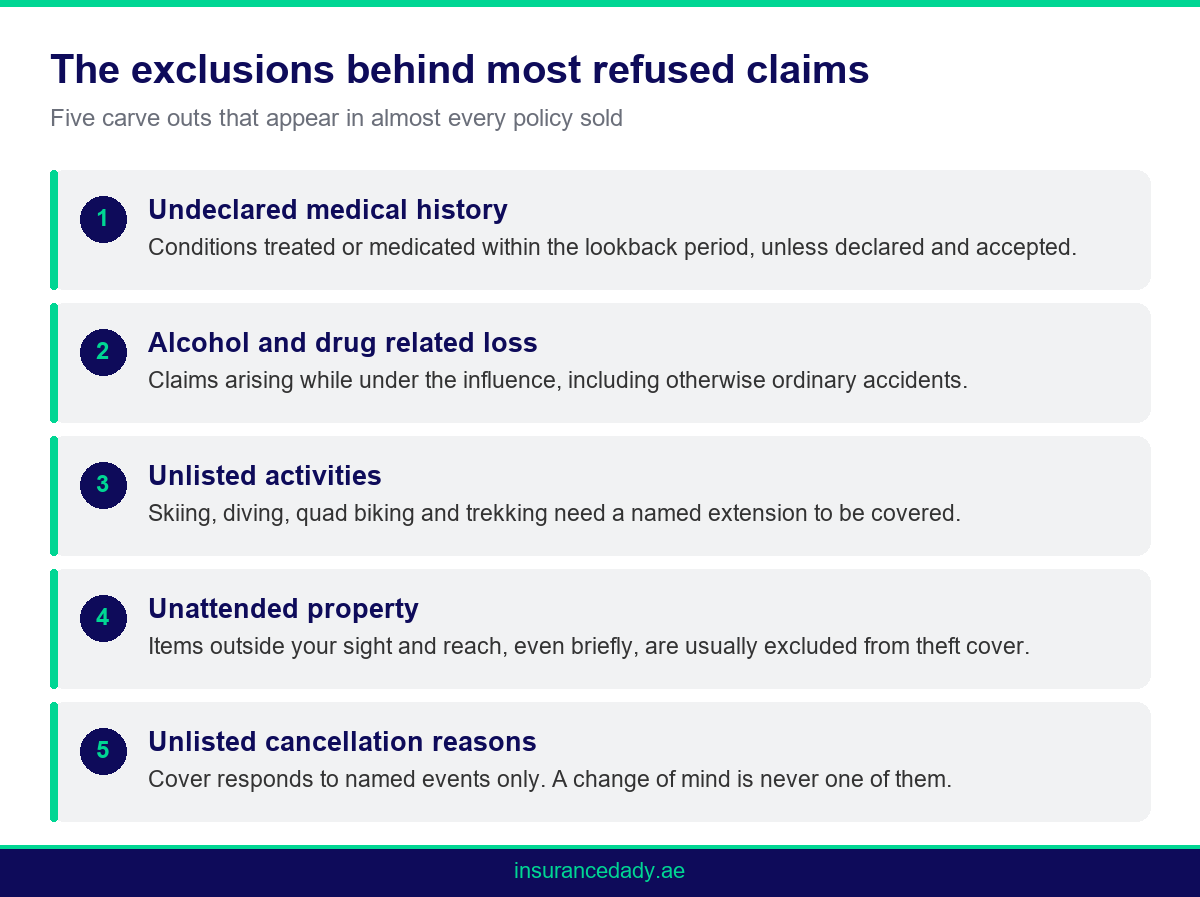
Pre existing medical conditions
This is the largest single cause of refused medical claims abroad, and the definition is far wider than most travellers assume.
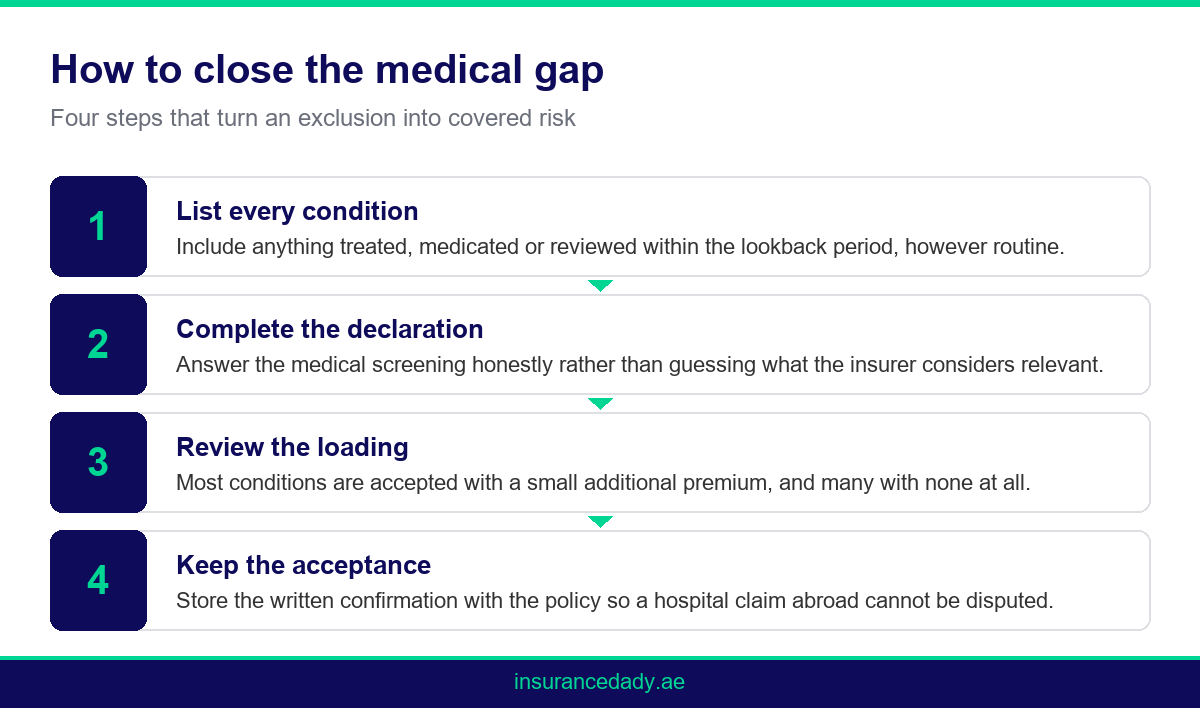
A pre existing condition is generally anything you have received advice, treatment or medication for within a defined period before travel, commonly twelve or twenty four months. That captures managed conditions such as blood pressure or diabetes, not just serious illness. If a hospital abroad treats you for something connected to an undeclared condition, the insurer can decline the entire claim, including costs that look unrelated at first glance.
Declaring changes the outcome rather than the price alone. Most conditions are accepted with a modest loading, and some are accepted with no increase. Refusing to declare saves a small amount and risks the whole benefit. Anything routine, ongoing or planned belongs with your resident medical plans, which are built for continuing care rather than emergencies away from home.
Behaviour, alcohol and risky activity
Policies exclude losses that follow from the traveller's own conduct, and these clauses are applied more strictly than people expect.
Claims arising while under the influence of alcohol or drugs are routinely declined, including accidents that would otherwise be straightforward. So are injuries sustained during activities the policy does not list. Skiing, diving, quad biking, motorcycling and trekking above certain altitudes all need a named extension. A family trip that includes one afternoon of watersports can sit entirely outside the policy for that afternoon.
Unattended property is the other behavioural exclusion. A bag left beside a chair while you order coffee is unattended for policy purposes, and the claim will usually fail. The test is whether the item was within your sight and reach, not whether you were nearby. Read the activity list before booking anything more energetic than sightseeing.
Motor related exclusions deserve their own check. Hiring a car or a scooter abroad is common on European and regional trips, and travel policies almost never cover damage to the hired vehicle or liability arising from driving it. That sits with the rental company's own cover or a separate excess waiver. Riding a motorcycle without the correct licence class voids the personal accident benefit as well, which turns a holiday injury into an entirely uninsured event.
Baggage, valuables and documents
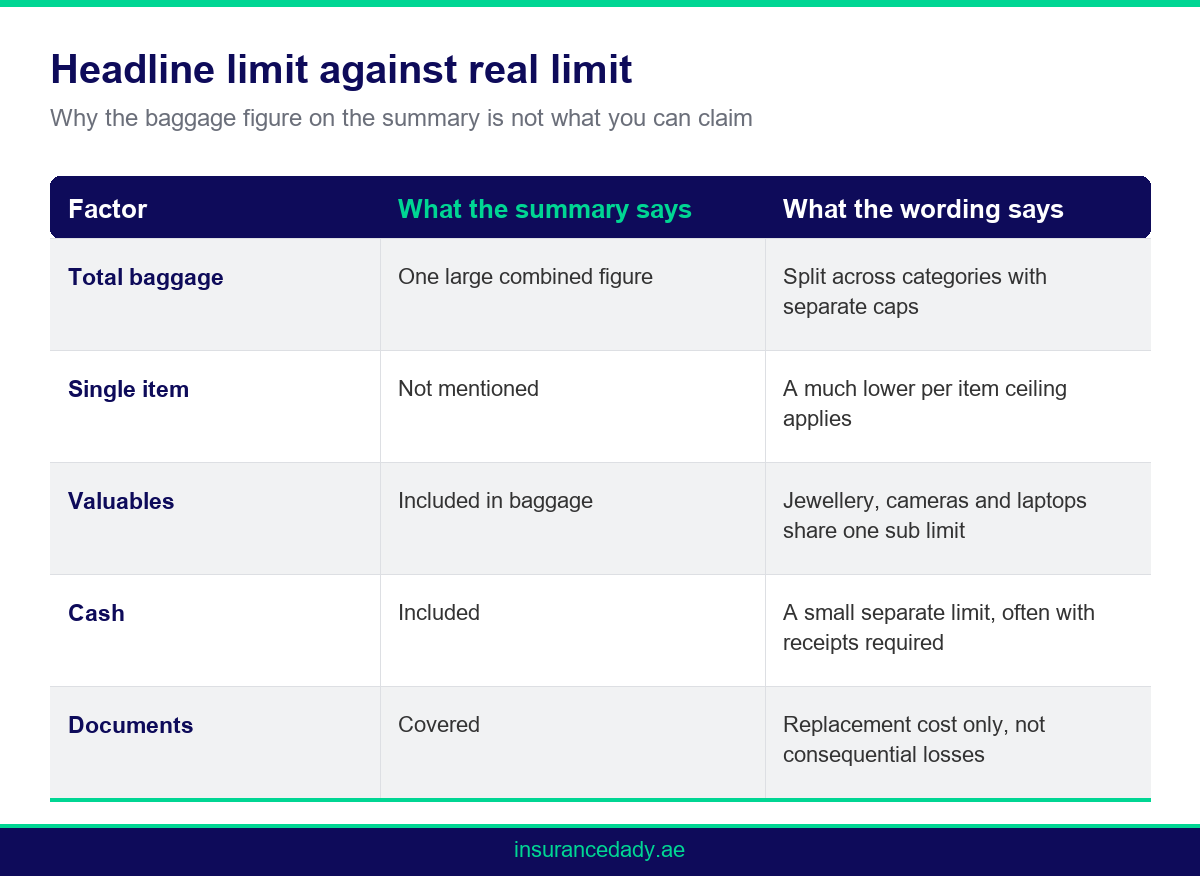
The headline baggage figure on a policy summary is almost never the amount you can actually claim for a single item.
Inside that total sit per item limits, per category limits and a separate valuables sub limit that often covers jewellery, cameras and laptops together. A traveller from Sharjah who loses a laptop and a watch may find both fall under one modest ceiling. Cash limits are lower still, and lost travel documents are usually covered only for replacement costs rather than consequential losses.
Two practical steps close most of this gap. Declare high value items individually so they are insured at their real worth, and report any theft to local police immediately, because a report is a condition of payment rather than a formality. Traffic and policing procedures across the emirates are coordinated through the Ministry of Interior, and equivalent local reporting applies abroad. For property at home rather than in transit, see cover for stolen property.
Cancellation and disruption
Cancellation cover is a list, not a promise. It responds to specified events and to nothing outside that list.
Typical covered reasons include serious illness, injury, death of a close relative, jury service and certain emergency work situations. Changing your mind, a visa refusal on an unrelated application, a business decision or a cheaper option appearing later are all excluded. Disruption caused by an airline going out of business is often excluded unless scheduled airline failure is specifically named.
Weather and natural events sit in a grey area. Delays caused by conditions that were already forecast when you booked are frequently excluded, which is why insurers check the timeline closely. Forecast and warning information issued by the National Centre of Meteorology is a matter of public record, and equivalent services exist at most destinations. Book cover as soon as the trip is paid for, because cancellation protection only works for events that arise after purchase.
Curtailment is the benefit travellers forget entirely. It covers returning home early for a listed reason and is calculated on the unused portion of the trip, not the full amount paid. Travellers who cut a trip short for a family emergency are often surprised by how little comes back. Keep every booking confirmation and receipt, because the insurer calculates the refund from documents rather than from what you say you spent.
Reading your policy before you fly
Twenty minutes with the wording removes almost every unpleasant surprise, and the sections worth reading are shorter than the document suggests.
Start with the definitions, because that is where pre existing condition, unattended and close relative are given precise meanings. Move to the general exclusions, which apply across every benefit. Then read the sub limits table rather than the headline summary. Finally, check the territorial limits and the maximum trip duration if you hold an annual policy.
Households in the capital and the Northern Emirates often hold several policies bought at different times from different sources, which creates both overlaps and gaps. Reviewing them together at one renewal date is more useful than optimising any single premium. You can compare options with us on that basis, and our wider general insurance range can be looked at in the same conversation.
Conclusion
Travel cover fails travellers far less often than travellers fail to read it. Almost every gap described here can be closed by declaring a condition, naming a valuable item, adding an activity extension or simply buying the policy earlier in the booking process. Residents of Abu Dhabi, Sharjah, Ajman and Ras Al Khaimah who travel regularly should treat the wording as part of the trip planning rather than paperwork to file away. Speak to Insurance Dady and we will walk through the exclusions on any policy you are considering before you commit to it.
Frequently Asked Questions
Q1: What counts as a pre existing medical condition?
Anything you have had advice, treatment or medication for within the policy's stated lookback period, often twelve or twenty four months. Managed conditions such as blood pressure are included.
Q2: Will declaring a condition make cover unaffordable?
Usually not. Most conditions attract a modest loading and some attract none. Declaring protects the entire claim, while staying silent risks the insurer declining it completely.
Q3: Is baggage covered for its full value?
Rarely. Per item and valuables sub limits sit beneath the headline figure. High value possessions need to be declared individually to be insured at what they are actually worth.
Q4: Does the policy pay if a bag is left briefly unattended?
Normally no. Unattended means outside your sight and reach, even for a moment. This clause causes a large share of refused theft claims at airports and cafes.
Q5: Are winter sports and diving included?
Not on a standard policy. Skiing, diving, quad biking and similar activities require a named extension. Without it, injuries during those activities fall outside the cover entirely.
Q6: Can I claim if I simply decide not to travel?
No. Cancellation responds only to listed events such as serious illness or bereavement. Changing plans, work decisions and finding a cheaper trip are never covered reasons.
Q7: What if an airline stops operating?
Only if scheduled airline failure is specifically named in the policy. Many standard policies exclude it, so check the wording before booking with a smaller carrier.
Q8: Does travel cover help with treatment after I return home?
Generally no. Travel policies handle the emergency abroad and repatriation. Continuing treatment at home is the job of your resident health plan instead.
Q9: When should cancellation cover be bought?
As soon as the trip is paid for. Protection only applies to events arising after purchase, so buying later leaves the earliest commitments unprotected. See https://www.insurancedady.ae/about
Q10: How do I check my own policy quickly?
Read the definitions, the general exclusions and the sub limits table. Those three sections contain almost every gap that matters. See https://www.insurancedady.ae/services