
Medical malpractice insurance, also known as professional medical indemnity insurance, protects doctors, healthcare professionals, clinics and hospitals against legal claims arising from medical negligence, errors, omissions or a failure to provide the accepted standard of care. For anyone licensed to treat patients in the UAE, it is the policy that stands between a clinical allegation and a personal financial exposure. This guide covers what the policy responds to, what it excludes, how limits of indemnity are set and exactly which documents you need to get quoted.
Key Takeaways
- Medical malpractice insurance covers the provider's legal exposure when a patient alleges harm. It is not health insurance, which covers the patient's own treatment costs.
- Cover typically extends to professional negligence, legal defence costs, court awards and settlements, wrong diagnosis, surgical errors and medication errors, all subject to policy terms.
- Individual practitioners and licensed facilities are quoted on different document sets, and both need a valid licence from DHA, DOH, MOHAP or the relevant authority.
Medical Malpractice Insurance Is Not Health Insurance
This distinction causes the most confusion, and it is worth settling before anything else. The two policies point in opposite directions.
Health insurance covers a patient's own medical costs. When a patient needs treatment, their health policy pays the provider. Medical malpractice insurance covers the legal and financial exposure a healthcare provider faces if a patient alleges that treatment caused them harm. One protects the person receiving care, the other protects the person delivering it.
That difference matters commercially as well as conceptually. A clinic that has arranged group medical insurance for its employees has covered its staff as patients. It has not covered itself against a claim brought by someone those staff treated. The two policies sit side by side and neither substitutes for the other.
Who May Need Medical Malpractice Insurance
Malpractice exposure follows clinical responsibility rather than job title, so the list extends beyond doctors alone. Anyone whose professional judgement or technique can affect a patient outcome carries some degree of exposure.
Individual Practitioners
- Doctors
- Dentists
- Surgeons
- Nurses
- Pharmacists
- Physiotherapists
- Radiologists
- Laboratory technicians
- Allied healthcare professionals
Licensed Facilities
- Medical clinics
- Hospitals
- Diagnostic centres
- Day surgery centres
Facilities and the practitioners inside them are usually insured under separate arrangements, as our Dubai medical insurance guide also notes, and a doctor should not assume that a clinic policy extends to them personally. Whether it does depends on how the facility's policy is written and who is named on it, which is a question worth asking directly rather than inferring.
What the Policy Can Help Cover
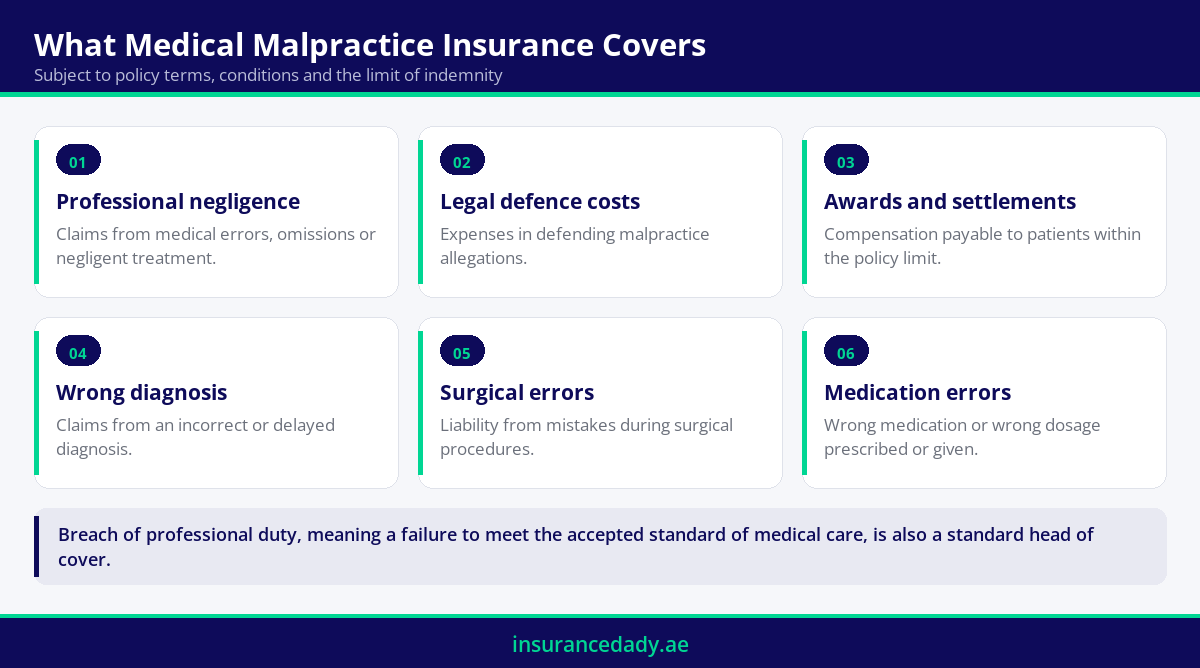
The heads of cover below are the ones a medical malpractice insurance policy commonly responds to. Each is subject to the policy terms, conditions and the limit of indemnity selected.
- **Professional negligence.** Claims arising from medical errors, omissions or negligent treatment.
- **Legal defence costs.** Expenses incurred in defending malpractice allegations, subject to the policy.
- **Court awards and settlements.** Compensation payable to patients, subject to the policy limit and terms.
- **Wrong diagnosis.** Claims arising from an incorrect or delayed diagnosis.
- **Surgical errors.** Liability arising from mistakes during surgical procedures.
- **Medication errors.** Claims arising from prescribing or administering the wrong medication or dosage.
- **Breach of professional duty.** Failure to meet the accepted standard of medical care.
Why Defence Costs Matter as Much as Awards
Practitioners tend to focus on the compensation figure, but legal defence costs are the head of cover that engages first and engages most often. An allegation has to be answered whether or not it is ultimately upheld, and answering it involves legal representation, expert clinical opinion and time. A policy that responds to defence costs lets a practitioner contest a claim properly rather than settle because contesting is unaffordable.
How Malpractice Exposure Differs From Other Business Risks
Most commercial insurance responds to events. A fire happens, a vehicle is damaged, a shipment is lost. Malpractice exposure behaves differently, because the trigger is an allegation rather than an incident, and the allegation can arrive well after the treatment it concerns.
That has two practical consequences for a healthcare provider. First, continuity of cover matters more than it does for property risks, because a gap in cover is not simply a gap in time. The second is that clinical record keeping is part of your insurance position, not just your regulatory one. Contemporaneous notes are what allow a defence to be built years later, and their absence is felt most acutely in exactly the cases where they are needed.
The limit is the number that determines how much protection you actually hold, and it deserves more thought than it usually gets. The instinct is to price several limits and pick the cheapest that feels responsible. A better approach is to work backwards from exposure.
Common Exclusions
Malpractice policies respond to clinical error, not to conduct that falls outside professional practice altogether. The exclusions below reflect that boundary.
- Criminal or fraudulent acts
- Intentional misconduct
- Cosmetic procedures, unless specifically covered
- Practising without a valid medical licence
- Contractual liabilities
- Cyber incidents, unless separately insured
- War, terrorism and nuclear risks
The Licence Exclusion Is the One to Watch
Practising without a valid medical licence is excluded, which makes licence renewal an insurance matter, not just a regulatory one. A lapse between a licence expiring and being renewed can leave treatment delivered in that window outside the policy. Practitioners who move between emirates or employers should be particularly careful, because the licensing authority may change with the move.
Cosmetic procedures are excluded unless specifically covered, which matters to any practice that has expanded into aesthetic work alongside its core speciality. Cyber incidents are excluded unless separately insured, which is increasingly relevant to clinics holding large volumes of patient data. Neither is uninsurable, but both usually need to be arranged deliberately.
Two standard exclusions have become far more relevant to UAE healthcare providers than when the wording was first drafted, and both warrant a deliberate decision rather than a default.
Working Across Multiple Emirates
Healthcare in the UAE is regulated at both federal and emirate level, as the UAE health and fitness services overview sets out. Different authorities administer licensing depending on where you practise, with the Dubai Health Authority, the Department of Health Abu Dhabi, and the Ministry of Health and Prevention each licensing practitioners and facilities within their remit. The insurance regulator oversees wider UAE insurance.
For a practitioner who works in more than one emirate, or who moves between employers, this creates a practical insurance question. The licence exclusion means cover depends on holding a valid licence for the work being performed, so a practitioner licensed in one emirate should confirm the position before treating patients under a different authority. It is worth raising this explicitly at quotation stage rather than assuming a single arrangement follows you everywhere.
Cosmetic Procedures
Cosmetic procedures are excluded unless specifically covered. The difficulty is that the boundary between clinical and cosmetic work has blurred in practice. Dermatology, dentistry, and plastic surgery practices frequently deliver both, and a practitioner who added an aesthetic service line after arranging cover may be operating on the wrong side of an exclusion without noticing. Reviewing your actual service list against the policy wording is the check that catches this.
Cyber Incidents
Cyber incidents are excluded unless separately insured. Clinics hold large volumes of sensitive patient data and increasingly run appointment systems, imaging and records digitally. An incident affecting those systems is not a clinical error, so a malpractice policy is not the instrument designed to respond to it. Providers carrying meaningful patient data should treat this as a separate conversation rather than assuming their existing cover reaches it.
Typical Limits of Indemnity
The limit of indemnity is the maximum the policy will pay, and it is the single largest driver of both protection and premium. Limits vary depending on specialty, risk profile and insurer, but the levels below are the ones commonly requested in the UAE.
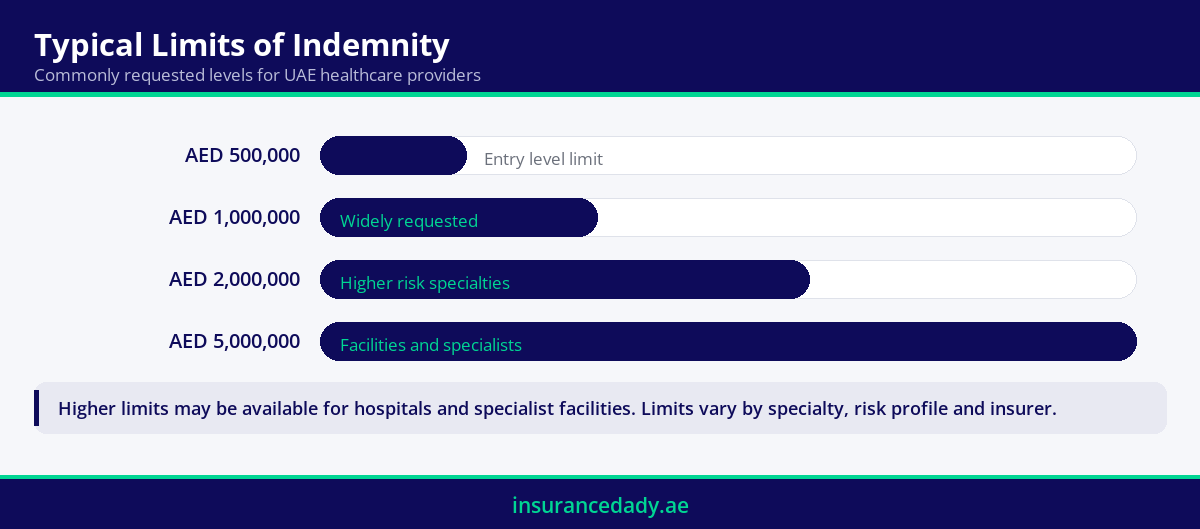
Higher limits may be available for hospitals and specialist medical facilities, depending on the insurer and the applicant's requirements. Choosing a limit is a judgement about the worst realistic claim your speciality could generate, not about the average one, because the average claim never tests the ceiling.
Think About Severity, Not Frequency
Most specialities generate few claims. The limit is not there for the typical case; it is there for the outlier. The question to ask is what the most serious realistic allegation in your speciality would look like, and whether the limit you are considering would still be standing at the end of it once defence costs are taken into account.
Consider Who Else Sets the Number
Practitioners do not always choose freely. Employers, facilities and regulators may each specify a minimum limit as a condition of employment, admitting privileges or licensing. Where more than one requirement applies, the highest governs. Confirm those requirements before you approach the market to avoid buying a limit twice.
Scale With the Practice, Not Just the Premium
A limit chosen when a clinic had three doctors and one speciality is unlikely to still be right after it has grown to twelve doctors across four specialities. Reviewing the limit at renewal against the practice's current shape is a small piece of housekeeping that prevents a large gap from opening quietly over several years.
What Affects the Premium
Malpractice pricing is speciality-driven, in a way that has no real equivalent in general insurance. Two practitioners with identical experience and identical claims records can be rated very differently if one is a general physician and the other is an obstetric surgeon, because the severity profile of their potential claims is not comparable.
- Medical speciality and associated risk
- Years of experience
- Claims history
- Selected limit of indemnity
- Scope of medical services
- Annual turnover, for clinics and hospitals
- Number of healthcare professionals covered
For facilities, the last three factors dominate. Turnover, service scope, and headcount together describe how much clinical activity the policy is backing, which is why a growing clinic should expect its premium to move with its activity even if nothing else changes.
Speciality Risk in Practice
Medical speciality and its associated risk sits at the top of the list of factors affecting the premium, and it is worth understanding why it carries so much weight.
Severity, not frequency, drives it. Specialities involving invasive procedures, irreversible outcomes, or the care of patients with limited capacity to recover from an error generate a small number of potential claims with a very high ceiling. Specialties that are largely diagnostic or advisory carry a different profile, where errors are more often correctable before serious harm occurs.
This is also why scope of medical services is asked for separately from specialty. A practitioner whose registered specialty suggests one risk profile but who performs a narrower or broader range of procedures in practice will be priced on what they actually do, provided the submission makes that clear. Being precise about scope is one of the few genuine levers available at quotation stage.
Documents for Individual Healthcare Professionals
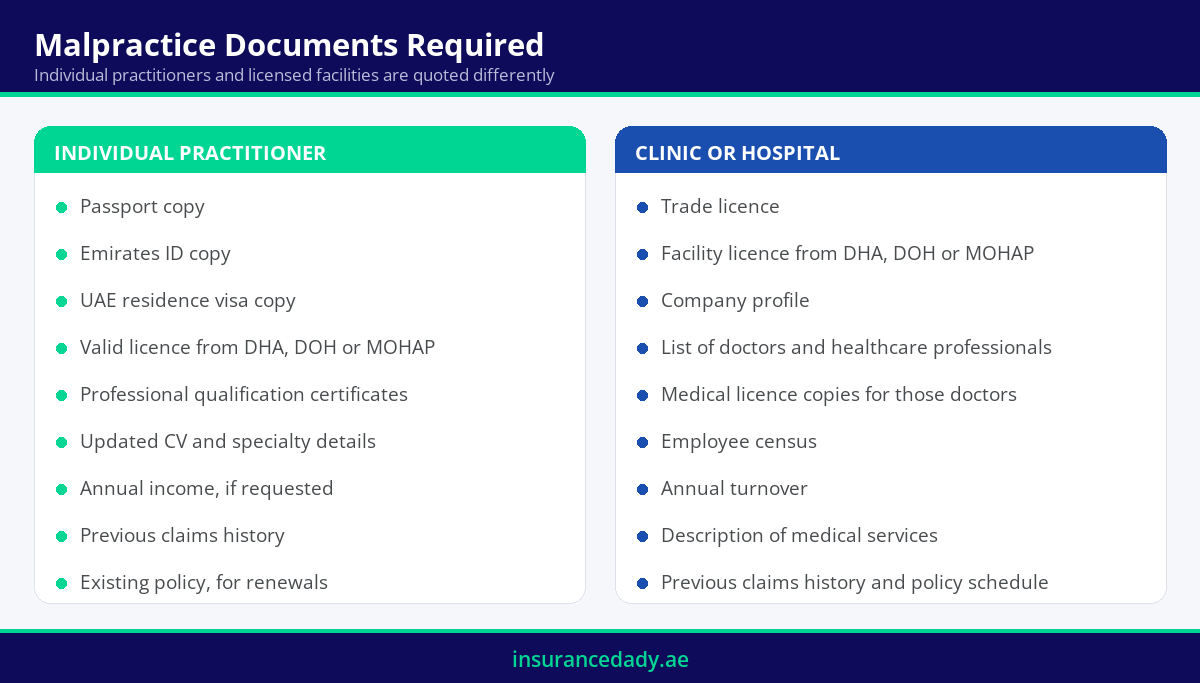
An individual practitioner is quoted on identity, licensing, qualification and history. The set below is what insurers generally ask for.
- Passport copy
- Emirates ID copy
- UAE residence visa copy
- Valid medical licence from DHA, DOH, MOHAP or the relevant authority
- Professional qualification certificates
- Updated CV or work experience record
- Speciality details
- Annual income, if requested
- Previous claims history
- Existing insurance policy, for renewals
The licence copy does most of the work. Practitioners licensed through the Dubai Health Authority, the Department of Health Abu Dhabi or the Ministry of Health and Prevention should supply the current certificate rather than an expired one, since the licence establishes both the right to practise and the scope being insured.
Documents for Clinics and Hospitals
A facility is quoted on its licence, its people and its volume. The submission is larger because the insurer is underwriting an organisation rather than an individual.
- Trade licence
- Facility licence from DHA, DOH, MOHAP or the relevant authority
- Company profile
- List of doctors and healthcare professionals
- Medical licence copies for those doctors
- Employee census
- Annual turnover
- Description of medical services
- Previous claims history
- Existing policy schedule, for renewals
The list of practitioners and their individual licence copies most often delays a facility submission because it must be current at the time of quotation. Clinics that maintain a licence register rather than assembling one at renewal move through the process much faster.
What Insurers May Ask For
Beyond documents, underwriters ask questions designed to size the clinical exposure. Preparing honest answers to these in advance tends to produce a cleaner quotation than answering them under time pressure.
- Medical specialty
- Years of professional experience
- Qualifications
- Number of patients treated annually
- Surgical procedures performed
- Previous malpractice claims
- Required limit of indemnity
Previous malpractice claims is the question practitioners are most tempted to soften. Disclosing a prior claim generally affects pricing. Failing to disclose one can affect whether a future claim is met at all, which is a materially worse outcome.
Preparing a Submission That Prices Well
Two practitioners with identical clinical profiles can receive materially different quotations based purely on how they present their submission. Underwriters price uncertainty, and a submission that answers questions before they are asked removes some of it.
Be Specific About Scope
Scope of medical services is one of the stated rating factors, and vagueness here works against you. A submission that says general practice invites an underwriter to assume the widest possible reading. One that sets out the procedures actually performed, and equally importantly those not performed, is priced against reality rather than against a worst case.
Disclose Claims History Fully
Previous malpractice claims are on the list of information insurers ask for, and a prior claim is not automatically disqualifying. Insurers are accustomed to seeing them, and a claim that was defended successfully tells a different story from one that settled. What damages a position is discovering an undisclosed claim, because that undermines the reliability of everything else on the form.
Keep the Licence Register Current
For facilities, the practitioner list with matching licence copies is the single biggest source of delay. Clinics that maintain this register continuously, rather than assembling it in the fortnight before renewal, consistently move through the process faster and avoid the risk of a lapse being discovered at the worst possible moment.
A Complaint Is Not Yet a Claim
Healthcare providers often encounter patient dissatisfaction long before anything resembling a legal claim appears, and how they handle that early stage matters.
A complaint raised directly with a clinic, or through a licensing authority's own complaints process, is not the same thing as a malpractice claim. Many are resolved through explanation, a review of the treatment, or a straightforward conversation. Treating every expression of dissatisfaction as litigation would be disproportionate and would unnecessarily damage the relationship.
At the same time, a complaint that alleges harm is worth taking seriously from the outset. Preserve the clinical records as they stand rather than supplementing them after the fact, avoid informal admissions before the position is understood, and speak to your broker or insurer about how and when a matter should be notified under your policy. Notification requirements vary between wordings, and finding out what yours says before you need it is considerably easier than afterwards.
Renewal and Continuity
Because malpractice claims can surface long after the treatment in question, protecting the continuity of your insurance history is worth it. Allowing a policy to lapse between renewals, or switching insurer without checking how the new policy treats your earlier work, are the two ways practitioners most often create a gap without intending to.
At each renewal, review the same three things: whether your specialty or scope of services has changed, whether your limit still matches the practice, and whether your licence and those of any practitioners you are responsible for remain current. InsuranceDady can help you compare renewal options across insurers so you can choose based on cover as well as price, subject to underwriting and policy terms.
Requesting a Quotation
Whether you are an individual practitioner or a facility with multiple doctors, having the right documents ready speeds up the quotation process considerably. The variables that most change the outcome are your specialty, your chosen limit of indemnity and your claims history, so it is worth being clear on all three before approaching the market.
InsuranceDady can help you prepare the checklist above and compare options across insurers, subject to underwriting and policy terms. You can review our wider medical, SME and corporate insurance guide or start a policy enquiry directly.
Conclusion
Medical malpractice insurance protects the healthcare provider rather than the patient, responding to negligence claims, defence costs, awards and settlements within the limit of indemnity you select. The exclusions that matter most in practice are the licence condition, cosmetic procedures and cyber, so check all three against how you actually practise. Not sure which policy fits your situation? The InsuranceDady team can walk you through your options and help you request a quotation that matches your needs, subject to insurer terms, conditions and underwriting.
Frequently Asked Questions
What is medical malpractice insurance?
Medical malpractice insurance, also called professional medical indemnity insurance, is a liability policy that protects healthcare providers against claims of medical negligence, errors, omissions, or failure to meet the accepted standard of care.
How is it different from health insurance?
Health insurance covers a patient's own medical costs. Medical malpractice insurance covers the legal and financial exposure a provider faces if a patient alleges that treatment caused harm. They protect opposite parties.
Who needs medical malpractice insurance in the UAE?
Doctors, dentists, surgeons, nurses, pharmacists, physiotherapists, radiologists, laboratory technicians and allied professionals, plus clinics, hospitals, diagnostic centres and day surgery centres.
What limits of indemnity are typically available?
Commonly requested limits are AED 500,000, AED 1,000,000, AED 2,000,000 and AED 5,000,000. Higher limits may be available for hospitals and specialist facilities depending on the insurer.
Does the policy cover legal defence costs?
Legal defence costs are a standard head of cover, subject to the policy. This matters because an allegation must be answered whether or not it is ultimately upheld, and defence engages before any award.
Are cosmetic procedures covered?
Cosmetic procedures are commonly excluded unless specifically covered. Any practice that has expanded into aesthetic work alongside its core speciality should confirm the position before relying on the policy.
What happens if my medical licence lapses?
Practising without a valid medical licence is a standard exclusion. Treatment delivered during a gap between expiry and renewal may fall outside the policy, so licence renewal is both an insurance and a regulatory issue.
What documents does an individual practitioner need?
Passport, Emirates ID, residence visa, a valid DHA, DOH or MOHAP licence, qualification certificates, an updated CV, specialty details, claims history and the existing policy for renewals.
What affects the malpractice premium most?
Specialty and its associated risk, years of experience, claims history and the limit of indemnity selected. For facilities, annual turnover, service scope and the number of professionals covered also drive pricing.
Can a clinic policy cover its doctors personally?
It depends on how the facility policy is written and who is named on it. Doctors should confirm this directly rather than assume. See our Abu Dhabi medical insurance guide or the services overview.