
PAR insurance, short for Property All Risks insurance, is a broad property policy that protects insured property against physical loss or damage from a wide range of accidental, sudden and unforeseen events. If you run an office, shop, warehouse, or clinic in the UAE, this is usually the core of your property protection. This guide explains what a PAR policy typically covers, what it leaves out, which documents you need for a quotation, and exactly what the proposal form asks you to declare.
Key Takeaways
- PAR insurance covers any cause of loss that is not specifically excluded, rather than a fixed list of named perils. The exclusions list is therefore the most important part of the wording to read.
- A property all risks insurance UAE policy can be extended to buildings, contents, machinery, stock and office equipment, with a separate sum insured declared against each interest.
- A quotation needs both supporting documents, such as the trade licence and tenancy contract, and a completed PAR proposal form that declares sums insured, claim experience and any mortgage.
What Does All Risks Actually Mean?
The phrase all risks causes more confusion than any other term in property insurance. It does not mean that every possible type of loss is automatically covered. It describes the structure of the policy, not the breadth of the promise.
PAR insurance works differently from a named perils policy, which pays only for the events it lists. If your loss is not on that list, there is no cover. A PAR policy inverts that logic. It generally covers any cause of loss not specifically excluded, which shifts the burden. Instead of hunting for your event in a list of inclusions, you check whether it appears in the list of exclusions.
That inversion is genuinely useful, because commercial property suffers losses that nobody thought to list in advance. It also means one thing for the buyer: the exclusions section decides what you actually own. Anything listed as an exclusion, or any risk that requires a separate add-on, will not be covered unless that cover has been added or endorsed onto the policy.
PAR Compared With Named Perils Property Cover
Buyers frequently ask whether they need PAR at all when a fire policy already exists. The answer depends on how much of the gap between the two structures matters to the property in question.
A named perils policy is easy to understand and generally cheaper, because the insurer knows exactly which events it has agreed to pay for. The trade is that anything outside the list is your cost. A PAR policy reverses that, which is most valuable in premises where losses vary and are hard to anticipate, such as a busy retail unit, a restaurant kitchen, or a working warehouse.
For a low activity office with few moving parts, the practical gap between the two can be narrower than the premium difference suggests. For a property where people, stock, and machinery are constantly in motion, the accidental-damage element of a PAR wording usually earns its keep. Comparing the two quotations against your own loss history is more informative than comparing them in the abstract.
What PAR Insurance Typically Covers
PAR insurance coverage varies by insurer and by the exact policy wording selected. The areas below are what insurers commonly offer under a PAR policy, but their presence on this list does not guarantee that every item is included in every policy you are quoted.
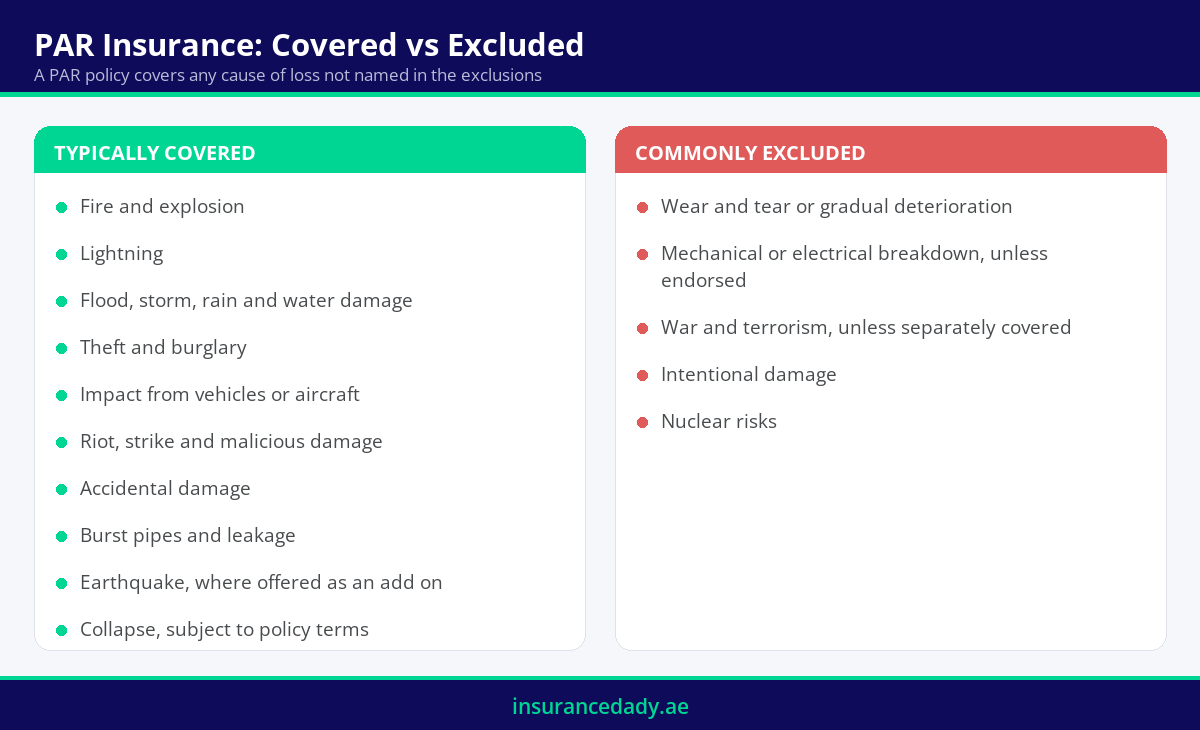
- Fire and explosion
- Lightning
- Flood, storm, rain and water damage
- Theft and burglary
- Impact damage from vehicles or aircraft
- Earthquake, where available as an optional or add-on cover
- Riot, strike and malicious damage
- Accidental damage
- Burst pipes and leakage
- Collapse, subject to policy terms
Two entries on that list deserve a closer look, because they are the ones most often assumed rather than checked.
It is also worth understanding how a PAR policy sits alongside narrower property covers. Businesses that already hold a standalone fire insurance policy or a theft insurance policy sometimes find those perils are also covered under a PAR wording. Overlapping cover is not automatically wasted, but it is worth reviewing so you are not paying twice for the same exposure.
What Can Be Insured Under a PAR Policy
PAR insurance is not a single lump of cover. It is a set of separately declared interests, each carrying its own sum insured. Getting these values right is the single most important thing a buyer controls, because underinsurance on one interest can reduce what is paid on a claim against that interest.
Buildings
The physical structure itself, together with its fixtures, fittings and decoration. For tenants rather than owners, this is often limited to improvements made to the demised premises, so confirm which party is insuring the shell.
Furniture, Fixtures and Contents
Everything that makes the space usable but is not part of the structure. In an office that means desks, seating, partitions and fit-out. In a clinic or restaurant, it extends to specialist furniture that would need replacing after a fire or flood.
Machinery, Equipment and Electronics
Plant and machinery, office equipment and electronics all sit here. Note the interaction with the exclusions list: PAR generally covers accidental external damage to machinery, but mechanical or electrical breakdown from an internal cause is usually excluded unless it has been endorsed on.
Stock and Inventory
Stock is the interest that moves most, which makes it the hardest to declare accurately. Insurers generally want to understand both the type of stock and its value profile, including the maximum value held at any point and the average value across the year. A retailer carrying heavy seasonal peaks should declare the peak rather than the annual average.
Who Typically Takes Out PAR Insurance in the UAE
PAR insurance is used across a wide range of UAE occupancies, and the UAE insurance regulator oversees the insurance sector. The common thread is that the business has physical property whose loss would interrupt trading, not that it belongs to any one sector.
- Offices and corporate premises
- Shops and retail outlets
- Warehouses and factories
- Hotels, restaurants and clinics
- Residential buildings, in applicable cases
Smaller operators sometimes assume that a property all-risks insurance UAE policy is aimed only at large industrial sites. In practice, a single retail unit or a two-room clinic carries the same structural exposures, only at a smaller sum insured. If you are weighing PAR against a packaged product, our guides to SME insurance and business insurance policies set out how the covers are usually bundled.
Common Exclusions You Should Read First
Because PAR insurance is defined by what it excludes, this section carries more weight than it would in a named perils wording. As with most property policies, PAR insurance generally excludes certain categories of loss unless they are specifically covered.
- Wear and tear or gradual deterioration
- Mechanical or electrical breakdown, unless endorsed
- War and terrorism, unless separately covered
- Intentional damage
- Nuclear risks
Why Wear and Tear Sits at the Top
Property insurance responds to sudden and unforeseen events. Gradual deterioration is neither sudden nor unforeseen, so it falls outside the intent of the cover. This exclusion generates the most declined claims because a slow leak that finally causes visible damage looks like an accident on the day it is discovered. Good maintenance records help distinguish a sudden failure from a long-running one.
Why Breakdown Is Treated Separately
A PAR policy is a property damage policy, not an equipment warranty. Damage to a machine caused by an insured external event generally falls inside the wording. A machine that fails from an internal electrical or mechanical cause generally does not, unless the policy has been endorsed to include it. Businesses that depend on a small number of critical machines should raise this specifically at quotation stage.
Exact coverage always depends on the specific policy wording, the extensions selected and the exclusions that apply. Review the schedule carefully before purchase or renewal rather than assuming this year matches last year. For perils driven by weather events in particular, our guide to natural calamity insurance in the UAE explains how these exposures are usually treated.
Documents Generally Required for a PAR Quotation
Insurers price property risk on evidence, not description. UAE business licensing guidance sets out trade licensing and company documentation requirements. The list below is the standard document set for a PAR quotation in the UAE, and having it ready in one place is the difference between a quotation that takes days and one that takes weeks.
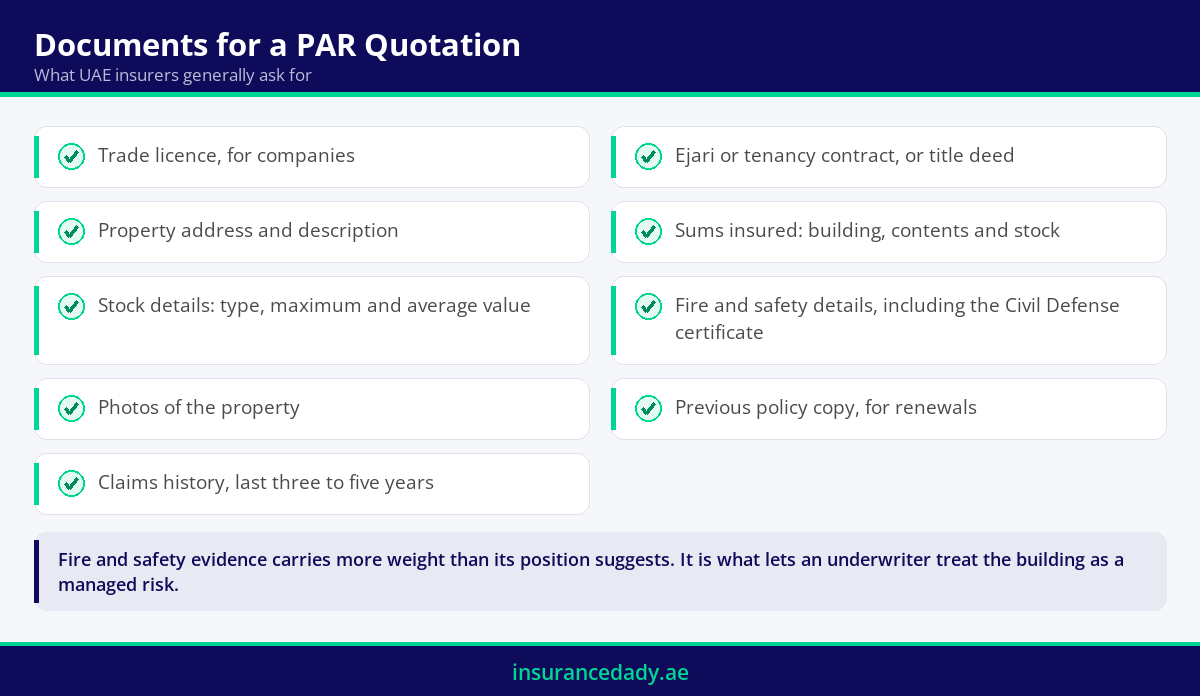
- Trade licence, for companies
- Property address and property description
- Sum insured details covering building value, contents value and stock value
- Stock details, including type, maximum value and average value
- Fire and safety details, such as the Civil Defence certificate, extinguishers and alarms
- Photos of the property
- Previous policy copy, if this is a renewal
- Claims history, generally for the last three to five years
The fire and safety evidence carries more weight than its position on the list suggests. Certification issued through Dubai Civil Defence, whose remit sits within the wider UAE justice, safety, and law framework, and the equivalent authorities in the other emirates, allows an underwriter to treat a building as a managed risk rather than an unknown one, and it is frequently reflected in the terms offered.
What Is on the InsuranceDady PAR Proposal Form
Alongside the document checklist above, applicants requesting a quotation through InsuranceDady complete a PAR proposal form. It is a declaration rather than an application, which is why the accuracy of what you enter matters. Knowing what it asks for in advance lets you gather the numbers once, not three times.
Applicant and Property Details
The first section establishes who is insured and what is being insured. It asks for your name and trade or business, your address, P.O. Box and telephone number, and the requested period of cover from and to.
It then pins down the building situation precisely: flat or house number, building number, street, block number and area. Two further questions establish your relationship to the property: whether you own it and whether you occupy it. Those two answers shape which interests you can insure, because an owner who does not occupy and an occupier who does not own are insuring different things.
Interests to Be Covered and Sums Insured
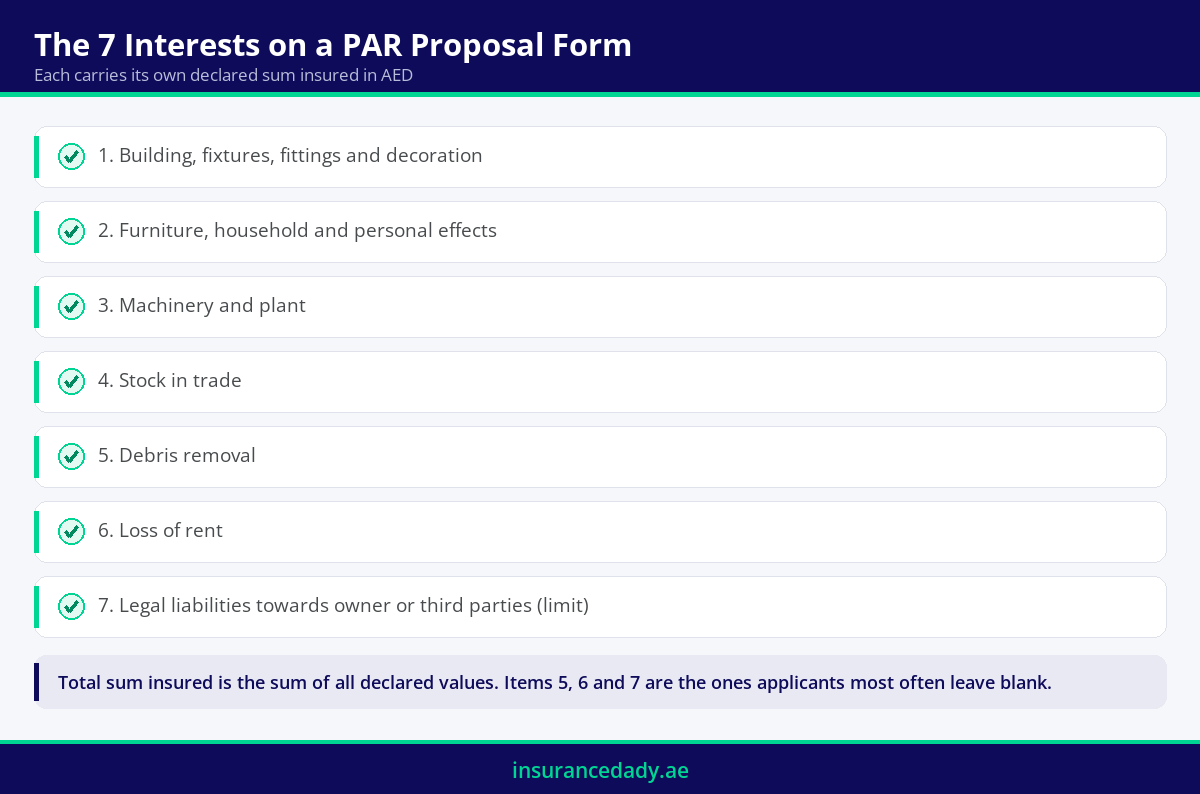
This is the core of the form. It asks you to declare a sum insured against each interest you want covered, and the total sum insured is the sum of all declared values.
Interest to be covered
Sum insured (AED)
1. Building, fixtures, fittings and decoration
As declared by applicant
2. Furniture, household and personal effects
As declared by applicant
3. Machinery and plant
As declared by applicant
4. Stock in trade
As declared by applicant
5. Debris removal
As declared by applicant
6. Loss of rent
As declared by applicant
7. Legal liabilities towards owner or third parties (limit)
As declared by applicant
Total sum insured
Sum of all declared values
Items five, six and seven are the ones applicants most often leave blank. Debris removal is the cost of clearing a site before rebuilding can begin, and it is a real expense after a serious fire. Loss of rent matters to any landlord whose tenant would stop paying while the premises are unusable. Legal liabilities towards the owner or third parties are entered as a limit rather than a value, and cover the exposure you carry towards other people rather than towards your own property.
Additional Declarations
The final section asks about your claim experience over the last three years and whether the property is mortgaged. If it is, you must provide the mortgagee's name, because a lender holding security over the property has an insurable interest that must be noted on the policy. The form closes with the proposer's signature and date, confirming that the information given is accurate to the best of their knowledge and belief.
That closing declaration is not a formality. It is the basis on which the insurer prices and accepts the risk, so an understated stock figure or an omitted prior claim can affect how a later claim is treated.
Setting Sums Insured That Will Actually Hold Up
The proposal form asks you to declare a value for each interest, and it is worth pausing to consider how you arrived at those numbers. A sum insured is not a valuation of what you paid or what the asset is worth second hand. It states the figure you want the policy to cover if the interest is lost.
Buildings and Fit Out
For a building, the relevant figure is generally what it would cost to rebuild the property, not what it would sell for. Those two numbers can diverge sharply in a market where land value carries a large share of the sale price. Tenants declaring fit-out should think in terms of what it cost to build out the space, including professional fees and the time involved in doing it again.
Stock, Which Moves
Stock is the interest most likely to be understated, because businesses tend to declare the figure that feels typical rather than the figure that is exposed. That's why the proposal form asks separately for the maximum value and the average value. A business holding four times its normal stock ahead of a seasonal peak is carrying four times the exposure during that window, and the declaration should reflect it.
The Interests People Forget
Debris removal, loss of rent, and legal liabilities are the three entries most often left at zero, usually because the applicant focuses on physical assets. Each represents a real cost that arrives after a serious loss rather than during it, when a business is least able to absorb it. Even a modest declared figure against each is better than a blank.
How the Form and the Documents Work Together
The proposal form and the supporting documents answer different questions, and an underwriter needs both. The form tells the insurer what you want covered and for how much. The documents verify that the property exists as described, that you have the legal standing to insure it, and that it is managed to a standard the insurer can price.
In practice, the two cross-check each other. The tenancy contract or title deed confirms the ownership and occupancy answers on the form. The photos and the Civil Defense certificate confirm the property description. The claims history confirms the three year claim experience you declared. Where the two sets disagree, the quotation stalls, which is the most common reason a straightforward PAR submission takes longer than it should.
If your property is residential rather than commercial, the process is similar but the paperwork is lighter. Our guides to a home insurance policy and to UAE property insurance for homeowners cover that route in detail.
Common Mistakes on a PAR Submission
A handful of avoidable errors account for most of the friction in PAR quotations. Knowing them in advance is usually enough to avoid them.
- Declaring stock at its average value when the peak is materially higher, which understates the exposure during exactly the period it is greatest.
- Leaving debris removal, loss of rent and legal liabilities blank because the focus was on physical assets.
- Supplying an expired Civil Defence certificate, which removes the evidence that the property is a managed risk.
- Answering the ownership and occupancy questions loosely, when those two answers determine which interests you are entitled to insure.
- Rolling last year's sums insured forward without checking whether the property, the stock or the machinery has changed.
None of these are difficult to get right. They matter because the proposal form closes with a declaration that the information given is accurate to the best of your knowledge and belief, and that declaration is the basis on which the insurer prices and accepts the risk.
What Changes at Renewal
PAR insurance is not a set-and-forget purchase, because the things it insures move over a year. Company and licensing records change too, and the requirements behind them are published on the official UAE government portal. The renewal conversation is where those changes get reflected, and it is the point at which most avoidable underinsurance is caught.
Ask yourself three questions before every renewal. Has the property changed, through fit-out works, a change of use, or new machinery installed? Has the stock profile changed, in value or in type? And has anything changed about the fire and safety position, such as a new Civil Defence certificate, a new alarm system or a lapsed inspection?
Insurers will ask for the previous policy and the claims history at renewal in any case. Presenting the changes yourself, rather than waiting to be asked, tends to produce a cleaner renewal and gives you the chance to have improvements recognised in the terms offered.
Getting a PAR Quotation
Because the right level of cover depends heavily on the type of property, its contents and its use, it helps to speak with a broker before choosing a policy. Two identical-looking warehouses can need very different wordings depending on what is stored inside them and how the space is used.
InsuranceDady can help you complete the proposal form and put together the supporting documents above, then compare quotation options across insurers. All cover remains subject to insurer terms, conditions and exclusions. You can review the wider general insurance range or start a policy enquiry directly.
Conclusion
PAR insurance gives UAE businesses broad property protection by covering any cause of loss that is not specifically excluded, which makes the exclusions list and the sums insured the two things worth your attention. Gather the trade licence, fire and safety evidence and claims history before you start, and work through the proposal form interest by interest so nothing material is left blank. Not sure which policy fits your situation? The InsuranceDady team can walk you through your options and help you request a quotation that matches your needs, subject to insurer terms, conditions and underwriting.
Frequently Asked Questions
What is PAR insurance?
PAR insurance, or Property All Risks insurance, is a broad property policy covering physical loss or damage to insured property from sudden and unforeseen events. It covers any cause that is not specifically excluded in the wording.
Does all risks mean everything is covered?
No. All risks describes the policy structure, not unlimited cover. The policy responds to any cause of loss not named in the exclusions, so anything listed as an exclusion needs a separate add on or endorsement to be covered.
What does a PAR policy usually exclude?
Common exclusions are wear and tear or gradual deterioration, mechanical or electrical breakdown unless endorsed, war and terrorism unless separately covered, intentional damage and nuclear risks. Exact exclusions vary by wording.
What can I insure under a PAR policy?
Buildings, furniture, fixtures and contents, machinery and equipment, stock and inventory, and office equipment and electronics. Each interest carries its own declared sum insured on the proposal form.
What documents do I need for a PAR quotation in the UAE?
Trade licence, property description, sums insured, stock details, fire and safety evidence, property photos, the previous policy for renewals and three to five years of claims history.
Who typically buys PAR insurance in the UAE?
Offices and corporate premises, shops and retail outlets, warehouses and factories, hotels, restaurants and clinics, and residential buildings in applicable cases. Smaller premises use the same cover, but with lower sums insured.
What is debris removal on the proposal form?
Debris removal is the cost of clearing a damaged site before rebuilding can start. It is declared as its own sum insured on the PAR proposal form and is often overlooked by applicants.
Why does the form ask whether the property is mortgaged?
A lender holding security over the property has an insurable interest in it. If the property is mortgaged, the mortgagee is named on the form so that interest can be noted on the policy.
Can InsuranceDady help me complete the PAR proposal form?
Yes. The team can help you complete the proposal form, assemble the supporting documents and compare quotation options. See the services overview or read more about InsuranceDady.