
Professional indemnity insurance, usually shortened to PI, protects professionals and companies against financial losses arising from claims of negligence, errors, omissions or professional misconduct while providing professional services. If a client alleges that your advice, service or professional decision caused them a loss, PI insurance helps protect your financial stability and your reputation while the matter is resolved. This guide covers what the cover responds to, who needs it in the UAE, and the documents required to get quoted.
Key Takeaways
- PI cover responds to claims about the service you delivered, covering legal defence costs, settlements and court fees subject to the policy.
- It applies to any business whose work involves advice or professional judgement, from engineers and accountants to IT companies and consultants.
- Some regulated professions face a PI requirement from their regulator or from contract counterparties, so confirm the obligation that applies to your field rather than assuming.
What Professional Indemnity Insurance Covers
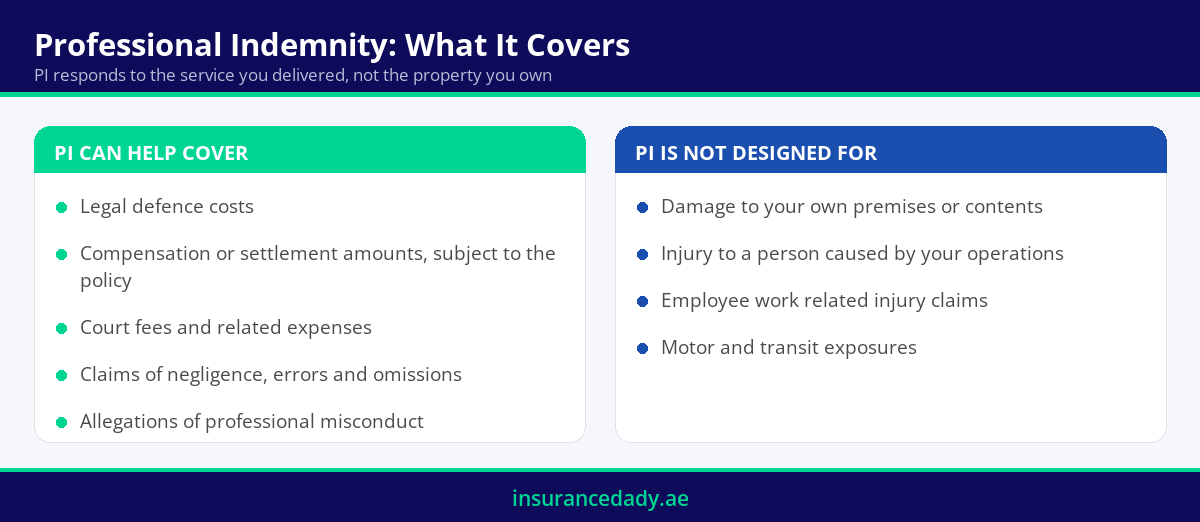
PI insurance responds when a client alleges that your professional work caused them a financial loss. The claim doesn't have to be correct for the policy to matter, because you have to respond either way. Cover commonly extends to legal defence costs, compensation or settlement amounts subject to the policy, and court fees and related expenses.
The distinction worth holding on to is that PI covers the consequences of your work, not damage to your property or injury to a person. A firm that has arranged property cover through a business insurance policy has protected its premises and contents. It has not protected itself against a client disputing the advice it gave.
Who May Need Professional Indemnity Insurance in the UAE
PI exposure follows professional judgement. If a client pays you for expertise and could later argue that the expertise was wrong, the exposure exists regardless of the size of your business.
- Insurance brokers and consultants
- Doctors, clinics and medical professionals
- Engineers and architects
- Accountants, auditors and tax consultants
- Management and business consultants
- IT and software companies
- Legal consultants
- Training and coaching firms
Healthcare appears on this list, but practitioners should note that clinical claims are usually handled under a dedicated medical malpractice wording rather than a general PI policy. Where the two overlap depends on how each is written, which is worth clarifying before relying on either. Our medical, SME and corporate insurance guide sets out how these covers are usually arranged together.
Is Professional Indemnity Mandatory in the UAE?
There is no single answer that applies across the board, and this is where a lot of misinformation circulates. Certain regulated professions in the UAE may be required, or strongly encouraged by their regulator or by contract counterparties, to hold professional indemnity cover.
Requirements differ by profession and by regulatory authority, so the reliable approach is to confirm the specific obligation that applies to your field rather than assuming PI is mandatory everywhere or nowhere. Contractual requirements matter just as much as regulatory ones, since many UAE clients and main contractors make a minimum PI limit a condition of appointment. Business licensing and regulatory guidance is published through the official UAE government portal, and insurance sector oversight through the UAE insurance regulator.
Documents Required for a Quotation
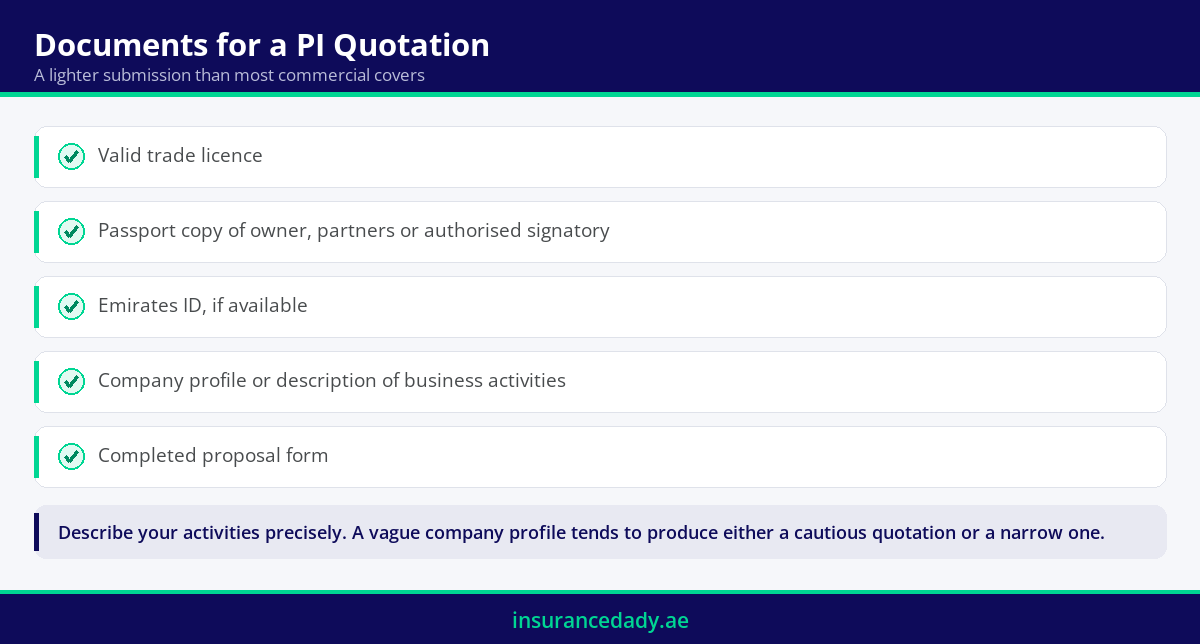
A PI submission is lighter than most commercial covers. Insurers primarily need to establish who you are, what you do and what scale you operate at.
- Valid trade licence
- Passport copy of the owner, partners or authorised signatory
- Emirates ID, if available
- Company profile or a brief description of business activities
- Completed proposal form
The company profile carries more weight than its position suggests. It is what tells an underwriter which services you actually deliver, and a vague description tends to produce either a cautious quotation or a narrow one. Describing your activities precisely usually works in your favour.
Why Businesses Choose to Carry PI Cover
Even a single client dispute can involve high legal costs, regardless of whether the allegation is ultimately upheld. PI insurance is designed to absorb that exposure.
The practical benefit is continuity. A firm with PI cover can defend itself properly and keep operating while the dispute runs. A firm without it faces the same legal costs out of working capital, which is how a survivable dispute becomes an existential one for a smaller practice. All of this remains subject to the specific policy terms, limits and exclusions that apply.
How a Professional Indemnity Claim Typically Arises
PI claims rarely begin with anything as clear-cut as an accident. They usually start as a disagreement about whether the work delivered was what was promised, and they escalate when that disagreement is not resolved commercially.
The pattern is familiar across professions. A design is built and something does not perform as expected. A set of accounts is relied on and a decision made off the back of it goes badly. A software project is delivered late or does not do what the client believed it would. In each case the underlying question is the same: did the professional meet the standard their client was entitled to expect?
That is why scope documentation matters so much in professional services. Engagement letters, written change requests, and clear scope limitations allow a firm to show what it actually agreed to deliver. They will not prevent a dispute, but they materially affect how quickly one can be resolved.
Choosing a Limit and Reviewing It
The right PI limit is driven less by the size of your business than by the size of the decisions your clients make on the strength of your work. A small consultancy advising on a large transaction can carry exposure well out of proportion to its own turnover.
Contractual requirements often settle the question in practice. Many UAE clients and main contractors specify a minimum PI limit as a condition of appointment, and where several contracts apply, the highest requirement effectively sets your floor. Checking those obligations before you buy avoids the awkward position of holding cover that disqualifies you from work you want.
Revisit the limit whenever your work profile changes, not only at renewal. Moving into a new sector, taking on larger projects or adding a service line all change the exposure the policy is standing behind.
What to Have Ready Before You Approach the Market
Beyond the formal document list, a few pieces of preparation consistently improve the outcome of a PI submission.
- A clear written description of every service line you deliver, and the ones you deliberately do not.
- An indication of your annual fee income, since scale is part of how exposure is assessed.
- The profile of your client base, including the sectors you work in and whether any single client dominates.
- Any contractual PI requirements imposed on you, with the limits those contracts specify.
- Details of any past disputes or circumstances that could give rise to a claim.
That last point is the one firms are most tempted to skip. Disclosing a known circumstance is uncomfortable, but non-disclosure is the problem that surfaces at exactly the wrong moment. Insurers are used to disputes in professional practice, and a matter handled well can read as a strength rather than a weakness.
Getting a Quotation
If your profession regularly involves giving advice, delivering a service, or making decisions a client could later dispute, it is worth reviewing whether your current cover, or lack of it, matches your actual risk. InsuranceDady can help you gather the documents above and compare PI quotations across insurers. Explore the general insurance range or start a policy enquiry.
Conclusion
PI cover protects the work you deliver rather than the property you own, responding to claims of negligence, errors and omissions with defence costs, settlements and court fees. Whether it is mandatory depends on your profession and your contracts, so confirm rather than assume. The documents needed are straightforward, and a precise description of your services usually improves the terms offered. Not sure which policy fits your situation? The InsuranceDady team can walk you through your options and help you request a quotation that matches your needs, subject to insurer terms, conditions and underwriting.
Frequently Asked Questions
What is professional indemnity insurance?
It protects professionals and companies against financial losses from claims of negligence, errors, omissions or professional misconduct arising from the services they provide.
What does PI insurance cover?
Legal defence costs, compensation or settlement amounts subject to the policy, and court fees and related expenses. Cover applies to claims about the professional service delivered.
Is professional indemnity insurance mandatory in the UAE?
Not universally. Certain regulated professions may be required or strongly encouraged to hold it by their regulator or by contract counterparties. Requirements differ by profession and authority, so confirm your own position.
Which professions typically need PI cover?
Insurance brokers, medical professionals, engineers and architects, accountants and auditors, management consultants, IT and software companies, legal consultants and training firms.
What documents are needed for a PI quotation?
A valid trade licence, passport copy of the owner or authorised signatory, Emirates ID if available, a company profile describing your activities, and a completed proposal form.
How is PI different from public liability insurance?
PI responds to financial loss caused by your professional advice or service. Public liability responds to injury or property damage caused by your business operations. They cover different types of harm.
Does PI cover a claim that turns out to be unfounded?
Defence costs are a core reason firms carry PI, because an allegation must be answered whether or not it is upheld. The specific position depends on the policy terms and limits.
Do small consultancies need professional indemnity insurance?
Exposure follows professional judgement rather than company size. A single disputed engagement can generate legal costs that a smaller practice would struggle to absorb from working capital.
Why does the insurer want a company profile?
It tells the underwriter which services you actually deliver. A vague description tends to produce a cautious or narrow quotation, so describing your activities precisely usually works in your favour.
How do I start a PI quotation with InsuranceDady?
Gather the trade licence, identification documents and company profile, then get in touch. See the services overview or read more about InsuranceDady.