
Goods can be damaged, stolen or lost at any point in a journey. Marine insurance covers that loss. It protects cargo, ships, containers and freight charges while they move by sea, air, road or rail. The name says marine, but a policy can cover a full multimodal journey, depending on the policy terms. This guide explains in plain language what a marine insurance policy covers, what it does not, and the extra cover you can add. If you are new to the subject, start with our overview of marine insurance types and coverage and come back here for the details.
Key Takeaways
- A marine insurance policy covers sudden and accidental loss or damage to goods in transit. It does not cover every loss, and the exact cover depends on the policy wording.
- Institute Cargo Clauses A, B and C set how wide your cover is. A is the widest, B sits in the middle and C is the most basic.
- Poor packing, delay, ordinary leakage and normal wear and tear are common exclusions. War, strikes and theft cover can often be added back as extensions, subject to the insurer.
- Your premium depends on the goods, their value, the packing, the route, the transport mode and the level of cover you choose.
What a Marine Insurance Policy Protects
A marine insurance policy protects goods, ships, containers and related interests against loss or damage while they are being moved. Cover can run by sea, by air, by road or by rail. Many UAE shipments use more than one of these on a single journey, and a policy can follow the goods across all of them, subject to the policy terms.
The simple version is this. Marine insurance gives you financial protection against unexpected events in transit. Accidents, theft, fire, sinking, collision and natural disasters are the usual examples. It does not guarantee you will be paid for every loss. Every claim is judged against the wording, the conditions and the exclusions in your own policy.
One thing surprises first-time buyers. Risk in an international sale does not always pass at the same point as ownership. Your delivery terms decide who carries the risk on each leg of the journey, and it is common for a buyer to be at risk for a shipment that is still sitting in the seller's country. Reading the delivery term on your invoice before you arrange cover avoids insuring a leg you were never exposed on, or worse, leaving one open.
Open Cover or Single Voyage: Which Policy Structure Suits You
Before you look at what is covered, decide how the policy should be arranged. Two common structures exist in the UAE market.
- Open Cover Policy. One policy that runs for the year and picks up your shipments as they happen. This suits businesses that ship regularly and do not want to arrange cover each time.
- Specific Voyage Policy. One policy for one shipment or one voyage. This suits a one off consignment or an occasional shipper.
Alongside cargo cover, the market also writes Hull Insurance for the vessel itself, Freight Insurance for freight charges or income that could be lost if goods are damaged or never delivered, and Marine Liability Insurance for legal liability arising out of marine operations. Most UAE traders only need cargo cover, but it helps to know the other three exist so you can ask for the right one. Businesses arranging several covers at once often review them together under a general insurance programme.
The practical difference is administration. On an open cover, you declare each shipment as it goes, often through a simple online form or a monthly declaration, and the cover is already in place. On a voyage policy, you arrange cover shipment by shipment, which is fine once a quarter and painful once a week.
What Marine Cargo Insurance Covers
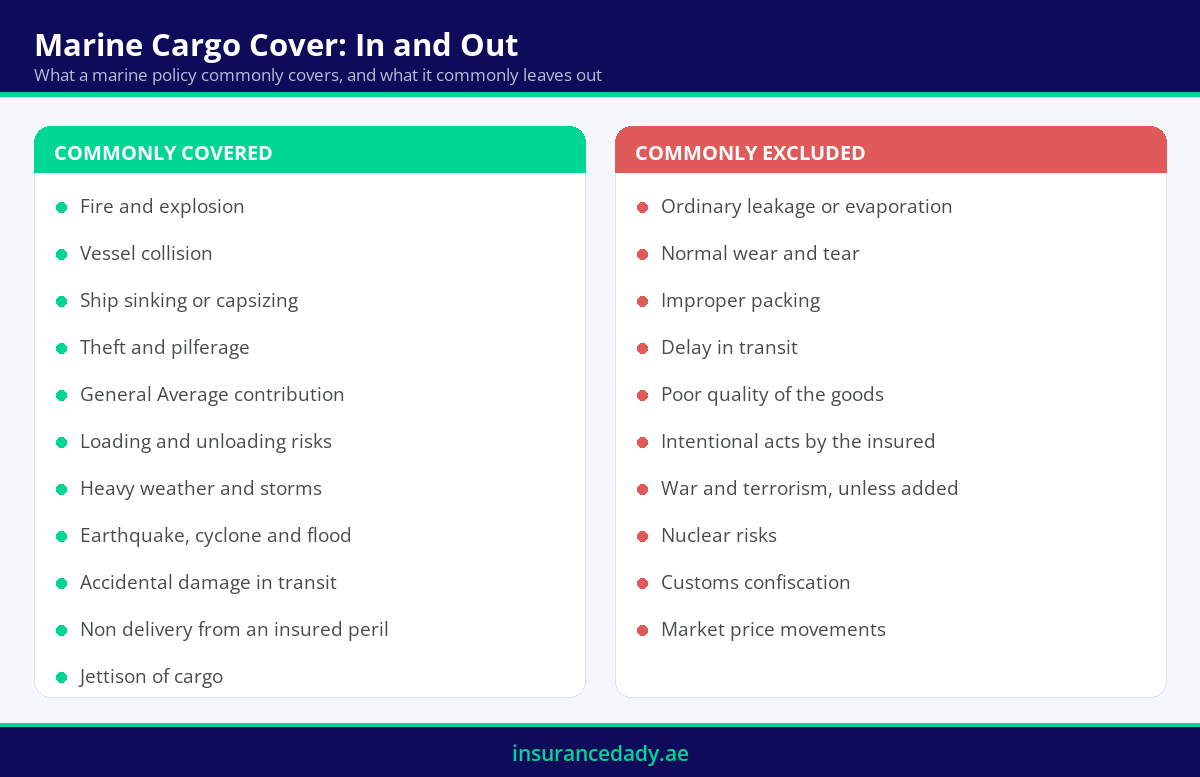
The list below is what most UAE marine cargo policies cover. Treat it as a guide. What you actually get depends on the clause set you buy and on any endorsements added to your policy.
- Fire and explosion
- Vessel collision
- Ship sinking or capsizing
- Theft and pilferage
- General Average contribution, which is your share of a loss when cargo is sacrificed to save the voyage
- Loading and unloading risks
- Heavy weather and storms
- Earthquake, cyclone and flood, subject to policy terms
- Accidental damage during transit
- Non-delivery caused by an insured peril
- Jettison of cargo, which is cargo deliberately thrown overboard
- Water damage, where the policy covers it
Two of these are worth a plain explanation. General Average is an old rule of the sea. If the crew has to throw some cargo overboard or pay for salvage to save the ship and the rest of the cargo, every cargo owner on board shares the cost. That can mean a bill arriving for a shipment that was never touched. A marine insurance policy is what pays that share. Jettison is the act itself: deliberately throwing cargo overboard.
What a Marine Insurance Policy Does Not Cover
This is the part most people skip, and it is the part that causes declined claims. The exclusions below are standard across the market, though the exact list depends on your policy wording and any endorsements.
- Ordinary leakage or evaporation
- Normal wear and tear
- Improper packing
- Delay in transit
- Loss caused by poor quality of the goods themselves
- Intentional acts by the insured
- War and terrorism, unless specifically covered
- Nuclear risks
- Customs confiscation
- Financial loss caused by market price movements
Improper packing is the exclusion that catches the most people. If cargo is crushed because it was packed badly, the insurer can decline the claim even though the damage is real. Delay is the second. If your goods arrive late and you lose a contract, a marine insurance policy will not pay for that loss. It covers physical loss or damage, not commercial disappointment.
It also helps to be clear about what all risks means. Institute Cargo Clauses A is described as an all-risks cover, and that phrase does a lot of damage. It means the policy responds to accidental, sudden and unforeseen loss unless something is specifically excluded. It does not mean everything is automatically paid.
Institute Cargo Clauses A, B and C
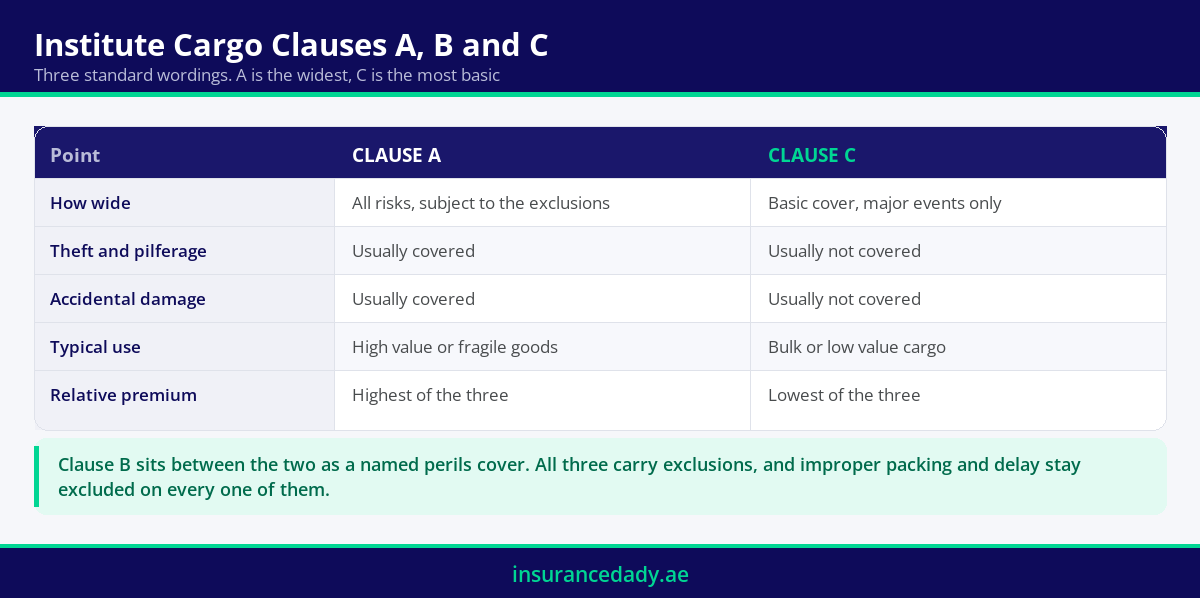
Institute Cargo Clauses are the standard wording used worldwide to define the scope of marine cargo cover. They are published in London and used in the UAE market as well. You will be asked to pick one when you request a quotation.
- Institute Cargo Clauses (A). All risks, the widest cover, subject to the exclusions in the wording. Typically suits high value, fragile or easily damaged goods.
- Institute Cargo Clauses (B). Named perils, a broader limited cover that lists what is included. Typically suits mid value goods where all risks cover is not required.
- Institute Cargo Clauses (C). Basic cover, the narrowest of the three, limited to major events. Typically suits bulk or low value cargo where the main worry is a total loss.
Clause A is the widest, but it is not unlimited. Even all-risks cover carries exclusions, and improper packing and delay stay excluded. Clause C is the cheapest, but it will not answer a pilferage claim. The right choice depends on what you are shipping and how much you can afford to lose. The Lloyd's Market Association maintains the clause wording, and the delivery terms that determine who must insure a shipment come from the Incoterms rules.
Extensions That Close the Gaps
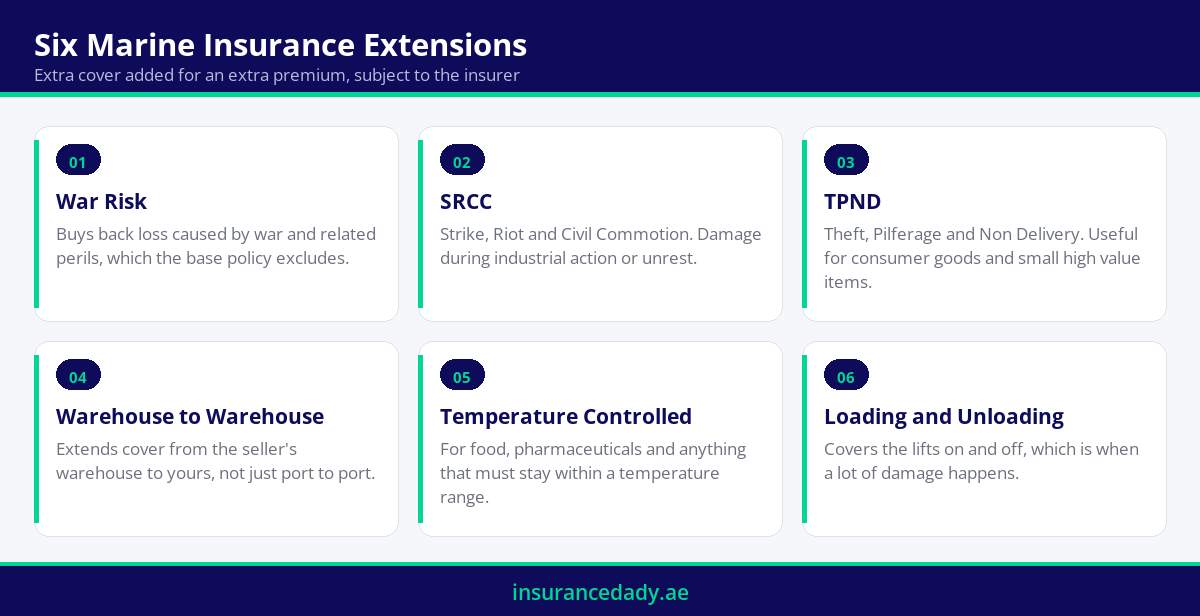
An extension is extra cover added to your policy for an extra premium. Extensions let you buy back some exclusions. These are the most commonly requested in the UAE market. Availability depends on the insurer, the goods and the route.
- War Risk. Cover for loss caused by war and related perils, which the base policy excludes.
- Strike, Riot and Civil Commotion, usually written as SRCC. Cover for damage during industrial action or unrest.
- Theft, Pilferage and Non-Delivery, usually written as TPND. Useful for consumer goods and small high-value items.
- Warehouse to Warehouse Cover. Extends the policy from the seller's warehouse to your own, not just port to port.
- Temperature Controlled Cargo Cover. For food, pharmaceuticals and anything that has to stay within a temperature range.
- Loading and Unloading Extension. Covers the moments cargo is lifted on and off, when a lot of damage happens.
Warehouse to Warehouse is the one most UAE importers should ask about. A policy that stops at the port leaves the inland leg uninsured, and that leg often runs through the same roads your commercial vehicles use every day. Ask your broker where cover starts and where it ends before you sign.
How a Marine Cargo Claim Works
Most people only read this part after something has gone wrong. Reading it first is cheaper. A marine claim follows roughly the same path every time.
- Inspect the goods on arrival and note any visible damage on the delivery receipt before you sign it.
- Give written notice to the carrier or their agent straight away, because there are time limits and they are short.
- Tell your insurer or broker as soon as you can, and within any notification period set out in the policy.
- Do not throw damaged goods or packaging away. A surveyor may need to see both.
- Allow the survey to take place. The surveyor's report is usually the document the claim turns on.
- Submit the claim documents, which normally include the invoice, packing list, transport document, survey report and the notice you served on the carrier.
Two mistakes cause most of the trouble. The first is signing a clean delivery receipt for cargo that arrived damaged, which makes it much harder to argue later that the damage happened in transit. The second is repacking or disposing of the goods before the surveyor arrives. Both are easy to avoid if the warehouse team knows the rule in advance.
Keeping the paperwork tidy also matters more than it sounds. The same documents that support a quotation support a claim, so a business that files its invoices, packing lists and transport documents properly is already most of the way there.
What Decides Your Marine Insurance Premium
There is no fixed price for marine cover. Insurers look at how likely a loss is and how big it could be. These are the factors they weigh.
- Nature of the goods. Electronics and glass are priced differently from steel.
- Cargo value. The higher the sum insured, the higher the premium.
- Packing quality. Good packing lowers risk and can lower the price.
- Mode of transport, whether sea, air, road or rail.
- Shipping route, including any high-risk waters on the way.
- Country of destination.
- Type of coverage, meaning whether you chose ICC A, B or C.
- Claims history.
- Annual shipment volume, which matters most on open cover.
Packing quality is the one factor you fully control. Better packing reduces the chance of a claim and removes the argument an insurer can make when a claim is filed. It is worth the extra cost. Businesses that also hold stock in a warehouse should check how their property all risks cover and their marine policy fit together, so there is no gap between the two.
Route matters more than most shippers expect. Two shipments of the same goods, at the same value, can be priced differently simply because one passes through waters the market treats as higher risk. If your route changes, tell your broker rather than assuming the existing terms still apply.
Who Needs Marine Insurance in the UAE
If you own goods while they are moving, or you are responsible for them, you have something to insure. The list below covers the businesses that buy marine cover most often.
- Importers
- Exporters
- Freight forwarders
- Trading companies
- Manufacturers
- Logistics companies
- Shipping companies
- E-commerce businesses
- Project cargo contractors
One point often missed. A freight forwarder's own liability cover is not the same thing as insurance on your cargo, and it will not pay you the value of your goods. The UAE freight and logistics sector is represented by the National Association of Freight and Logistics, and the international rules that shape a forwarder's liability come through FIATA. If you own the cargo, insure the cargo.
E-commerce businesses are the newest group on this list and often the least insured. High volumes of small, high-value parcels are exactly the profile that theft and pilferage cover was written for, and courier liability is normally capped well below the value of the goods.
What Insurers Ask For When They Quote
A marine quotation moves quickly once the insurer has the details below. Having them ready in one message usually saves a day or two.
- Name of the insured
- Nature of the goods
- Packing details
- Shipment value
- Currency
- Origin
- Destination
- Mode of transport
- Voyage details
- Required coverage, meaning ICC A, B or C
- Any additional extensions required
Insurers may ask for more or less than this depending on the shipment and their own underwriting rules, so treat the list as a starting point rather than a fixed requirement. If you would like help putting a submission together, InsuranceDady can compare marine quotations for you. Look through the general insurance range or start a policy enquiry.
Conclusion
A marine insurance policy is straightforward once you separate three things: what the policy covers, what it excludes, and what you can add back through extensions. Choose your Institute Cargo Clause set to match the goods, pack properly to keep the insurer's main argument off the table, and check where cover starts and stops so the inland legs aren't left open. All cover remains subject to the policy terms, conditions, exclusions and endorsements that apply. Not sure which level of cover fits your shipments? The InsuranceDady team can walk you through the options and help you request a quotation.
Frequently Asked Questions
What does a marine insurance policy cover?
Sudden and accidental physical loss or damage to goods in transit. Typical causes include fire, collision, sinking, theft, storms and accidental damage while loading or unloading, all subject to the policy terms.
Is marine insurance mandatory in the UAE?
It is usually a commercial decision rather than a legal one, although banks and buyers often require it. Check what your contract and letter of credit require, because the delivery terms determine who must insure the goods.
What is the difference between ICC A, B and C?
Institute Cargo Clauses A is an all-risks cover, the widest of the three. B is a named-perils cover in the middle. C is basic cover limited to major events. All three carry exclusions.
Does marine insurance cover air and road shipments?
Yes. Despite the name, a marine insurance policy can cover transport by sea, air, road or rail, and it can follow a multimodal journey across more than one of them, depending on the policy terms.
Why was my marine cargo claim rejected?
The most common reasons are improper packing, delay, ordinary leakage, wear and tear, or a peril that the clause set you bought does not cover. Read the exclusions in your own wording before you assume a loss is covered.
What is General Average?
It is the rule that every cargo owner on a ship shares the cost when cargo or money is sacrificed to save the voyage. Your policy can pay that share even if your own goods were never damaged.
What is the difference between open cover and a voyage policy?
Open cover is an annual policy that picks up your shipments as they happen, which suits regular shippers. A specific voyage policy covers one shipment only, which suits an occasional or one off consignment.
Can I add war risk cover to a marine policy?
War and terrorism are excluded from the base policy but can often be added back as a War Risk extension, along with Strike, Riot and Civil Commotion. Availability depends on the insurer and the route.
How is a marine insurance premium calculated?
Insurers weigh the nature and value of the goods, the packing, the transport mode, the route, the destination, the clause set chosen, your claims history and, on open cover, your annual shipment volume.
Do I still need cargo insurance if I use a freight forwarder?
Usually yes. A forwarder's liability cover protects the forwarder, not the value of your goods. Read our SME insurance guide for how these covers fit together.