
Commercial insurance is usually bought once, at licensing, and then renewed without thought for years while the business changes underneath it. That is how a company ends up insured for what it was rather than what it is. This guide sets out what a business programme needs to cover, how property, liability, workforce and interruption cover fit together, what changes by sector and by emirate, and how to review a schedule that has drifted. It is written for owner managed companies in Abu Dhabi and the Northern Emirates as much as for larger operations in Dubai.
Key Takeaways
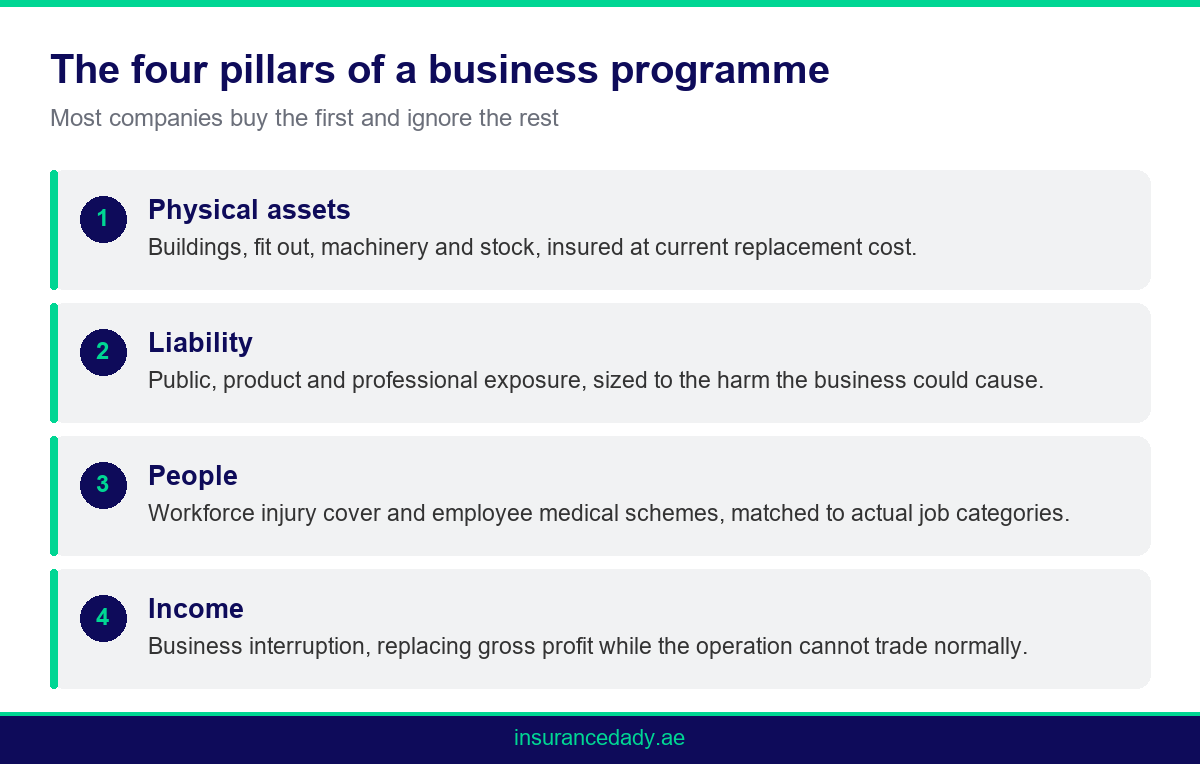
- A programme has four pillars: property and stock, liability, people, and the income lost while you recover.
- Business interruption is the most commonly omitted cover and usually the largest part of a serious claim.
- Sums insured must be re stated annually, because underinsurance is settled proportionately.
- Licence conditions and lease terms often impose insurance requirements that general law does not.
What a business programme has to do
Insurance for a company is not one product. It is a set of covers chosen to match how that business actually loses money, and the right combination looks different for a trading firm, a consultancy and a workshop.
Four questions define the shape of any programme. What physical assets would be expensive to replace? Who could sue the business and for what? What obligations does it carry towards its people? And how long could it survive without trading while it recovers from a serious incident?
Most owner managed businesses answer the first question and ignore the other three. That produces a policy covering the building and the stock, with nothing for the liability claim, the injured employee or the six months of lost revenue. The overall structure is set out in how a business programme is structured.
Property, stock and equipment
Physical damage cover is the foundation of most programmes and the easiest section to get wrong, because the values move constantly.
Buildings, fit out and machinery
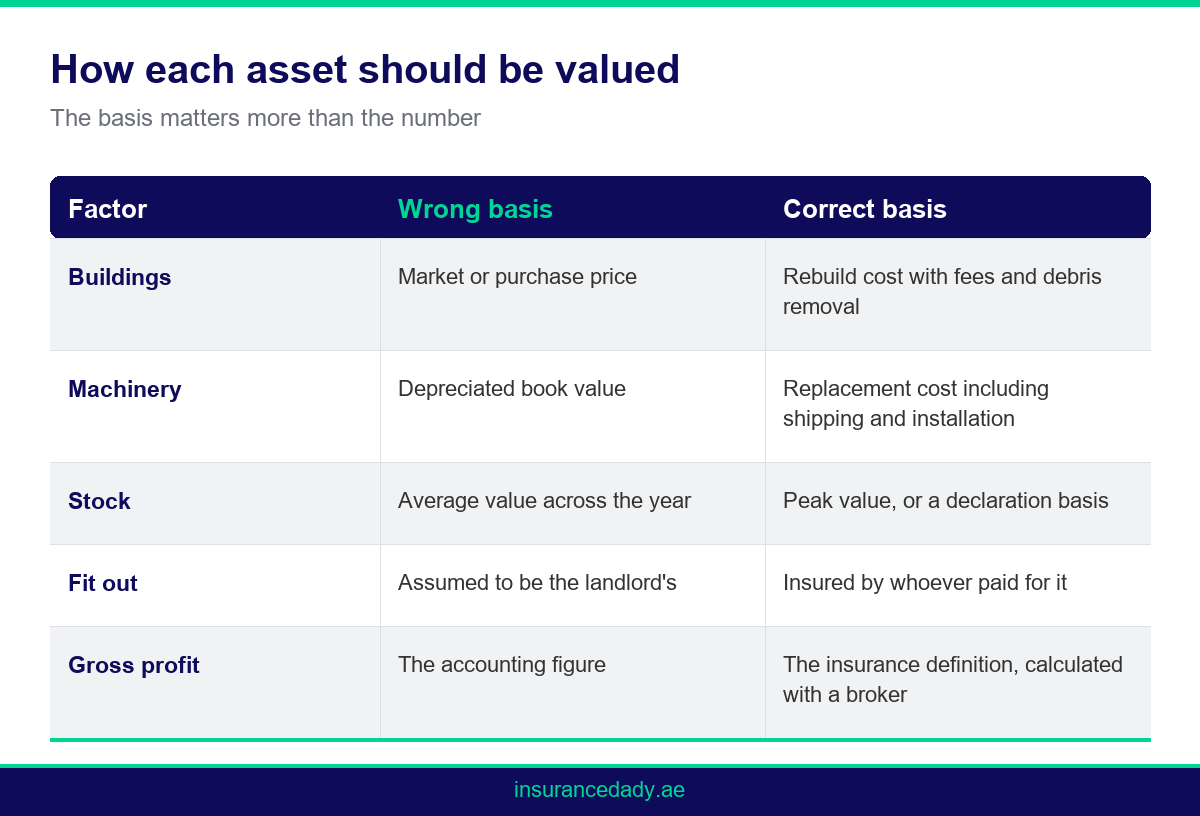
Where the business owns its premises, buildings cover is set on rebuild cost including demolition, debris removal and professional fees. Where it leases, the tenant usually insures the fit out, fixtures and improvements it has paid for, and the landlord insures the shell. Read the lease to find the dividing line rather than assuming it.
Machinery and equipment should be insured at replacement cost rather than book value. Depreciated accounting figures bear no relation to what a replacement machine costs today, particularly for imported equipment where shipping and installation add substantially to the price.
Stock and the problem of peak values
Stock is where trading businesses become underinsured without noticing. A sum insured set at an average level will be inadequate at the point in the year when stock peaks, which is usually exactly when a fire would hurt most.
Insure at peak value, or negotiate a declaration basis where the insurer adjusts the premium against actual monthly values. A wider form of cover is described in property all risks cover explained, which responds to any sudden physical loss unless specifically excluded rather than only to named perils. Fire remains the dominant peril and is covered in fire cover for premises and stock.
Business interruption, the cover that saves the company
Property cover rebuilds the premises. Business interruption keeps the business alive while that happens, and the second is usually the larger figure.
The cover replaces lost gross profit during the period the business cannot trade normally, and funds increased costs of working such as renting temporary premises, chartering transport or outsourcing production to keep customers supplied.
Two settings decide whether it works. The sum insured should be based on gross profit as insurers define it, which is not the same as the accounting figure and usually needs a broker to calculate properly. The indemnity period is the maximum time the cover will run, and twelve months is the default rather than the correct answer.
Choose the indemnity period from how long recovery would genuinely take. Sourcing specialist machinery, refitting a unit, reobtaining approvals and winning back customers frequently runs beyond a year. A business that would take eighteen months to recover and holds twelve months of cover has insured two thirds of its own survival.
Dependency on others is the refinement most policies miss. If a single supplier, a single customer or a single utility connection would stop your operation, an incident at their premises can shut you down without touching yours. Supplier and customer extensions exist for exactly this, and they matter most for the businesses that assume they are too small to need them. List your genuine single points of failure once, then ask whether the policy responds to any of them.
Liability: who can sue, and for what
Liability exposure varies more by activity than by size, and a small firm doing physical work can carry more risk than a large one selling advice.
Public and product liability
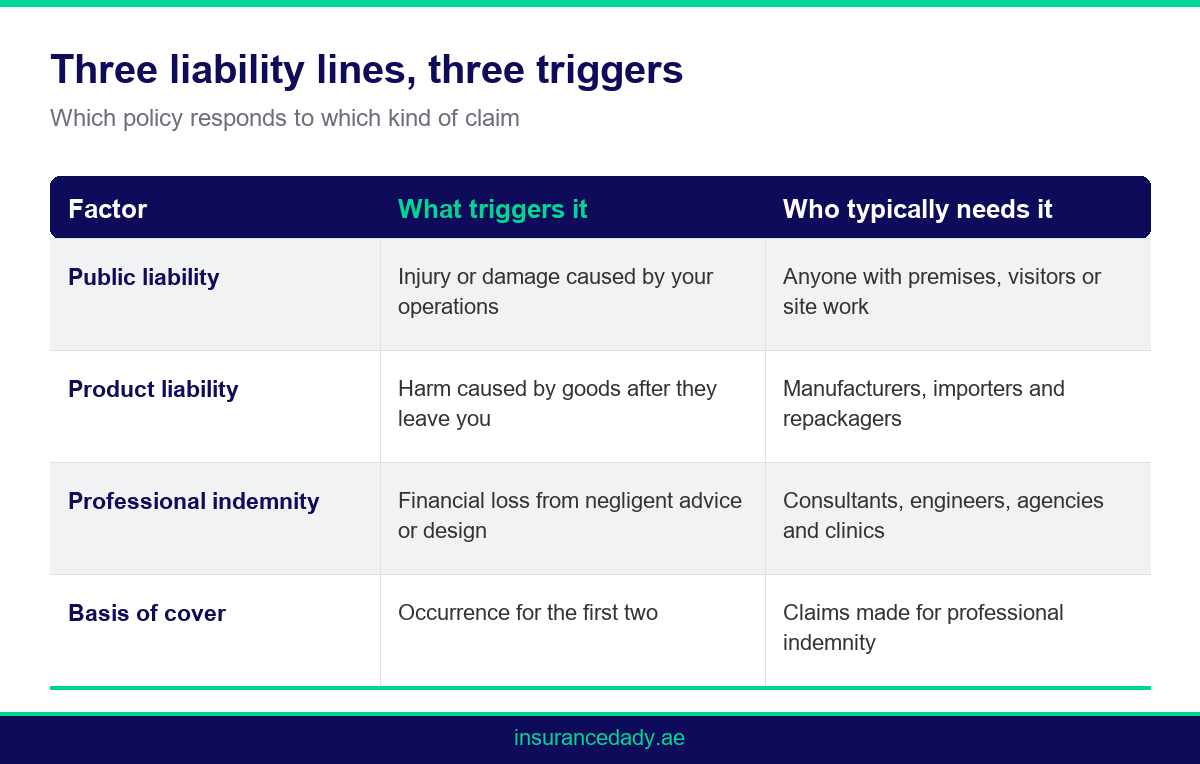
Public liability responds when a third party is injured, or their property damaged, by your operations. Businesses that receive visitors, host collections, work on client sites or operate vehicles around the public face this routinely. Limits should reflect worst case injury costs rather than the size of the balance sheet. A small company can cause a large injury, and the claim does not scale itself down to match the defendant.
Product liability follows goods after they leave you and applies to manufacturers, assemblers, importers and anybody repackaging or rebranding. Traders often assume it is the manufacturer's problem, and it is not once your name is on the product.
Professional indemnity
Professional indemnity covers financial loss caused to a client by negligent advice, design or service. It matters for consultants, engineers, architects, accountants, agencies, clinics and increasingly for technology firms, and many client contracts and licence conditions require it at a stated limit.
It is written on a claims made basis, meaning the policy in force when the claim is made responds rather than the one in force when the work was done. That makes continuity essential, and it is why letting a policy lapse after finishing a project leaves past work unprotected. Further detail sits in cover for professional advice and services.
People: injury cover and staff benefits
Obligations towards employees are the least negotiable part of a programme and the most frequently underbought.
Workforce injury cover responds when an employee is hurt in the course of their work. The critical detail is the occupation categories listed on the schedule, since a policy written for office roles will not respond correctly to a warehouse, workshop or driving injury. Review the categories whenever the workforce changes shape, and see workforce injury cover and its documents for the paperwork involved.
Employee medical cover is a separate obligation, mandated in Abu Dhabi and Dubai and commonly provided elsewhere to remain competitive for staff. Group schemes are usually cheaper than individual policies and avoid medical underwriting for members. Businesses with staff across several emirates can structure a single scheme to satisfy more than one regulator, as described in staff medical schemes for companies.
Key person cover is worth considering in owner managed firms. Where one individual holds the client relationships, the technical knowledge or the licences, their sudden absence is a commercial risk rather than a personal one, and it can be insured as such. The benefit funds recruitment, covers lost margin and buys the business time to steady itself.
End of service obligations are the liability that sits quietly on every balance sheet. Gratuity accrues month by month for every employee, and a company that has not provisioned for it faces a real cost whenever several long serving staff leave together. This is not insurance in the usual sense, but it belongs in the same annual conversation, because the businesses that ignore it are usually the same ones carrying thin injury cover and no interruption protection.
Vehicles, goods in transit and things that move
Assets in motion are covered by different policies from assets standing still, and the handover between them is a frequent gap.
Commercial motor cover reflects higher mileage, multiple drivers and goods carrying use. Private policies do not respond to business use, and businesses running several vehicles should compare individual pricing against a fleet arrangement. The options are set out in vehicle and fleet options for businesses.
Goods in transit is the cover most often missing. Stock travelling between a Sharjah warehouse and a Dubai customer is not covered by the property policy, which attaches to a location, nor by the motor policy, which covers the vehicle and third parties rather than the load. For importers and exporters, marine cargo cover performs the same function across borders.
Plant and equipment moving between sites needs its own thought. Contractors plant cover follows machinery to wherever it is working, whereas a property policy leaves it insured only at the address on the schedule. Hired in plant is a further trap, since the hire agreement usually makes the hirer responsible for damage and for continuing hire charges while a damaged machine is repaired. Both can be insured, and neither is included by default.
Where the requirements come from
Companies often assume insurance obligations come from law alone. In practice most of them arrive through licences, leases and customer contracts.
Licence conditions vary by emirate and by activity, and certain trades carry mandatory cover as a condition of operating at all. Construction, medical practice, transport and financial intermediation are the usual examples, and the required limits are set by the licensing body rather than negotiated.
Lease terms are the second source. Free zone and industrial landlords commonly require public liability at a stated limit, fire cover noting the landlord's interest, and proof of workforce cover before staff occupy a unit. These are contractual conditions, and breaching one can put the lease at risk even when no claim has occurred.
Customer contracts are the third and fastest growing source. Larger clients increasingly pass obligations down their supply chain, requiring named limits, additional insured status, waivers of subrogation or indemnities that a standard policy does not automatically accept. Send any unusual indemnity clause to your broker before signature, because agreeing to it does not make your insurer agree to it.
Sector notes: office, retail and warehouse
Two businesses of identical turnover can need very different programmes, because the hazard follows the activity rather than the revenue.
Offices and professional services
The assets here are equipment, fit out and data rather than stock, so property sums insured are modest. The real exposure sits in professional indemnity and in the interruption that follows losing an office, since client work continues whether or not you have somewhere to do it.
Cyber exposure belongs in this conversation too. Client data, payment details and email compromise are realistic losses for a services firm, and standard property and liability policies do not respond to them. Cover is now widely available and priced sensibly for small firms.
Retail and warehousing
Retail carries public liability exposure from customers on the premises, theft exposure from stock on display, and money exposure from cash held and banked. Shop fronts and glazing are worth insuring specifically, since replacement is expensive and damage is common.
Warehousing shifts the weight to fire, stock value and the way goods are stacked and separated. Insurers will ask about racking height, sprinkler coverage and what is stored nearby, and the answers move the rate materially. Businesses handling goods for third parties also need to consider their liability for property in their custody, which a standard property policy does not cover. Goods held on behalf of customers belong to somebody else, and insuring them requires a specific extension rather than a larger stock figure.
How the emirates differ
Licensing, lease conditions and the commercial mix all vary by emirate, and a programme copied from a Dubai template often fits poorly elsewhere.
In the capital, licensing runs through the Abu Dhabi Department of Economic Development, with a commercial base weighted towards energy, construction, government supply chains and professional services. Contractual insurance requirements imposed by large clients are common and often exceed anything required by law.
Sharjah, Ajman and Ras Al Khaimah carry a heavier concentration of warehousing, light manufacturing and trading. Licensing runs through bodies such as the Sharjah Economic Development Department, and free zone leases frequently mandate liability limits and fire cover as a condition of occupancy. Wider information for companies is published through government business services.
The practical consequence is that a business licensed in one emirate, storing goods in another and delivering into a third needs territorial limits and named locations that reflect all of it. Our sector view for smaller firms is set out in a practical guide for smaller firms.
What drives the premium
Commercial rating is built from exposure and experience, and both can be influenced more than most owners assume.
Exposure
Activity is the largest factor. A trading office and a metal workshop at the same address will be rated very differently, because the hazard is in what is done rather than where. Sums insured, turnover, headcount and the number of locations follow.
Construction and protection of the premises matter for property rates. Sprinklers, alarms, separation between units and the condition of electrical installations all feed into the figure, and improvements usually pay for themselves over a few renewals.
Experience and presentation
Claims history is rated directly, and a run of small claims can cost more than one large one because it suggests a systematic problem. Addressing the cause and documenting what changed is worth more at renewal than arguing about the rate.
Presentation genuinely affects price. An underwriter who receives photographs, a clear description of the operation, an accurate schedule of values and evidence of risk improvements prices the risk they can see. One working from a thin proposal form prices the uncertainty instead, and uncertainty is always expensive.
Timing helps as well. Approaching the market four to six weeks before renewal gives insurers space to review properly and gives you room to negotiate. A submission arriving three days before expiry gets whatever terms are quickest to produce.
Making a claim without losing the argument
Commercial claims are won or lost on documentation and on the first forty eight hours after an incident.
Immediately after a loss
Make the site safe and take reasonable steps to prevent further damage, which is a condition of every policy rather than a courtesy. Notify the insurer straight away, even where the extent of the loss is unclear, because most policies impose a reporting deadline and late notification gives grounds to decline.
Photograph everything before anything is moved or cleared, obtain a police or civil defence report where relevant, and keep damaged stock and equipment until a loss adjuster has inspected it. Disposing of evidence to resume trading quickly is understandable and frequently fatal to the claim.
Supporting the figures
Property claims are proved with purchase invoices, asset registers and stock records. Interruption claims are proved with management accounts, filed financial statements and evidence of what trading would have looked like without the incident. Businesses with tidy records settle faster and at higher amounts than those reconstructing history afterwards.
Appoint someone internally to own the claim. Adjusters work through a single point of contact, and a claim handled by whoever happens to be available drifts for months. For larger losses, a broker managing the process on your behalf usually recovers more than the fee it costs.
Reviewing a programme that has drifted
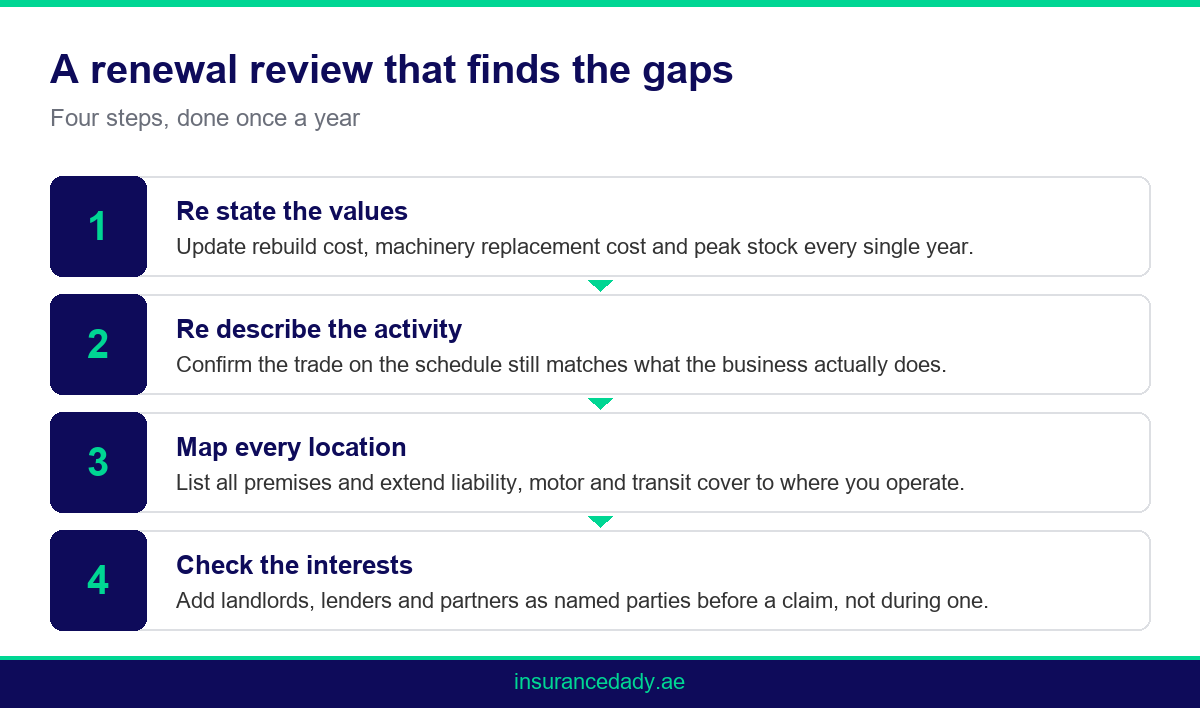
Most disputed commercial claims trace back to a schedule that stopped describing the business some years earlier.
Start with values. Rebuild cost, machinery replacement cost and peak stock should be re stated every year, because underinsurance is met with a proportionate reduction rather than a refusal. A company insured at sixty percent of value can expect roughly sixty percent of a partial loss.
Then check the activity description. Businesses evolve quietly, and a firm licensed for trading that has begun assembling, repacking or installing has changed its risk without telling its insurer. Add new locations as they open rather than at the following renewal.
Turnover and headcount deserve the same treatment. Both are rating factors on liability and workforce policies, and both are typically declared once and never revisited. Understating them is not a saving, because insurers adjust at claim stage once the real figures emerge from the accounts.
Finally, confirm the named interests. Landlords, lenders, lessors and joint venture partners frequently need to be noted on the policy, and adding them during a claim is considerably harder than doing it at renewal. You can request business terms once those three points are settled, or review our general insurance lines to see what else belongs in the programme.
Conclusion
A commercial insurance programme is worth what it pays when something goes wrong, and that depends almost entirely on decisions taken at renewal. Cover the assets at current replacement values, insure the income that pays the wages while you rebuild, match liability limits to the harm the business could cause rather than to its size, and make sure the workforce categories reflect what people actually do. Companies in Abu Dhabi, Sharjah, Ajman and Ras Al Khaimah should also check that territorial limits follow an operation that crosses emirate borders daily. Talk to Insurance Dady and we will review your existing schedule against your business and compare terms across our partner insurers.
Frequently Asked Questions
Q1: What should a small business insure first?
Liability and workforce cover, then property and stock, then business interruption. The first two address obligations you cannot avoid, whatever the size of the company.
Q2: Why is business interruption so important?
It replaces gross profit lost while you cannot trade and funds temporary arrangements. In a serious fire it is usually larger than the property claim itself.
Q3: How long should the indemnity period be?
Long enough to source equipment, refit premises, regain approvals and win back customers. For specialist operations that often exceeds the twelve month default setting.
Q4: Is professional indemnity relevant to a trading company?
Usually not, unless it gives advice or provides design and specification services. It covers financial loss caused by negligent professional work rather than physical damage.
Q5: What does claims made mean?
The policy in force when a claim is made responds, not the one in force when the work was done. Letting cover lapse leaves past projects unprotected.
Q6: Does my property policy cover stock in transit?
No. Property cover attaches to named locations and motor cover protects the vehicle. Goods in transit is a separate cover for stock moving between sites.
Q7: What happens if my sums insured are too low?
Settlements are reduced in proportion to the shortfall. A business insured at half its true value can expect roughly half of a partial claim to be paid.
Q8: Do free zone leases require insurance?
Frequently yes. Zone agreements commonly mandate liability limits and fire cover noting the landlord's interest before staff are permitted to occupy a unit.
Q9: Can one policy cover premises in several emirates?
Yes, and it is usually better. A single programme with one renewal date makes gaps visible across locations. See our services for how this is structured.
Q10: How often should a business review its cover?
At every renewal and immediately after any change in activity, premises, headcount or turnover. Drift between schedule and reality causes most disputes.