
Health insurance coverage in this country is mandatory in some emirates, contractual in others, and misunderstood almost everywhere. Residents typically receive a card from an employer, use it until something is refused, and only then read the policy. That is an expensive way to learn how the system works. This guide explains who regulates what, how individual, family and group plans differ, how to read the limits and networks that decide where you can be treated, and what to do when you change job or move between emirates. It is written for residents of Abu Dhabi and the Northern Emirates first, since most published guidance assumes a Dubai reader.
Key Takeaways
- Cover is mandated and supervised at emirate level, so the rules in the capital and Dubai are genuinely different.
- The network attached to a plan usually matters more day to day than the headline annual limit.
- Basic mandated products guarantee access to essential care rather than comprehensive treatment.
- Waiting periods and continuity of cover are the two things most often lost when changing employer.
How health cover is organised across the emirates
There is no single national health insurance scheme. Each emirate decides whether to mandate cover, who must provide it and what the minimum product looks like. Understanding that structure explains most of the confusion residents encounter, including why a colleague on the same salary holds a visibly different card.
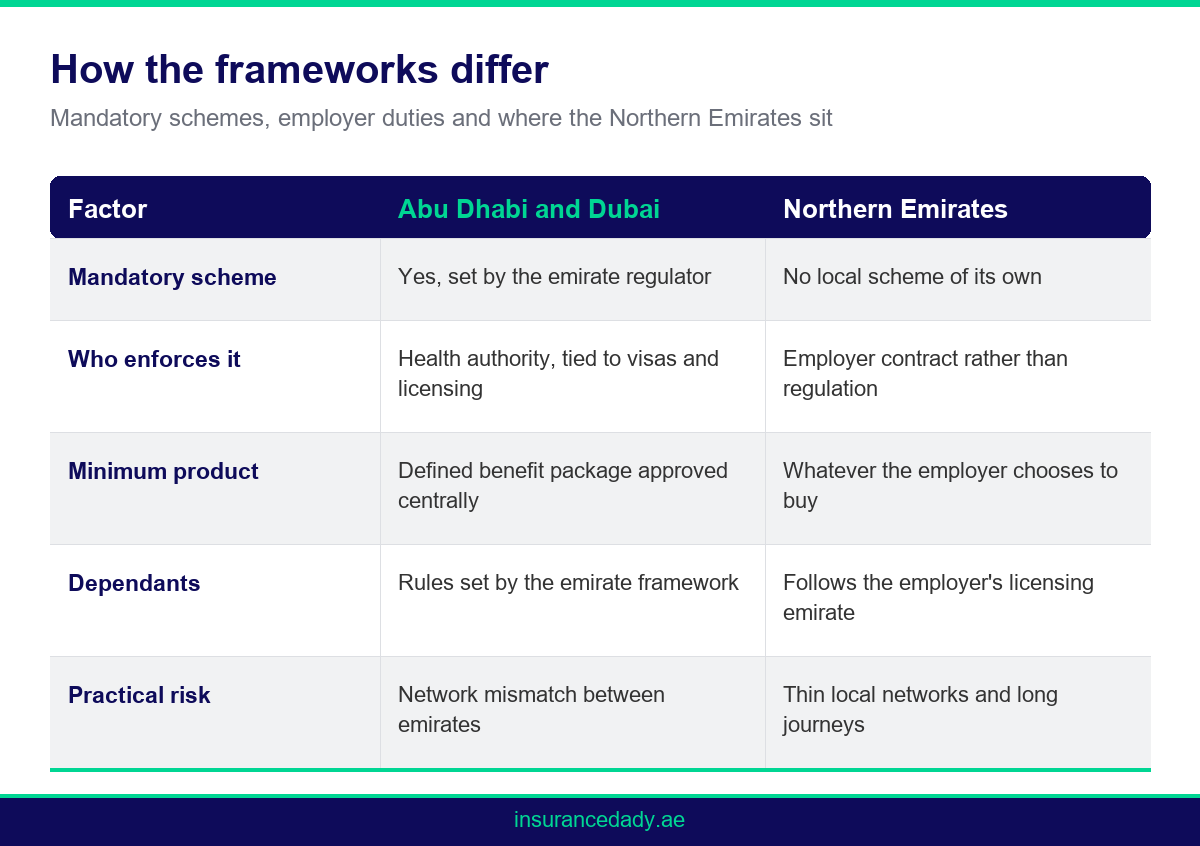
The two emirates with formal mandatory schemes are Abu Dhabi and Dubai. Both require employers to insure their staff, both license insurers and approve products, and both tie compliance to visa and licensing processes. The remaining emirates do not operate equivalent schemes, which does not mean residents there go without cover. It means their entitlement follows their employer rather than a local rule.
The regulators and what they control
In the capital the framework is set by the Department of Health Abu Dhabi, which defines the mandated benefit package, approves products and supervises insurers and providers. In Dubai the same role belongs to the Dubai Health Authority. Each publishes its own permitted benefit structures, co payment ceilings and network standards.
Because the two frameworks developed separately, the minimum products differ in scope rather than merely in price. The capital's basic package has historically mandated a broader benefit set, including elements of maternity and screening. Dubai's essential benefits plan is built around a capped annual limit and a defined network aimed at lower income employees. Background on the wider system sits in the government health services information pages.
Where residents of the Northern Emirates stand
Sharjah, Ajman, Ras Al Khaimah, Fujairah and Umm Al Quwain have no mandatory scheme of their own. In practice most residents there are insured under a plan issued in Dubai or the capital because their employer is licensed in one of those emirates. A Sharjah resident working for a Dubai licensed company will normally hold a Dubai compliant plan.
This creates an odd result that residents notice quickly. Two neighbours in the same Ajman building can hold entirely different entitlements, because one works for a company licensed in Dubai and the other for a company licensed in the capital. Neither arrangement is irregular. Each simply answers to the regulator that licensed the employer, and the emirate they live in plays no part in the calculation at all.
The group needing most care is those employed by locally licensed businesses in the Northern Emirates. Their cover is contractual rather than mandated, and quality varies enormously. A thin network can mean travelling to another emirate for routine appointments, which is a real cost even when the policy pays. Judge such a plan on its provider list close to home rather than on the number of hospitals nationwide.
Individual, family and group plans
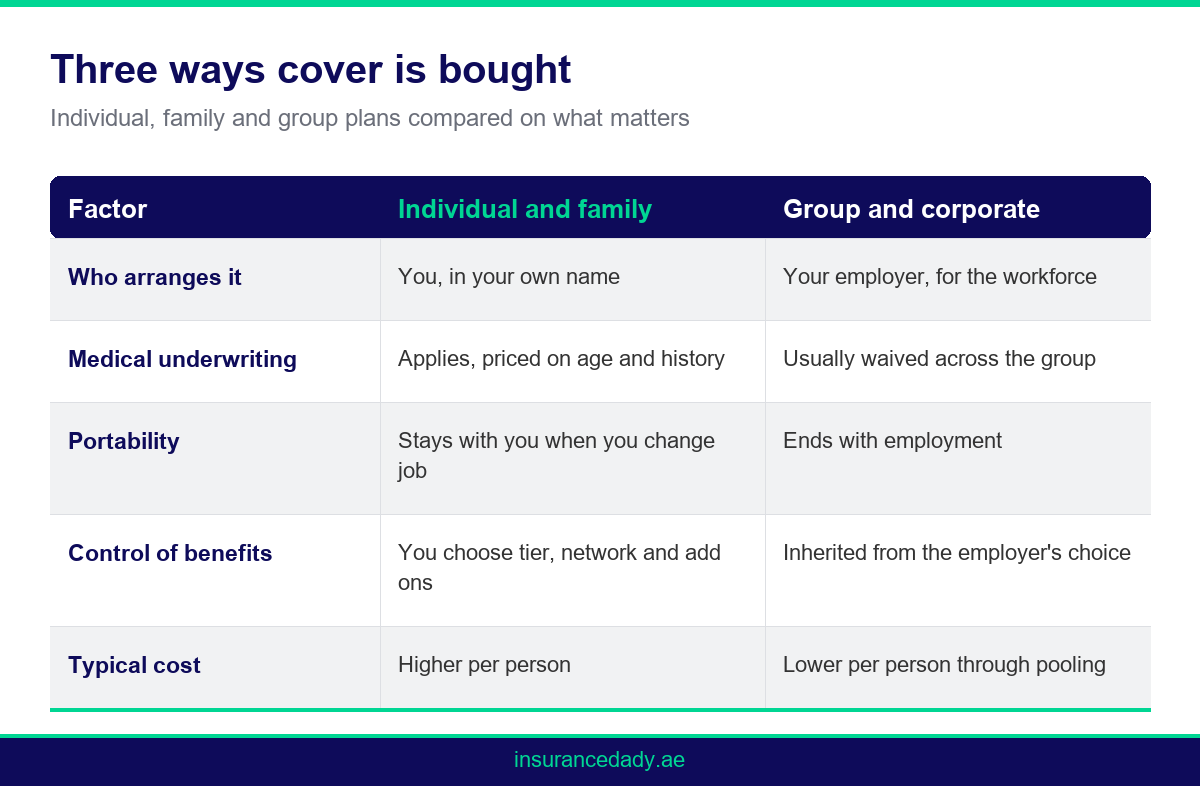
Plans are sold in three broad shapes, and the shape determines who negotiates the terms, who pays and how much flexibility you have. Most households will encounter at least two of the three over a decade of residency.
Individual cover
An individual plan is bought in your own name, priced on your age and medical history, and stays with you when you change job. That portability is the main advantage. Self employed residents, business owners and anybody whose employer offers only the minimum product will usually need one. The trade off is price, since there is no group to spread risk across, and medical underwriting applies.
Individual plans also give the most control over network and benefit level. You choose the tier rather than inheriting it, and you can build maternity, dental or optical in from the start rather than negotiating for them. Our guide to cover bought in your own name sets out how these are priced and what to check before committing.
Family cover
A family plan insures a household under one policy and one renewal date, which simplifies administration considerably. The important questions are how the annual limit is applied, whether each member has an individual ceiling or the family shares one pool, and whether maternity is included for the plan year you actually need it.
Sizing is where families most often get it wrong. Buying the largest available limit is rarely the best use of budget. A mid tier plan with a strong local network and sensible outpatient co payments usually serves a family better than a high ceiling they will never approach. There is more on this in choosing a plan for a household.
Group and corporate schemes
Group cover is arranged by an employer for its workforce, priced on the group as a whole rather than on individuals. That usually means no medical underwriting for members and better terms than an individual could obtain alone. For small businesses, a group scheme is frequently cheaper than insuring the same people separately.
Employers with staff across several emirates can structure one scheme to satisfy more than one regulator, which avoids running parallel policies. The detail sits in employer schemes explained, and the benefit structure itself is easiest to read through what a table of benefits shows.
Reading a plan properly
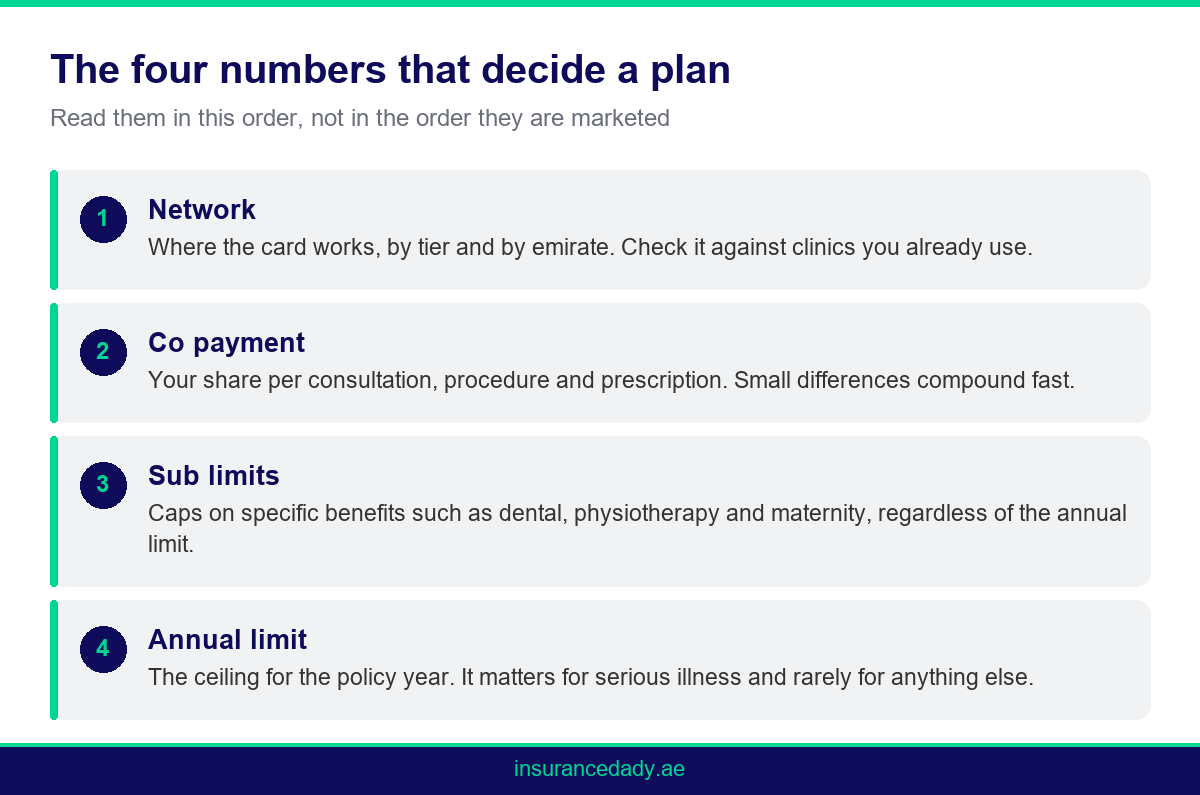
Four numbers decide what a plan is worth in practice: the annual limit, the network, the co payment structure and the sub limits. Marketing material emphasises the first. Daily experience is governed by the other three.
The annual limit is the maximum the insurer will pay in a policy year. It matters for serious illness and rarely for anything else. A household that never approaches the ceiling gains nothing from paying for a larger one, which is why raising the limit is usually the least efficient way to spend an increased budget.
The network is the list of hospitals and clinics where the card works, and it is normally tiered. A plan can include a provider at a higher co payment while excluding it from the preferred tier, which reads as covered but costs more at the counter. Always ask for the provider list in your own emirate.
Co payment is the share you pay per consultation, procedure or prescription. Small percentage differences compound quickly for families with young children. Sub limits then cap specific benefits, such as physiotherapy sessions, dental treatment or maternity, regardless of the overall annual ceiling. Those caps are where most unpleasant surprises live. Plans that let you move between these settings are covered in flexible plan structures.
Life stage cover: maternity, senior care and personal accident
Health needs are not evenly distributed across a life, and most plans reflect that with separate rules for the periods when claims concentrate. Planning around these rules rather than discovering them is the single biggest saving available to most households.
Maternity cover almost always carries a waiting period, commonly somewhere between six and twelve months from the start of the policy. A plan bought after conception will not usually pay for the pregnancy. Sub limits apply separately to antenatal care, normal delivery and complicated delivery, and the gap between the normal and complicated figures matters, because the complicated route is the expensive one.
Senior cover becomes harder and more expensive with age, and some insurers decline new applications above a certain threshold. Parents joining adult children in the country should be insured before any condition is diagnosed rather than after, since pre existing conditions are excluded or loaded once known. Starting cover early and maintaining it continuously is worth far more than shopping for a lower premium later.
Personal accident cover sits alongside health insurance rather than inside it. It pays a defined benefit for death or permanent disability following an accident and does not reimburse treatment costs. For a household dependent on one income, it addresses a different problem from medical cover and is frequently the cheaper of the two.
Children bring their own pattern. Paediatric consultations, vaccinations and repeated seasonal illness generate frequent small claims rather than occasional large ones, which means co payment structure matters far more than the annual ceiling for families with young children. Check whether routine immunisations are covered as standard, because some entry level plans treat them as preventive care and exclude them. Screening and preventive checks for adults follow the same logic. They are inexpensive individually and add up across a household, and a plan that covers them encourages the early diagnosis that keeps later claims small.
What mandated minimum plans leave out
Both entry level products exist to guarantee access to essential care. Neither was designed to be comprehensive, and treating them as such causes most complaints.
Dental and optical are typically excluded or reduced to emergency treatment only. Advanced diagnostics may require prior approval that primary care clinics are not set up to obtain quickly. Treatment outside the assigned network is usually not covered at all rather than covered at a lower rate.
Chronic conditions are covered for stabilisation but often with restrictions on long term medication and specialist review frequency. Elective procedures, cosmetic treatment and most alternative therapies sit outside. Mental health provision has improved but remains capped on many entry level products, often to a small number of sessions per year. Where a family can afford to upgrade, the improvement in network access is usually more valuable than the increase in annual limit. Comparisons between the two mandated products are set out in the position in the capital and the entry level product in Dubai.
Changing job, changing emirate, keeping continuity
Cover changes whenever an employer changes, and the handover between policies is where residents lose entitlements they had already earned.
Waiting periods are the main exposure. A new plan can reimpose maternity and pre existing condition waiting periods even after years of continuous insurance, unless continuity is formally recognised. Ask about this at the offer stage, keep the old certificate as evidence, and get any agreement in writing before the start date rather than afterwards.
Sequence the switch carefully. Do not cancel existing cover until the new card is active and confirmed, and check that any treatment already underway will be recognised by the new insurer. A course of physiotherapy or an ongoing investigation can be treated as a pre existing condition by a new plan even though it began while you were insured.
Moving emirate without changing employer usually changes nothing on paper and a great deal in practice, because your network stays where it was. A family relocating from Dubai to Sharjah or the capital should review the provider list immediately rather than at the next renewal. The same applies in reverse for anybody moving into Dubai on a plan issued elsewhere. Insurers will usually agree a network change mid term where the reason is a genuine relocation, but they will not initiate it, and nobody is monitoring your address on their behalf. Raising it costs one phone call and can save an entire policy year of inconvenience. If you are arranging cover independently you can compare cover with us with the network as the starting point.
How to compare plans across insurers
Comparing medical insurance on price alone produces reliably poor outcomes, because the cheapest plan is usually cheap for reasons that only appear later.
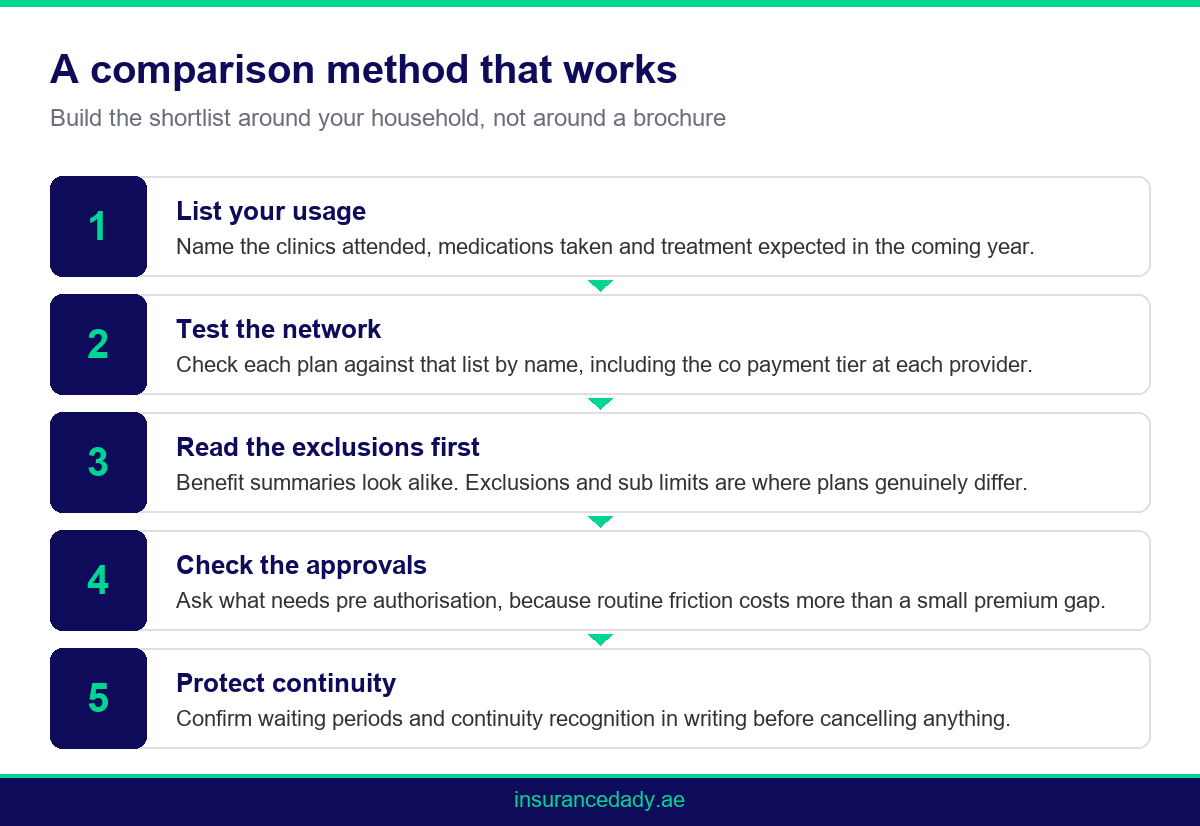
Build the comparison around your own usage. List the clinics your household already attends, the medications taken regularly, and any treatment expected in the next twelve months. Then test each plan against that list rather than against a generic benefit table. A plan that covers everything except your paediatrician is the wrong plan regardless of its limit.
Weigh the four decision numbers in the order they will affect you: network first, co payment second, sub limits third and annual limit last. That order is the reverse of how plans are usually marketed, and it reflects how families actually spend. Ask specifically about pre approval processes too, since a plan that requires authorisation for routine diagnostics creates friction at every visit.
Do the comparison on identical assumptions. Quotes built on different family compositions, different start dates or different network tiers are not comparable however neatly they are presented side by side. Fix the variables first, then let the price fall where it does.
Finally, read the exclusions before the benefits. Every plan looks similar in its benefit summary and differs sharply in its exclusions. If you would rather not do this alone, our team compares plans we arrange for residents across our partner insurers and will build the comparison around your household rather than around a brochure.
Claims, approvals and avoiding refusals
Most refused medical claims are administrative rather than clinical. The treatment was covered, the paperwork was not. Understanding how the approval chain works removes the majority of that risk before it arises.
Direct billing and reimbursement
Inside the network, treatment is normally settled directly between the provider and the insurer. You present the card, pay any co payment and leave. Outside the network, or where direct billing fails, you pay in full and claim back afterwards. Reimbursement requires original invoices, the prescription, the diagnosis code and often a completed claim form signed by the treating doctor.
Submit quickly. Most policies impose a deadline measured from the date of treatment, commonly between thirty and ninety days, and a late submission is refused however valid the underlying claim. Photograph every document at the clinic before you leave, because originals go missing more often than people expect.
Pre approval and the refusals it prevents
Planned procedures, advanced imaging, physiotherapy courses and most inpatient admissions require prior authorisation. The clinic usually requests it, but responsibility for confirming it sits with the patient, and proceeding without approval is one of the most common reasons a large claim is declined outright.
Allow time. Authorisation typically takes between a few hours and two working days depending on the treatment, and emergency admissions are handled retrospectively rather than in advance. If a clinic tells you approval is not needed, ask them to confirm that with the insurer and note who said it. Disputes almost always turn on what was authorised and when, so a short written trail is worth more than any amount of recollection afterwards.
What actually drives the premium
Medical premiums look opaque from the outside, but they are built from a small number of inputs. Knowing which ones you can influence turns an annual price increase from something that happens to you into something you can manage.
Factors you cannot change
Age is the dominant factor and it moves in bands rather than smoothly, which is why a premium can jump sharply in a year when nothing else has altered. Medical history follows, since declared conditions attract a loading that reflects expected claims. Family size matters for household policies, and the emirate of issue affects pricing because provider costs differ between markets.
Claims experience is the factor that surprises employers most. Group schemes are re rated on the previous year's claims, so a heavy year pushes the renewal up for everybody. That is not a penalty. It is the arithmetic of pooling, and it is why larger groups tend to enjoy steadier pricing than small ones.
Levers you can actually pull
Network tier is the most effective lever. Moving from a premium network to a strong mid tier network often produces a substantial saving while leaving the clinics a family actually uses untouched. This is almost always a better trade than reducing the annual limit.
Co payment is the second lever. Accepting a slightly higher share per consultation reduces the premium, and for households that rarely visit a clinic it is efficient. For families with young children it is usually false economy, since the saving disappears across a winter of paediatric visits.
Deductibles on outpatient care, optional benefits such as dental and optical, and the choice between individual and family structures all move the number too. Review them together rather than one at a time, because reducing two benefits that you use while retaining one you do not is a common and costly mistake.
Conclusion
Good health insurance coverage is not the plan with the largest number on the front page. It is the plan whose network includes the clinics your family uses, whose co payments you can absorb without thinking, and whose sub limits match the treatment you are realistically going to need. Residents of Abu Dhabi and the Northern Emirates should pay particular attention to provider lists close to home, since national coverage figures disguise how thin some networks become outside Dubai. Review your plan at every renewal and every job change, and protect continuity when you switch. Speak to Insurance Dady and we will compare plans across our partner insurers against how your household actually uses care.
Frequently Asked Questions
Q1: Is medical cover compulsory everywhere in the country?
It is mandated in Abu Dhabi and Dubai through their own regulators. Other emirates have no equivalent scheme, so residents there rely on employer provided or personally arranged cover.
Q2: What is the difference between the annual limit and a sub limit?
The annual limit caps everything the insurer pays in a year. Sub limits cap individual benefits such as dental or maternity, and they apply regardless of the annual ceiling.
Q3: Why does the network matter more than the limit?
Because the network decides where your card works. A generous limit is worthless at a hospital outside the network, while routine care happens repeatedly close to home.
Q4: How long are maternity waiting periods?
Commonly six to twelve months from policy start. A plan bought after conception will not normally pay for that pregnancy, so plan cover well in advance.
Q5: Can I keep my plan when I change employer?
Only if it is an individual policy in your own name. Group cover ends with employment, which is why portability is a genuine advantage of individual plans.
Q6: Will waiting periods restart with a new employer?
They can, unless continuity of cover is formally recognised. Raise it at the offer stage and keep your previous certificate as supporting evidence.
Q7: Does health insurance cover me while travelling abroad?
Usually only for emergencies, and often within a limited region. Planned treatment abroad and most overseas costs belong with a separate travel policy instead.
Q8: Are parents and elderly dependants insurable?
Often yes, though premiums rise steeply with age and some insurers decline new applications above a threshold. Arrange cover before conditions are diagnosed rather than after.
Q9: What does personal accident cover add?
It pays a defined benefit for accidental death or permanent disability rather than reimbursing treatment. It addresses lost income, which medical cover does not. See our services.
Q10: How often should I review my plan?
Every renewal, and immediately after any change of job, emirate or family size. Networks and sub limits change between policy years more often than people expect.